Introduction –
Polyester is one of the most commonly utilized fabrics alongside such applications as clothing, furniture, and fabric for outdoor products. One question, however, arises repeatedly: is polyester waterproof? People want answers as to whether polyester will absorb rain, sweat, or other liquids, and remain resistant to penetration. This question becomes most relevant for buyers of jackets, tents, and backpacks. Although there is no doubt that most polyester fabrics will absorb some water, the amount of water polyester will absorb does depend on a range of conditions. Examining the fabric’s water resistance, structure, treatments, and practical applications all provide relevant answers.
What is Polyester?
Polyester, created from synthetic fuels, is a polymer textile based principally on polyethylene terephthalate (PET). Polyester was first invented in the 1940s but gained popularity within a few years because of its durability, reasonable price, and adaptability. Unlike other natural fibers, polyester does not shrink, stretch, or wrinkle which is why it is highly appreciated in modern textiles.
Polyester has increasingly gained popularity over other fabrics in the dominion of clothing, especially in clothing designed for exercising, sports, and uniforms. Outside of clothing and apparel, it is also extensively used in furniture upholstery, curtains, and bedding alongside some industrial functions. Such a tremendous reach of polyester fabric makes it curious whether it can also act as a barrier to water.
Is Polyester Waterproof or Water-Resistant?
The reality is that polyester does not offer full waterproof capabilities. Polyester is naturally water resistant which means the fibers can minimize water interaction to an extent, and can withstand moderate exposure to moisture, but not to water. In order for a fabric to be classified as waterproof, it must completely stop water penetration under any circumstances for a defined duration. Polyester does not meet that standard on its own. However, with some additional technological advancement like coatings and laminations, can perform similarly to a waterproof material. This fact is crucial when considering polyester for use as rainwear or in open air conditions.
How Polyester Reacts to Water
Absorption
Polyester does not absorb water easily. Unlike cotton which absorbs moisture, polyester is moisture repellent. This assists the fabric to remain drier on the upper surface.
Drying Time
Polyester dries more rapidly than the majority of cotton. Prevention of water retention enables moisture to evaporate rapidly. This allows polyester to be effectively used in sportswear and travel clothing.
Comparison with Cotton
Polyester has superior moisture performance than cotton does. Unlike cotton which becomes saturated with moisture and becomes heavy, polyester retains its buoyancy. Hence, polyester is often a logical selection for wet regions.
Comparison with Nylon
When it comes to waterproofing, nylon exceeds polyester, even though it has a slower drying rate than polyester does. Unlike the former which is hydrophobic and retains moisture, polyester offers the advantage of drying quickly and retaining a moderate level of water repelling.
Factors That Affect Polyester’s Water Resistance
Fabric Thickness
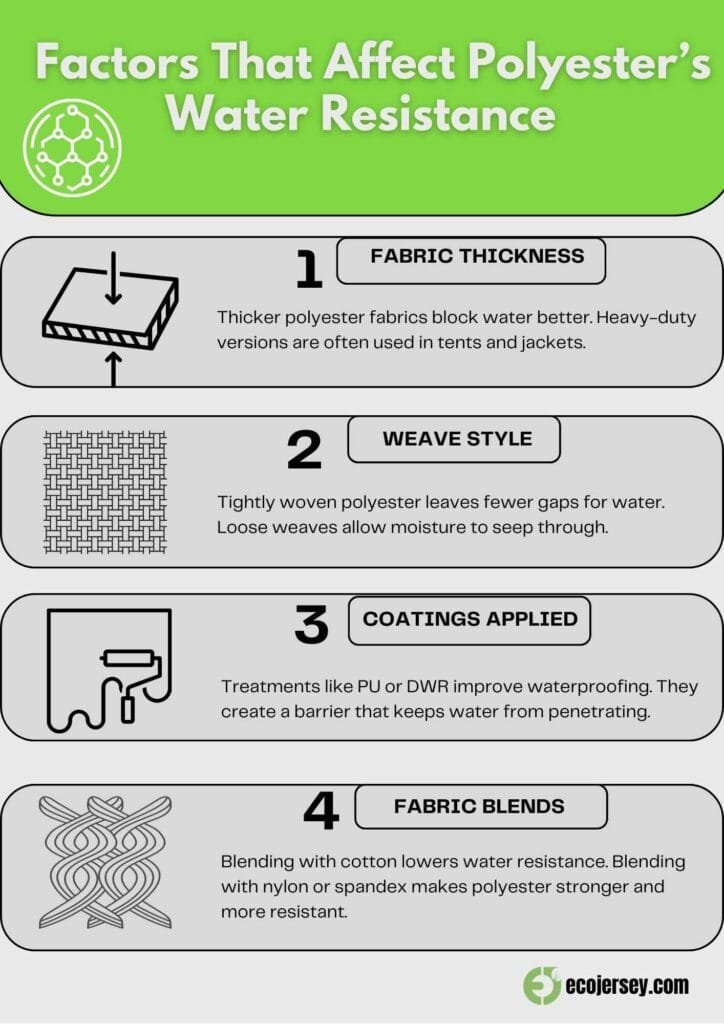
Thicker polyester textiles undoubtedly blocks water more effectively than thinner fabrics of the same material. Structural elements of the fabric make more dense moisture harder to permeate the material. Because of this, polyester fabric on the outer shell of outdoor garments such as tents and rain jackets are of greater density.
Weave Style
The manner the individual polyester threads are woven to form the fabric determines the water resistance of the fabric as well. The more tightly woven a fabric is, the less aperture it has to allow water to get through, hence the more water resistant such fabrics are. Loosely woven moisture permeable polyesters will thus be less effective, no matter the thickness, compared to more dense, tightly woven fabrics.
Coatings Applied
When coatings are added to polyester, its behavior becomes totally different. Polyurethane (PU) or durable water repellent (DWR) treatments are applied to increase water resistance by providing protection through a protective layer. Outdoor gear is typically treated with such coatings, and polyester fabrics can be used outdoors in the rain.
Fabric Blends
The water resistance of polyester is also determined by the type of fibers that it is mixed with. When it is mixed with cotton, the cloth can absorb a greater amount of water, which reduces its performance. Adding polyester to nylon or spandex, however, is likely to add strength and water repellency, enhancing the wet performance.
Waterproof Coatings and Treatments
Durable Water Repellent (DWR)
DWR is a chemical finish which enhances the natural resistance of polyester to water. It functions by causing the water to bubble up on the surface of the fabric and run off rather than sink in. DWR does however wear off, particularly when washed many times, thus this means that it has to be reworn.
Polyurethane (PU) Coating
Polyester is commonly given a waterproof polyurethane coating. It also forms a protective layer that is very thin and yet the fabric remains lightweight and flexible. Due to this balance, polyester PU-coated fabrics are popular in jackets, tents, and backpacks, which require wet conditions.
Polyvinyl Chloride (PVC) Coating
When used on polyester, PVC coating provides a powerful and complete barrier against water. This way no water can bypass it and it is applicable to heavy duty equipment such as tarps and rain covers. The disadvantage is low breathability and rigidity, which may limit card comfort during extended use.
Laminated Fabrics
Polyester can be overlaid with hi-tech waterproof sheets like Gore-Tex. These laminations form a fabric that is completely waterproof and breathable simultaneously. Because of this, high-quality outdoor jackets and high-performance gear are frequently lined with laminated polyester fabrics.
Is 100% Polyester Waterproof Without Coating?
No, 100% polyester that has not been coated is not really waterproof. It is not affected by light rain or splashes, but, sooner or later, water leaks through the fibers. An example would be a simple polyester shirt that would resist a drop of water but would be wet in heavy rainfall. Waterproof performance is practically never achieved without some sort of coating or laminations being added to outdoor gear by manufacturers. In the absence of such treatments, polyester can only be water-resistant.
Pros and Cons of Polyester in Wet Conditions
Pros:
- Natural is more waterproof than cotton.
- Wet garments dry fast.
- Lightweight and easy to wear during wet weather.
- Cheaper than entirely waterproof fabrics.
- Preserves form and toughness in presence of moisture.
Cons:
- Coatings needed to be completely waterproof.
- In dampness May is damp on skin.
- Not as breathable as there are other natural fabrics.
- Lose repellency on repeated washing.
- Tend to develop electric charges in the dry season.
How Polyester Compares to Other Fabrics
Polyester vs. Cotton
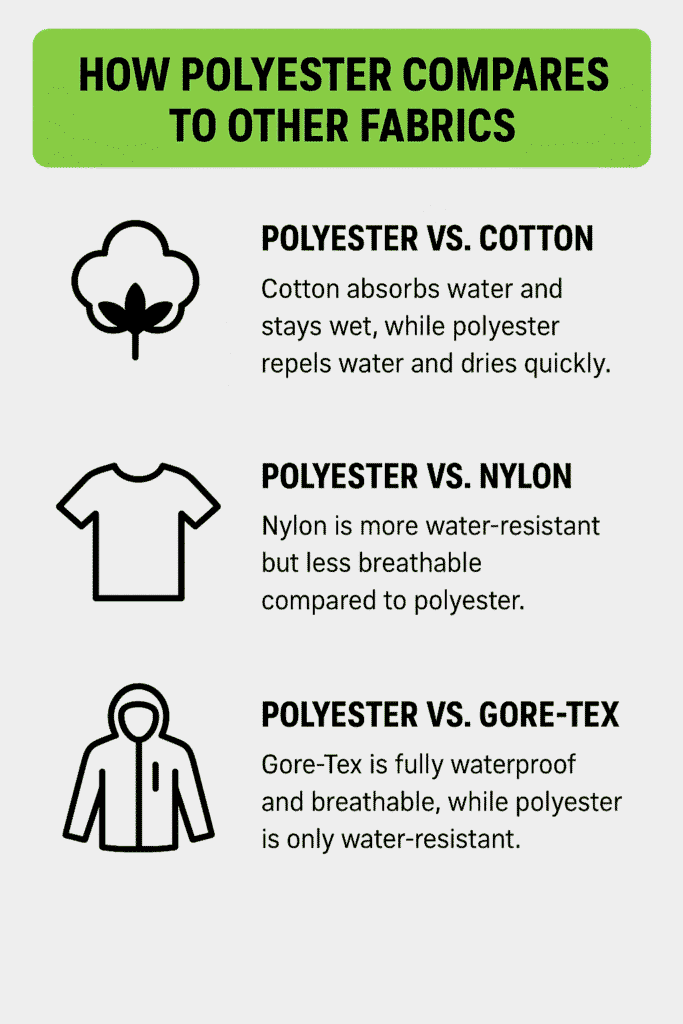
Cotton is a rapid water absorber and thus becomes heavy, wet and slow to dry after rain. Polyester on the other hand is naturally water-resistant and in wet conditions it is still light-weight. This distinction allows polyester to be more convenient in outdoor activities and activewear. Though cotton is lightweight and smooth, polyester is more suitable on uncertain weather.
Polyester vs. Nylon
The stronger and tighter fibers of nylon tend to make it more water resistant than polyester. Nylon, however, retains more water with time and cannot be dried easily compared to polyester. The other disadvantage is that it has a low UV resistance that breaks down easily in the sun. Polyester offers the best balance between durability, drying time, and cost, thus it is widely used as gear.
Polyester vs. Gore-Tex
Gore-Tex is designed to be completely waterproof and extremely breathable, much better than regular polyester. It keeps away the heavy rain and sweat vapor can escape, which is perfect in hard-working activities in the outdoor environment. Its disadvantage is that it is very expensive and is therefore not affordable to all people with low incomes. Polyester is not as sophisticated, but it provides a cheaper alternative when it comes to daily rain coatings.
How to Make Polyester More Waterproof?
- Waterproofing Spray or Wash-in: Wipe the piece with water and then spray it or treat it by a waterproofing spray (such as Nikwax or Grangers) or by a wash-in treatment (such as Nikwax or Grangers). These replace the DWR coating of jackets and tents.
- Seam Sealing: Seal up the stitch lines with seam sealer or tape. Water usually drips in between, therefore, sealing the seams significantly increases tightness to water.
- Heat-Activate the Coating: Treat then dry on low or iron (gently) (unless care label indicates otherwise). The low temperature allows the DWR finish to connect with the fiber of the cloth.
- Apply After Washing: DWR finishes are washed away by many detergents. Machine polyester gear using a light technical cycle, followed by another application of waterproof spray. This makes the fabric repulsive in the long run.
- wear Rain Covers or Liners: With heavy articles in mind, an extra coating should be employed. As an example, a lot of the backpacks have a PU-coated rain cover or a liner inside. In this manner, a naked polyester shell can lose water by having a protective layer on the inside.
Is Polyester Good for Outdoor Gear?
Jackets
Rain is not an issue in polyester jackets in DWR or PU coating. They also dry fast, and are thus convenient to carry.
Tents
Polyester tents can withstand rain as compared to cotton tents. When coated with PU or PVC they are working in wet camping conditions.
Backpacks
Backpacks made of polyester can resist light rain. Most of them are waterproofed or covered with rain covers.
Umbrellas
Umbrellas are mostly made of polyester. It is ideally suited to this application because of its natural water resistance.
Eco-Friendliness and Sustainability
The concerns regarding the environmental impact of polyester are significant. Traditionally, the production of polyester derives from non-renewable petroleum resources which contributes to the rising issue of microplastic pollution. On the other hand, rPET, or the more sustainable approach of recycled polyester, utilizes plastic bottles thereby minimizing waste. Recycled polyester, while still shedding microfibers on release, aid in diminishing the prominence of newly sourced raw materials. The use of rPET recycled polyester outdoor clothing in gear provides the the environmental benefits which cannot be achieved without loosing the water resistant qualities.
Conclusion –
Is polyester waterproof? Actually, polyester fibers have some water-resistant properties, although they are not completely waterproof since they allow some moisture penetration. Moisture penetration can easily occur in untreated polyester, especially in the case of rain, which comes in the form of external water pressure. To enhance the moisture resistance of polyester, various treatments such as DWR, PU, laminates, and coatings can be applied. Polyester is an ideal candidate for the manufacturing of garments and equipment like jackets, tents, and umbrellas for such reasons.
However, its non-biodegradable nature means its use in the form of polyester garments and equipment is more sustainable when consumers choose products made from recycled polyester. Provided such limitations are clearly understood, polyester is an inexpensive and versatile option.
Read More>> In detail about types of polyester.
FAQs
Is polyester waterproof for jackets?
By default, polyester jackets are water-resistant, but water-proofing them requires additional processes. To waterproof them, manufacturers add coatings, more specifically PU or DWR. Such coatings ensure that jackets are able to withstand the rain while keeping the user dry during more strenuous adventurous activities outdoors.
Can polyester keep you dry in heavy rain?
Polyester without coating is only able to withstand light rain for a very short period before wicking through. Withstanding, heavy or continuous rain will penetrate the fabric. During storms, the better option would be to use coated or laminated polyester.
Is polyester good for waterproof tents?
Certainly, polyester finds application in the manufacture of tents due to its ability to resist stretching, its ability to dry faster, and its ability to retain shape and dimension. When coupled with PU or PVC coatings, the fabric becomes completely waterproof allowing for its use in camping activities during the rain. This makes it an excellent and economical choice for outdoor shelters.
Does polyester lose water resistance over time?
Indeed, polyester easily loses its waterproof capabilities when the coatings wear off after multiple washes or uses. However, the ability to restore it with waterproofing sprays or reapplications of DWR treatments is a huge plus. Regular maintenance is the key to achieving performance longevity.
Is polyester better than cotton in wet weather?
Indeed, when it comes to the moisture, polyester utterly outperforms cotton. Cotton absorbs water, becomes heavy, and takes ages to dry; in stark contrast to polyester which repels water, allowing the wearer to dry quickly. This makes polyester immensely superior during outdoor and rainy weather conditions.