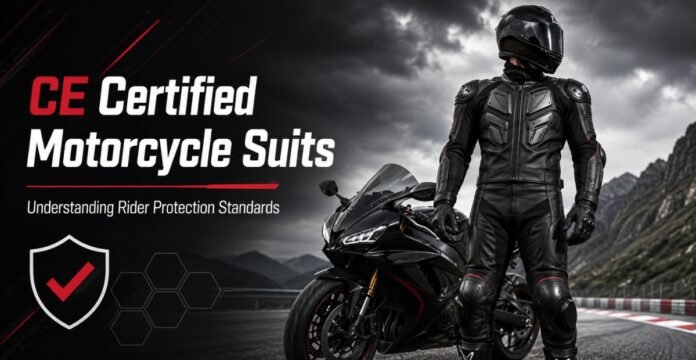
Motorcycle suits should do more than just give a sporty look. They should offer protection to the riders in case of a slide or impact. This is why CE certified motorcycle suits are important. In Europe, motorcycle protective clothing are considered personal protective equipment (PPE). CE certified motorcycle suits are made and evaluated against certain safety standards as opposed to just marketing their products as “heavy duty” or “racing quality.” A CE mark on a suit does not ensure that a suit will prevent all injuries, but it provides a comparison on protective suit standards.
What the CE Mark Means on a Motorcycle Suit
The CE mark on a motorcycle suit shows that the protective clothing has considered the applicable safety standards of the EU, and that the manufacturer has taken responsibility for placing the product on the market. In the EU PPE system, motorcycle suits and protective clothing have to be evaluated for safety and health before they are sold. For the consumers, CE certified motorcycle suits indicate that the clothing has been assessed for a protection standard with available testing and has user guidance. CE certified motorcycle suits do not just have the CE mark. Consumers should further investigate the protection class, the standard number, and the information provided.
CE Certified Motorcycle Suits and EN 17092 Classes
The EN 17092 series is a grouping of standards for protective motorcycle clothing. They classify protective clothing into several protection classes. Class AAA is the highest protection class, and Class AA offers a measure of protection balance with weight and comfort of the garment. Defining classes with lower protection levels, Class A might emphasize comfort and range of motion. Class B is focused on abrasion protection and does not require impact protection within that garment class. Lastly, Class C is focused on protection garments that contain impact protection. Since these protection classes are distinct from one another, CE certified motorcycle suit designs can greatly differ from one another.
Abrasion Resistance Is an Important Part of Suit Safety
If a rider gets involved in a road crash, the outer shell of the motorcycle suit will rub on the road. Use of strong fabrics, reinforced zones, and strong seams improve the garment’s durability. CE certified motorcycle suits factor this type of risk, and the level of performance is dependent on the garment class and body zone. Parts of the body such as the shoulders, elbows, knees, hips, and the seat usually need stronger construction as they are likely to be in contact with the road. Riders need to assess the strength of leather/textile panel, quality of the seams, and the placement of the stretch panel.
Armor and Impact Protection Need Attention Too
A motorcycle’s outer shell must include strong outer materials, and they’re not the only protective element. Impact protectors are designed to help lessen the impact on key areas like the shoulders, elbows, knees, hips, and the back. Many CE certified motorcycle suits use protectors that are tested to standards of the EN 1621 family. Riders should look to see what exactly the optional and included protectors are. Some CE certified motorcycle suits may include a pocket for a back protector but don’t come with the protector in question. Armor should also remain over the correct body area when the rider is sitting on the motorcycle.
Fit Should Keep Protection in the Correct Position
A motorcycle suit should fit close enough to keep its protective areas in place, but it should not be so tight that the rider cannot bend, breathe, or control the motorcycle comfortably. This matters with CE certified motorcycle suits because armor can only help properly when it stays around the intended area. Women can compare purpose-designed women’s motorbike suits while looking at differences in waist, hip, shoulder, and leg shaping. Riders should test the suit in a riding position instead of only standing straight. Good CE certified motorcycle suits should allow comfortable handlebar reach, easy knee movement, and enough flexibility for normal riding without excessive loose material or armor moving away from the body.
Quick Checks Before Choosing a CE Motorcycle Suit
Before buying CE certified motorcycle suits, riders can use these simple checks instead of choosing a suit only because of its color, price, or sporty appearance.
- Check the CE label and motorcycle garment standard.
- Check whether the garment is Class AAA, AA, A, B, or C.
- Check which shoulder, elbow, knee, hip, chest, or back protectors are included.
- Check that armor stays correctly positioned while sitting on the motorcycle.
- Check the main seams, zippers, fasteners, and reinforced areas.
- Check ventilation and liners for the weather in which you normally ride.
- Check the size because loose armor may move away from important areas.
- Check washing and care instructions before cleaning the protective garment.
These simple checks make CE certified motorcycle suits easier to compare and help riders focus on real protection rather than branding alone.
One-Piece and Two-Piece Motorcycle Suits
One-piece suits are popular for track riding and sport-focused riding because the upper and lower parts are permanently connected. Two-piece CE certified motorcycle suits can be more practical for road riders because the jacket and trousers may be easier to remove when taking a break. Some two-piece suits use a strong connecting zipper so the two parts stay joined during riding. Riders exploring different motorcycle suit options should consider riding speed, trip length, weather, comfort, and how often they get on and off the motorcycle. CE certified motorcycle suits should match the rider’s actual use instead of simply looking aggressive. A suit that offers suitable protection and remains comfortable is more likely to be worn regularly.
Materials, Ventilation, and Weather Matter
Motorcycle suits can be made of leather or textile. Leather offers high levels of abrasion resistance. Textile suits offer reinforced or layered fabrics, built-in ventilation, and protective panels that can be more accommodating. But materials alone don’t tell riders the full picture of the suit’s safety. CE certified suits should be assessed for garment class, armor, and seam construction. Hot weather riders may opt for ventilation/perforation and riders in cold weather may need removable liners and enough room for a thin, breathable base layer. CE certified suits that are too hot, cold, or just uncomfortable may be left at home.
Do Not Confuse Price or Racing Style With Certification
An expensive motorcycle suit is not automatically the safest choice, and a racing appearance does not prove that a garment has been properly tested. CE certified motorcycle suits should be compared by looking at their labels, class, armor, materials, fit, and construction. Men comparing different fits can look at examples such as men’s motorbike suits while still checking the actual safety specifications of the suit they want to use. Knee sliders, bright graphics, aerodynamic humps, large logos, and thick-looking materials can make a suit look professional, but none of these features replaces certification information. CE certified motorcycle suits give riders a better starting point because their protection claims can be connected with defined requirements instead of appearance alone.
Caring for a Certified Motorcycle Suit
Even strong CE certified motorcycle suits need proper care. Dirt, sweat, moisture, poor storage, damaged seams, and incorrect washing can slowly affect materials and protective parts. Riders should follow the manufacturer’s cleaning instructions instead of using strong chemicals or very hot washing methods without checking first. Leather CE certified motorcycle suits may need suitable leather care, while textile suits can have different washing rules depending on waterproof membranes, coatings, and removable protectors. Armor should normally be inspected when cleaning the garment, especially after a fall. Zippers, seams, connection systems, and fastening points should also be checked regularly.
Conclusion
The most protective motorcycle suit cannot just be defined as the most expensive, thickest, and best-looking suit. The best motorcycle suit should have the best fit, clearly marked safety ratings, appropriate armor, and be designed for the rider’s normal riding environment. Motorcycle suits that have CE certification help make protective clothing more similar as CE certified motorcycle suits allow riders to look at safety ratings and garment class certifications as opposed to the advertising ploys that most motorcycle suits sell under. CE certified motorcycle suits still do not make motorcycle riding completely safe. They still have to be the right size, be cared for correctly, have the armor positioned correctly, and the rider has to be responsible.
FAQs
What does CE certified mean on a motorcycle suit?
CE certification shows that the protective motorcycle garment follows applicable European PPE requirements. Riders should also check the standard number and protection class instead of relying only on the CE logo.
What is the best CE class for a motorcycle suit?
Class AAA provides the highest protection level within the EN 17092 motorcycle garment classes. However, AA or A garments may provide a different balance of protection, comfort, weight, and flexibility for particular types of riding.
Do CE certified motorcycle suits include armor?
Many CE certified motorcycle suits include shoulder, elbow, knee, or hip protectors, but the included armor varies by product. Back and chest protectors may sometimes be optional, so always check the product specification.