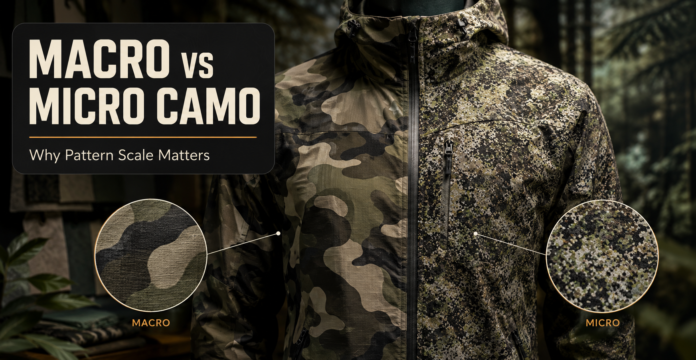
Two hunters stand in identical woodland terrain wearing camouflage from the same manufacturer — one in a macro pattern with large bold elements, the other in a micro pattern with fine detailed printing. At 10 meters, both appear effectively concealed. At 100 meters, one disappears almost completely. At 200 meters, the other suddenly performs better. Understanding macro vs micro camouflage patterns — and why pattern scale determines concealment effectiveness across different observation distances — is one of the most practically important and least discussed aspects of hunting camouflage selection.
What Pattern Scale Actually Means
Pattern scale refers to the physical size of the visual elements that make up a camouflage design — the leaves, branches, pixels, or abstract shapes that create the pattern’s visual disruption effect on the fabric surface.
Macro patterns use large-scale elements — broad color areas, large leaf or branch representations, bold color boundaries — that are clearly distinguishable individually at normal viewing distances. These elements typically measure several centimeters across on the fabric surface.
Micro patterns use fine-scale elements — small, detailed imagery, tight pixel distributions, intricate branch and foliage detail — that require close viewing to distinguish individually. These elements typically measure millimeters across on the fabric surface, creating highly detailed visual complexity that appears almost textural from normal viewing distances.
Most real-world camouflage patterns incorporate elements at multiple scales simultaneously — using both macro and micro elements within the same design to address the different concealment challenges that different observation distances create. Understanding the complete science of this in the context of hunting field use is explored in this camouflage patterns guide covering how pattern design choices affect real-world hunting concealment performance.
How Human Vision Processes Pattern at Different Distances
The visual science underlying macro vs micro camouflage patterns connects directly to how human and animal visual systems process spatial information across different observation distances — and why the same pattern can perform completely differently at varied ranges.
At close range — 10 to 30 meters — fine micro-scale pattern elements remain individually distinguishable. The visual system processes these fine details actively — and micro patterns with accurate environmental element reproduction create strong background matching at this range. Macro patterns at close range may present large color boundaries that the close-range visual system reads as unnatural divisions against the fine-textured backgrounds of natural terrain.
At medium range — 30 to 100 meters — micro-scale elements begin blending together through the averaging effects of visual resolution limits at distance. Individual micro elements are no longer distinguishable — they merge into averaged color tones that either match or contrast with the environmental background color. Macro patterns maintain their element distinguishability at this range — continuing to provide active disruption while micro patterns have transitioned to providing primarily color-average background matching.
At long range — beyond 100 meters — even macro pattern elements begin blending into averaged color areas. Both micro and macro patterns now perform primarily through their averaged color contribution to background matching rather than through active visual disruption. Pattern designs with averaged color tones closely matching environmental color signatures perform best at long range regardless of whether their element scale is micro or macro in closer observation.
Where Macro Patterns Perform Best
Macro-scale camouflage patterns suit specific hunting and outdoor scenarios where their performance characteristics align with actual field conditions.
Medium-range hunting scenarios — deer hunting from elevated stands, where most shots occur between 20 and 80 meters, represents the optimal performance range for macro pattern elements that maintain active visual disruption across these distances.
Low-visibility conditions — dawn and dusk hunting periods where light levels reduce visual acuity naturally favor macro patterns whose larger elements remain detectable and disruptive at light levels that make fine micro elements invisible and therefore non-functional as disruption tools.
Dense vegetation environments — where observation distances are naturally limited by vegetation density, macro patterns perform effectively by providing disruption at the close-to-medium ranges that dense forest terrain creates naturally through sight line limitation.
Where Micro Patterns Perform Best
Micro-scale camouflage elements suit different hunting scenarios where fine pattern detail provides genuine performance advantages over macro alternatives.
Close-range hunting — bowhunting, turkey hunting, and any hunting scenario where game approaches within 20 meters requires close-range concealment where micro pattern detail provides the strongest visual disruption against the fine-textured natural backgrounds that close observation reveals.
High-resolution observation scenarios — waterfowl hunting where approaching birds observe hunters from aerial angles with excellent visual acuity, and predator hunting where called animals approach to very close range — both benefit from micro pattern detail that provides concealment against the high-resolution visual examination these scenarios create.
Photorealistic pattern applications — the Realtree and Mossy Oak photorealistic pattern families use fine micro-scale leaf and branch detail that creates the most convincing visual matching with specific vegetation environments at the close observation distances where hunting often reaches its critical moment.
Multi-Scale Patterns — The Design Solution
The most sophisticated contemporary camouflage designs address the macro-micro scale challenge through deliberate multi-scale pattern construction — incorporating elements at both fine and coarse scales simultaneously to provide effective concealment across the full range of observation distances that real hunting scenarios create.
Effective multi-scale pattern construction layers:
- Fine micro-scale detail elements providing close-range disruption and photorealistic environment matching
- Medium-scale transition elements bridging the visual gap between fine detail and broad color areas
- Macro-scale color area distributions that determine averaged color performance at long range
This layered scale approach explains why the most commercially successful hunting camouflage patterns from established brands appear visually complex across multiple simultaneous scales — the complexity isn’t decorative but functionally necessary for multi-distance performance that single-scale patterns cannot achieve.
Digital pixel-based camouflage achieves multi-scale performance through mathematical pixel distribution that creates effective spatial frequency disruption across multiple simultaneous scales — a computational approach to the same multi-scale challenge that photorealistic pattern designers address through deliberate artistic layering of fine detail over broader color structure.
Pattern Scale and Fabric Construction Interaction
The performance of both macro and micro pattern scales depends not just on pattern design but on the fabric construction that carries the printing — because fabric surface texture, weight, and drape all affect how pattern elements appear and function in actual field conditions. Understanding how waterproof fabric construction affects outdoor clothing performance — including how construction choices interact with surface printing — is explored in this waterproof clothing guide covering the fabric performance properties that outdoor clothing construction demands across varied field applications.
Lightweight fabrics with smooth surfaces reproduce fine micro-scale detail most accurately — maintaining the precise edge definition that micro pattern effectiveness depends on. Heavier textured fabrics may blur fine micro-scale edges during printing — reducing micro pattern effectiveness while leaving macro-scale elements unaffected. This fabric-pattern interaction means that pattern scale selection should consider the fabric construction being used — particularly relevant for brands developing camouflage products where pattern and fabric decisions must be made as an integrated system rather than independently.
Our camouflage clothing manufacturer page covers the complete range of camouflage clothing options available for brand development — including the printing quality standards, fabric construction options, and pattern reproduction capabilities that ensure both macro and micro pattern elements achieve their intended visual performance across real field conditions.
These outdoor cargo pants demonstrate how performance fabric construction combines with practical field features in outdoor lower body garments — the same construction platform directly applicable to camouflage pant development where fabric choice affects both pattern reproduction quality and field performance simultaneously.
Choosing Pattern Scale for Your Hunting Application
The practical selection guidance that emerges from understanding macro vs micro camouflage patterns is straightforward — match pattern scale to the typical observation distances your hunting scenarios create.
Choose micro-dominant patterns for: Bowhunting, turkey hunting, waterfowl hunting, predator calling — any hunting where game approaches to close range and observes with high visual acuity at short distances.
Choose macro-dominant patterns for: Rifle hunting from elevated stands, open country big game hunting, and any hunting where typical game detection distances are 50 meters and beyond where micro elements have blended into averaged color.
Choose multi-scale patterns for: Mixed hunting scenarios, hunters who pursue multiple species across varied terrain, and any application where the full range of observation distances from close to long range will occur across normal hunting seasons.
Conclusion
Macro vs micro camouflage patterns matter because observation distance determines which pattern scale provides effective concealment — and most real hunting scenarios include observation distances across the full range where different scales perform differently. Understanding why fine elements work at close range while broad macro areas matter at long range allows hunters and brand developers to make informed pattern selection decisions based on actual field performance science rather than visual complexity alone. The most effective hunting camouflage combines both scales intelligently — addressing the full distance range that modern hunting creates across varied terrain and game species pursuit scenarios.
FAQs
Do macro or micro patterns perform better overall for hunting?
Neither is universally superior — micro patterns excel at close observation distances while macro patterns maintain active disruption at medium ranges. Multi-scale patterns combining both element sizes provide the most consistent performance across the full observation distance range that varied hunting scenarios regularly create.
Does pattern scale affect concealment differently for different game species?
Yes — game species with exceptional close-range visual acuity like turkeys and waterfowl benefit more from fine micro-scale detail. Deer at typical rifle hunting distances benefit more from macro-scale disruption and averaged color matching that functions effectively at the medium-to-long ranges where rifle hunting typically occurs.
Can pattern scale be seen on fabric swatches at retail?
Yes — examining camouflage fabric at arm’s length versus close inspection reveals how pattern elements scale. Patterns that appear highly detailed at close inspection but blend into smooth color areas at arm’s length are micro-dominant. Patterns maintaining clear element distinction at arm’s length are macro-dominant.
Can camouflage clothing with specific pattern scales be produced under a private label?
Yes. Professional outdoor apparel manufacturers offer complete private label production with precise pattern scale control — ensuring macro, micro, or multi-scale pattern elements reproduce accurately at intended sizes across fabric surfaces — giving outdoor brands full technical and creative control over their camouflage collections.