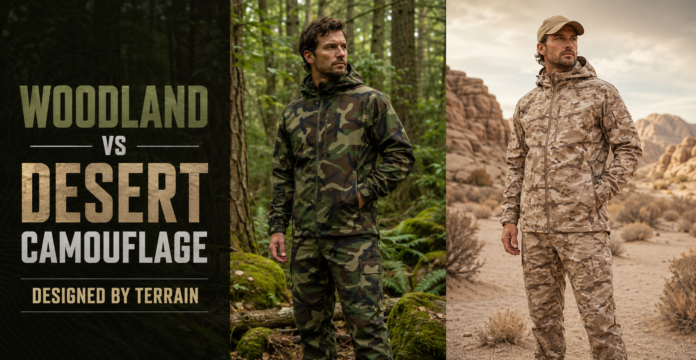
The main difference in woodland vs desert camouflage is how each design responds to its environment. Woodland camouflage uses green, brown, olive, and dark shadow tones for forests and dense vegetation. Desert camouflage relies on tan, sand, beige, and muted brown for dry, open, sun-exposed terrain.
The difference extends beyond color. Vegetation density, light, shadow, viewing distance, temperature, and ground texture influence pattern shape, scale, contrast, fabric weight, and garment construction. Effective camouflage clothing must visually match the terrain while keeping the wearer comfortable and mobile.
Woodland Camouflage Design
Woodland camouflage is created for environments filled with trees, leaves, branches, uneven shadows, and dark ground. Its irregular green, brown, black, and olive shapes copy the broken visual structure of a forest. Darker areas imitate shade, while lighter sections resemble leaves and filtered sunlight.
Traditional woodland designs often use medium or large curved shapes. These forms help break up the recognizable lines of the shoulders, torso, arms, and legs from moderate distances. Eco Jersey’s camo guide explains how woodland patterns compare with snow, desert, digital, and transitional designs.
Desert Camouflage Design
Desert camouflage is built around pale, low-saturation colors found in sand, rock, dry soil, and sparse vegetation. Tan, beige, light brown, muted olive, and soft grey reduce contrast under intense sunlight. Large black areas are normally limited because they may stand out against bright, open ground.
Desert patterns often use smaller markings or widely spaced shapes to reflect the less crowded visual character of arid terrain. The pattern may include rock-like spots, soft waves, or scattered brush forms. Designs for semi-desert regions may add muted green where shrubs and dry grass remain present.
How Vegetation Changes Pattern Structure
Dense woodland creates complex visual backgrounds with overlapping leaves, branches, tree trunks, and shadows. Camouflage for this environment can use stronger contrast and more irregular shapes because the surrounding landscape already contains many dark and light areas.
Desert terrain is often simpler and more open. A highly detailed or dark pattern may become more visible instead of less visible. The best desert designs use controlled contrast and more open spacing. The tactical guide provides further guidance on matching garments to woodland, arid, urban, and cold environments.
Light and Shadow Influence Color
Forests contain deep shadows even during daylight. Dark olive, brown, and limited black can therefore help a woodland garment merge with shaded vegetation. However, the same colors may form a noticeable solid block when the wearer moves into an open field or dry hillside.
Deserts receive stronger direct sunlight and contain fewer deep shadows. Lighter colors reflect this brightness and may also absorb less solar heat. During sunrise, sunset, or rocky canyon travel, slightly darker tan and brown areas can imitate the longer shadows created by uneven ground.
Pattern Scale and Viewing Distance
Pattern scale determines how camouflage appears from different distances. Small details help at close range, while large color areas disrupt the body from farther away. Woodland patterns often combine both scales because visibility may shift quickly between dense vegetation, clearings, and forest edges.
Desert terrain commonly provides longer sightlines, so large soft-edged areas can help divide the body’s outline from a distance. Fine details remain useful around rocks and shrubs, but they may merge into one color when viewed from far away. Multiscale construction improves performance in both environments.
Clothing Construction for Each Terrain
The comparison of woodland vs desert camouflage also includes fabric and garment construction:
- Woodland clothing benefits from abrasion-resistant fabrics.
- Quiet surfaces reduce noise against vegetation.
- Reinforced panels protect high-contact areas.
- Desert clothing needs lightweight, breathable materials.
- Ventilation zones help release body heat.
- UPF finishes improve protection in direct sun.
- Full coverage protects against insects, dust, and plants.
Woodland users may need water resistance for wet leaves, mud, and changing rain. Desert users normally prioritize airflow, moisture management, and sun protection. However, desert nights can become cold, so the garment should still allow a light insulating layer when necessary.
Choosing Between Woodland and Desert Camo
Select woodland camouflage when dark vegetation, tree cover, irregular shadows, and moist ground dominate the location. Choose desert camouflage for open, bright environments containing sand, pale rock, dry brush, and limited shade. Users should test fabric outdoors because colors can look different under natural light.
Garment function matters alongside pattern accuracy. Insulated hunting bibs can be customized with suitable camouflage for colder outdoor conditions. Brands building broader collections can work with an outdoor manufacturer to coordinate pattern, fabric, fit, weather protection, labels, and packaging.
Conclusion
The woodland vs desert camouflage comparison shows how terrain directly shapes apparel design. Woodland patterns use darker greens, browns, and stronger disruption for dense vegetation and shadow. Desert patterns use lighter, more open designs for bright ground, sparse plants, and longer viewing distances.
Neither pattern is universally better. Effective camouflage matches the dominant environment while supporting temperature control, movement, durability, and protection. Evaluating terrain and season before selecting clothing produces more reliable concealment than choosing a pattern by appearance alone.
FAQs
Can woodland camouflage work in a desert?
Usually not well because its dark greens and shadows may contrast strongly with pale, open terrain.
Why is desert camouflage lighter?
It matches sand, dry soil, pale rock, and the intense brightness of sun-exposed environments.
Which pattern works in mixed terrain?
Transitional camouflage combining tan, brown, and muted olive can work across neighboring environments.
Can brands customize woodland and desert camo?
Yes. Brands can customize colors, shapes, scale, fabrics, garments, labels, and packaging.