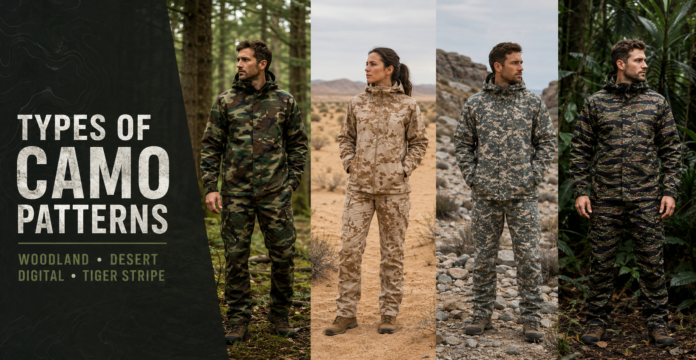
The main types of camo patterns include woodland, desert, digital, snow, brush, tiger stripe, and multicam designs. Each uses a different combination of colors, shapes, contrast, and scale to reduce the visible difference between a wearer and a specific environment.
No pattern performs equally well everywhere. Woodland may blend into a forest but stand out in dry grass, while desert colors can appear too pale among dense vegetation. Choosing correctly requires understanding terrain, season, light, and distance.
Woodland Patterns
Woodland camouflage combines green, brown, olive, and black in irregular shapes that resemble leaves, branches, shadows, and forest ground. Traditional versions use large curved forms that help disrupt the shoulders, torso, arms, and legs when viewed from medium or long distances.
Bright green woodland patterns suit dense spring and summer vegetation. Muted olive and brown versions perform better during autumn or in forests with dry leaves and exposed soil. Eco Jersey’s pattern guide explains how camouflage clothing changes across woodland, desert, snow, and mixed environments.
Desert Patterns
Desert camouflage uses tan, sand, beige, light brown, and muted grey. The pattern may imitate rock, dust, dry soil, and sparse vegetation. Lower contrast often works well in open terrain where harsh sunlight reduces deep shadows and makes very dark areas more noticeable.
Clothing must also suit hot conditions. Breathable fabrics release heat, while long sleeves and trousers protect against sunlight, dust, and rough plants. UPF treatments and ventilation improve performance.
Digital Patterns
Digital camouflage is built from small square or pixel-like blocks rather than traditional curved shapes. These blocks combine into larger color areas when viewed from a distance. Digital designs can be created for woodland, desert, snow, urban, or mixed terrain.
The pixel shape does not automatically make a pattern more effective. Color selection, contrast, scale, and environmental matching still determine concealment. Digital prints remain popular because they create a technical appearance and reproduce consistently across shirts, trousers, jackets, balaclavas, and equipment.
Snow and Arctic Patterns
Snow camouflage normally uses white and light grey with limited dark markings. Pure white can work across complete snow coverage, while broken patterns perform better where rocks, branches, and vegetation remain visible. Excessive dark contrast can make the wearer easier to identify from a distance.
Snow patterns are often printed on lightweight over-garments worn above insulated clothing. This allows users to change concealment without replacing their cold-weather layers. The outer cover must provide enough room for fleece, insulation, and shells without restricting movement.
Brush and Grassland Patterns
Brush patterns use vertical strokes, narrow shapes, and earth tones that resemble tall grass, reeds, twigs, and open scrub. They are commonly suited to grassland, marshes, farmland edges, and lightly wooded environments where vertical vegetation dominates the background.
These designs usually combine tan, olive, brown, and faded green. The vertical direction helps interrupt the horizontal shoulder line and straight edges of the body. However, brush camouflage may appear too light or open inside dense, shadowed woodland.
Tiger Stripe Patterns
Tiger stripe camouflage uses bold, irregular bands inspired by the shadows and vegetation found in tropical environments. Dark stripes cross green, olive, brown, or tan backgrounds, producing strong disruption in dense jungle and high-contrast foliage.
Tiger stripe is also popular in fashion. For concealment, its colors and stripe size must match the environment because dark versions may stand out in open terrain.
Multicam and Transitional Patterns
Multicam-style designs combine several neutral shades with soft-edged shapes and gradual color transitions. They are intended for movement between grass, woodland edges, rocky terrain, and semi-dry environments. This versatility makes them useful when carrying different outfits is impractical.
Transitional camouflage offers broad performance but may not beat a specialized pattern in one setting. Snow camouflage remains more suitable for deep snow, while a dedicated woodland print normally blends better into dense green vegetation.
Features of Effective Camo Patterns
The strongest types of camo patterns share several design qualities:
- Colors reflect the dominant shades of the environment.
- Irregular shapes disrupt recognizable body edges.
- Multiple scales work across different viewing distances.
- Controlled contrast creates depth without standing out.
- Matte surfaces reduce unwanted light reflection.
- Pattern placement avoids obvious repeated shapes.
- Garment coverage limits exposed visual areas.
Pattern alone cannot guarantee concealment. Movement, shiny fabric, exposed hands, and reflective equipment may reveal the wearer. A tactical guide can help users consider terrain, climate, fabric, and construction together.
Choosing Camo for Clothing
Observe the background colors, vegetation, shadows, and viewing distance. Testing fabric outdoors is more reliable than selecting it indoors. Seasonal changes should influence whether the design uses green, brown, white, or transitional tones.
Garment performance matters alongside appearance. Durable camo pants can combine pattern coverage with stretch and practical storage. Brands developing full collections can work with an outdoor manufacturer to coordinate prints, fabrics, fits, features, labels, and packaging.
Conclusion
Woodland, desert, digital, snow, brush, tiger stripe, and multicam designs serve different landscapes. Their effectiveness depends on accurate colors, suitable contrast, pattern scale, viewing distance, fabric finish, and complete body coverage.
Understanding the major types of camo patterns helps outdoor users and brands select designs based on real environmental needs. The best pattern is not the most complex one; it is the one that matches its surroundings while supporting comfort and movement.
FAQs
Which camo pattern works best in forests?
Woodland patterns with green, brown, olive, and shadow-like shapes generally work best in forests.
Is digital camo better than traditional camo?
Not automatically. Color, contrast, scale, and environmental matching determine performance.
Which camo pattern works across mixed terrain?
Multicam and transitional patterns are designed to perform across several neighboring environments.
Can brands create custom camo patterns?
Yes. Brands can customize colors, shapes, scale, fabrics, garments, labels, and packaging.