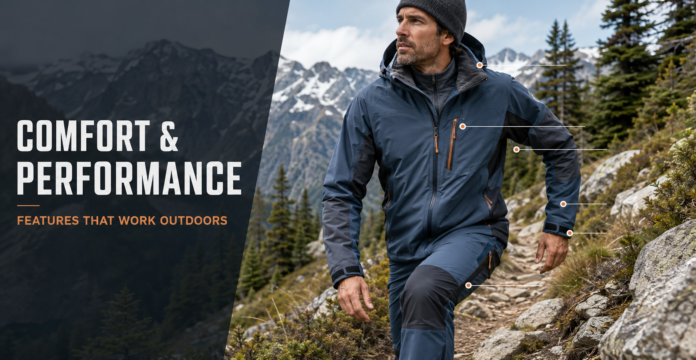
Technical outdoor clothing is full of features — some genuinely transforming how a garment performs, others adding complexity without meaningful benefit. Knowing which outdoor clothing features actually improve your comfort and performance helps you evaluate garments intelligently rather than being impressed by specification lists that include details irrelevant to your specific outdoor activities. Here’s a clear breakdown of the features that genuinely matter and exactly why each one earns its place in quality outdoor apparel.
Articulated Construction — Movement That Matches Your Body
Articulated knees, pre-shaped elbows, and gusseted crotch panels are among the most impactful construction features in outdoor clothing — yet they’re invisible when a garment hangs on a rack. These construction details pre-shape the garment to match common athletic body positions rather than forcing fabric to accommodate movement from a flat starting point.
Articulated knees in hiking pants bend with the leg naturally during steep trail climbing — preventing the fabric tension that flat-cut alternatives create at the front of the knee during high-step movements. Gusseted crotch panels eliminate the pulling sensation that limits stride length during scrambling and creek crossing. Pre-shaped elbows in shell jackets prevent sleeve bunching during pack carrying and overhead reach that unshaped alternatives create throughout full outdoor days.
These construction details add manufacturing complexity without adding meaningful fabric weight — creating some of the best performance-per-gram improvements available in outdoor clothing design.
Pit Zip Ventilation — Controlling Heat When You Need It Most
Underarm zip vents — universally called pit zips — open directly at the body’s highest heat generation zones during physical activity. During intense uphill effort, body temperature rises faster than even highly breathable fabrics can manage passively — and pit zips provide the additional direct airflow that prevents uncomfortable heat accumulation without requiring complete jacket removal in cold or wet conditions.
The practical value is immediate and significant. Opening pit zips during a steep ascent while keeping the jacket closed against wind and weather above creates a ventilation effect that maintains comfort throughout the effort — without the thermal shock of removing and replacing the jacket at the top that wind and cold exposure would otherwise demand.
Quality pit zip constructions use waterproof zippers and mesh-backed openings that maintain weather protection at the zipper interface while maximizing airflow through the ventilation opening during active use.
Adjustable Hoods — Complete Head Coverage When Conditions Demand It
Hood design separates genuinely functional outdoor jackets from casual outdoor-aesthetic garments that look technical without performing technically. Quality outdoor jacket hoods provide three-axis adjustment — volume control for fitting over helmets or base layer hats, cinch adjustment for facial coverage in wind-driven rain, and hem adjustment that prevents the hood from shifting during movement.
Wire-brim peaks maintain hood shape against wind — preventing the hood from collapsing across the face during high-speed descents and strong gusts that flatten soft-brim alternatives directly into eyeline. Helmet-compatible volume accommodates ski, climbing, and cycling helmets without uncomfortable pressure points that improperly designed hoods create during activities where helmet wear is non-negotiable for safety.
Flatlock Seams — Eliminating Friction at High-Contact Points
Standard sewn seams create raised ridges that cause friction against skin during sustained movement — a minor irritation during short activities that becomes significant discomfort across full outdoor days. Flatlock seam construction joins fabric panels with a flat stitching pattern that lies smoothly against skin — eliminating the friction points that standard seams create at shoulder blade areas beneath pack straps, inner thigh zones during hiking, and waistband contact points throughout extended outdoor wear.
This feature matters most for base layers and mid-layers worn directly against skin across long active days — where cumulative friction creates hot spots and irritation that distract from the outdoor experience and create genuine discomfort by late afternoon on demanding trail days.
Waterproof Zippers — Keeping Weather Out at Every Opening
Standard metal or plastic zippers create moisture entry points that undermine the weather protection that waterproof face fabrics and sealed seams provide across the rest of the garment. Waterproof zippers — using gasket seals or laminated fabric over-tapes — prevent moisture entry at every opening point where standard zippers allow penetration during sustained rain.
YKK Aquaguard and equivalent waterproof zipper systems operate smoothly with gloved hands in cold conditions — an operational requirement that standard zippers often fail during the cold weather situations where weather protection matters most critically. Storm flap covers over main zippers provide additional protection against wind-driven moisture entry at the primary closure point that receives the most direct weather exposure during outdoor use.
Secure Pocket Systems — Storage That Works During Activity
Pocket placement and closure design determines whether storage is actually usable during active outdoor movement rather than theoretically present but practically inaccessible beneath pack hip belts, harnesses, and climbing equipment. Chest pockets positioned above pack hip belts remain accessible during fully loaded hiking — hip pockets covered by hip belts do not. Zippered closures prevent pocket contents loss during scrambling sections where pocket orientation changes unpredictably with body position.
Soft-lined goggle pockets prevent lens scratching during ski jacket storage. Internal security pockets protect phones and valuables at body temperature — preventing battery failure in extreme cold that external pocket storage allows. Designated map pockets in hiking jackets provide quick-access document storage that dedicated pocket sizing makes practical rather than cramped.
Understanding how technical outdoor jacket features combine into complete performance systems is explored clearly in this types of jackets guide — covering how different jacket constructions integrate these features for different outdoor activity requirements.
Thumb Loops — Sleeve Position Control During Activity
Thumb loops at cuff ends maintain sleeve position during overhead reach, scrambling, and pack adjustment movements that pull sleeves upward and expose wrists to cold air and weather. This simple construction addition — a fabric loop at the cuff interior that the thumb passes through — prevents the cold gap between sleeve and glove that repeated sleeve riding creates during active outdoor movement.
Thumb loops matter most for base layers and mid-layers worn in cold conditions where wrist exposure to cold air creates immediate discomfort — and for shell jackets where sleeve riding exposes wrist skin to rain and wind during the arm movements that outdoor activity constantly creates.
Packability Features — Gear That Travels With You
Stuff-pocket systems — where the garment packs into its own chest or interior pocket — transform outdoor clothing from static wardrobe pieces into genuinely portable equipment that travels with you on every outing. A packable shell jacket that compresses to hip belt pocket size gets carried on every hike regardless of forecast — and provides protection when unexpected weather arrives that non-packable alternatives left at the trailhead cannot.
Packable insulated jackets, compressible fleece mid-layers, and roll-up rain pants all apply this principle — ensuring protective clothing options are always immediately available rather than contingent on accurate weather forecasting that mountain environments regularly make impossible.
DWR Treatment — Surface Performance Maintenance
Durable Water Repellent treatment on face fabrics causes water to bead and roll off rather than saturating the fabric — maintaining breathability by keeping face fabric pores clear of liquid water that would block moisture vapor transmission from inside the garment. DWR isn’t waterproofing — it’s the surface performance layer that allows waterproof membranes to breathe effectively by keeping the face fabric above them dry during rain exposure.
Regular DWR refresh through tumble drying on low heat maintains this essential surface function across the garment’s service life — preventing the face fabric wetting-out that reduces breathability even in technically waterproof garments with intact membranes beneath.
Natural Fiber Features — Merino’s Unique Contributions
Beyond technical construction features, natural fiber properties in merino wool base layers contribute performance advantages that no construction feature on synthetic garments replicates. Natural temperature regulation across wide condition ranges, odor resistance that allows multi-day wear, and softness against sensitive skin all improve outdoor comfort throughout extended trips in ways that technical feature lists don’t typically capture but real-world outdoor use immediately demonstrates.
Understanding exactly how merino fiber properties translate into outdoor performance advantages is explored in this merino wool t-shirts guide — covering fiber structure, moisture management, odor resistance, and care requirements relevant to anyone considering merino base layers for their outdoor clothing system.
Building Feature-Rich Outdoor Collections
For outdoor brands developing clothing collections, feature selection signals brand positioning as clearly as fabric specifications and retail pricing. Technical features without genuine performance justification add cost and complexity without customer value. Genuine performance features that solve real outdoor problems create the product quality that serious outdoor enthusiasts recognize immediately and recommend actively within their communities.
Our outdoor jackets manufacturer page covers the complete range of technical outdoor jacket options available for brand development — including the specific feature constructions that distinguish genuinely performance-focused outdoor jackets from fashion-inspired alternatives that approximate technical aesthetics without delivering technical performance.
For a practical example of how performance features translate into complete outdoor garment products, these waterproof pants demonstrate how articulated construction, secure pocket systems, and waterproof membrane technology combine in a complete lower body outdoor protection garment built for serious trail and mountain use.
Conclusion
The outdoor clothing features that genuinely improve comfort and performance — articulated construction, pit zip ventilation, adjustable hoods, flatlock seams, waterproof zippers, secure pockets, thumb loops, packability systems, and DWR treatment — each solve specific outdoor problems that their absence creates across real-world use. Understanding what each feature does and when it matters helps you evaluate outdoor clothing intelligently and helps brands build collections that deliver genuine performance value rather than impressive specification lists that don’t translate into meaningful outdoor experience improvement.
FAQs
Which outdoor clothing feature provides the greatest performance improvement?
Articulated construction consistently delivers the most immediate and noticeable performance improvement — enabling natural athletic movement across demanding terrain without fabric restriction that un-articulated alternatives impose throughout active outdoor days.
Are pit zips worth the additional cost in outdoor jackets?
Yes for high-intensity outdoor activities where heat management during sustained effort matters. For low-intensity recreational outdoor use where activity levels don’t generate significant heat accumulation — pit zips add cost without meaningful practical benefit during typical use.
Do waterproof zippers require special maintenance?
Quality waterproof zippers benefit from occasional lubrication with zipper wax or paraffin to maintain smooth operation — particularly in cold conditions where zipper stiffness can make operation difficult with gloved hands during the weather situations where jacket access matters most.
Can outdoor clothing with technical features be produced under a private label?
Yes. Professional outdoor apparel manufacturers offer complete private label production incorporating all major technical outdoor features — articulated construction, pit zips, waterproof zippers, adjustable hoods, and packable systems — giving outdoor brands full control over their technical outdoor clothing collections.