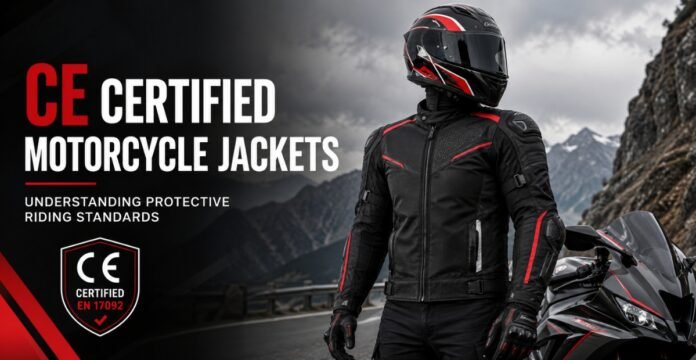
A motorcycle jacket is much more than just a windbreaker. A riding jacket that is properly designed will reduce the risk of injury during a slip or fall. It is important to choose motorcycle jackets that are CE certified motorcycle jackets if you want clothing that has been thoroughly tested and meets European standards. Motorcycle jackets that are CE certified can be made of leather, textiles, mesh or a combination of these materials. Material alone is not enough to make a motorcycle jacket protective. Consideration should be given to the construction strength, impact protection, abrasion resistant, seam strength and fit of the jacket, as well as its overall certification.
What Are CE Certified Motorcycle Jackets?
CE certified motorcycle jackets are protective riding garments assessed against applicable European requirements for motorcycle protective clothing. For modern motorcycle jackets, EN 17092 is an important standard used to classify garments according to their intended level of protection. Riders should look at the actual certification information instead of assuming that every leather or armored jacket has the same protective performance. A jacket may look strong but still lack the construction required for protective riding. Buyers comparing different designs can first explore the motorcycle jacket range to understand how jacket materials, cuts, and features can vary.
Why CE Certification Matters for Motorcycle Riders
CE certified motorcycle jackets help riders better understand the level of protection provided by a garment. Instead of relying on marketing terms such as “heavy duty,” “protective,” and “racing-quality,” riders can check a garment’s classification, certification, and provided information. It is important to consider this because clothing can be subjected to a variety of stresses during crashes. The jacket can be subjected to impact from the rider hitting the road, abrasion when sliding and strong pulling forces at the seams.
Understanding EN 17092 for Motorcycle Jackets
EN 17092 covers motorcycle protective clothing. The standard includes several performance classes, so that riders can choose clothing based on the level of protection they require and their riding conditions. CE certified motorcycle jackets can be classified as AAA, AAA, A, A, B or C, depending on their intended protective function and the type of garment. The highest level of protection is AAA, which is the EN 17092 classification system for garments. AA offers a good balance between comfort and mobility. Class A is more concerned with the balance of protection, comfort and mobility.
AAA, AA, and A Motorcycle Jacket Classes
Understanding the different classes of motorcycle jackets makes it easier for riders to compare and contrast. The AAA class is designed to offer the highest level protection according to EN 17092, but this may come at a cost of extra weight, stiffness or reduced ventilation. AA garments strike a balance between practicality and protection. Class A clothing is generally less protective, but offers greater comfort and flexibility. It is more important to choose the right class based on your riding conditions than the largest letter combination.
Main Features to Check in a CE Motorcycle Jacket
When comparing CE certified motorcycle jackets, riders should look beyond the front appearance of the garment. Important areas include shoulders, elbows, back coverage, seams, closures, abrasion-resistant zones, and the position of impact protectors. A well-designed jacket should also remain properly positioned when the rider moves.
- Certification label: Check which standard and garment class are stated.
- Shoulder protection: Look for correctly positioned impact protectors.
- Elbow protection: Protectors should remain over the elbow during riding.
- Abrasion resistance: High-risk areas need suitable protective materials.
- Strong seams: Critical seams should resist opening during a crash.
- Secure closures: Zippers and fasteners should stay closed when needed.
- Correct fit: A loose jacket can allow protective components to move.
- Back protection: Check whether a back protector is included or can be added.
- Protective coverage: The jacket should cover important impact and slide zones.
These checks help riders judge CE certified motorcycle jackets as complete protective systems rather than focusing on one feature such as leather thickness or visible armor.
CE Armor and CE Garment Certification Are Different
One of the most common mistakes is believing that a jacket containing CE-rated armor automatically becomes a fully CE certified motorcycle jackets. The certification of an impact protector and the certification of the complete garment are separate matters. Shoulder or elbow protectors may comply with their own impact-protection standard while the complete jacket is assessed under a garment standard such as EN 17092. This distinction is especially important when looking at motorcycle-style products. For example, a men’s biker jacket may have a motorcycle-inspired design, but buyers should verify its stated protective certification before treating it as certified PPE.
Leather, Textile, and Other Jacket Materials
CE certified motorcycle jackets can use different materials because certification is based on the performance of the complete garment rather than simply the name of the outer fabric. Leather remains popular because suitable motorcycle-grade leather can provide strong abrasion performance. Textile jackets can combine abrasion-resistant fabrics with lighter construction, ventilation, waterproof layers, and removable thermal liners. Riders interested in leather construction can view a genuine cowhide biker jacket as an example of leather jacket construction, while remembering that the material description alone does not prove CE certification.
How Fit Affects Protective Performance
Even good CE certified motorcycle jackets need to fit correctly. Shoulder armor should sit over the shoulder, while elbow armor should cover the elbow without moving far away when the rider bends the arm. Sleeves should remain long enough when the rider reaches forward toward the handlebars.
The body of the jacket should also remain secure without creating painful pressure. If a jacket is much too loose, armor can shift during movement or a crash. If it is too tight, riding can become uncomfortable and restricted. Riders should therefore check jacket measurements while sitting in a normal riding position rather than judging fit only while standing.
How to Check Whether a Motorcycle Jacket Is Really CE Certified
Buyers of CE certified motorcycle jackets should examine the permanent label, documentation, declared standard and protection class, as well as manufacturer information and instructions. It is not sufficient for a seller to simply write “CE protection” on a product’s title. This does not explain which part of the jacket has been certified. Ask if the certification is for the entire garment or just the removable armor. When certification is a requirement, buyers should ask for supporting documentation.
Choosing CE Certified Motorcycle Jackets for Different Riding Styles
What makes a good CE certified motorcycle jackets depends in part on where and how you ride. Urban riders might value a lighter jacket, better ventilation and ease of movement. Touring riders need to be able to store their gear, regulate ventilation, and have enough space for extra layers. For road racing or performance riding, abrasion resistance is usually more important than a secure fit, sturdiness, and protection performance. The climate should also be considered when making a choice. In hot weather, a heavy jacket can be uncomfortable.
Common Mistakes When Buying Protective Motorcycle Jackets
All motorcycle jackets that look like protective gear are not the same. Fashion biker jackets may have similar panels, zippers and leather-like materials, but they are not designed to provide crash protection. Another mistake is to check the armor, but ignore the garment construction, the seams, the closures and the abrasion resistant areas. It is also important that riders do not buy motorcycle jackets with CE certification based on their normal clothing sizes. The motorcycle garment must keep the protective areas in place while the rider moves.
Conclusion
CE-certified motorcycle jackets give riders a more accurate and reliable way to evaluate protective riding apparel. EN 17092 classifies motorcycle clothing to help riders understand the level of performance. Separate standards may apply for impact protectors at the shoulders or elbows. The best CE-certified motorcycle jackets combine a combination of certifications, materials, seams that are secure, armor that is correctly positioned, a comfortable fit and features suited to the environment in which riders ride. The certification should not be judged solely on appearance.
FAQs
What are CE certified motorcycle jackets?
CE certified motorcycle jackets are protective motorcycle garments that meet applicable European PPE requirements and carry relevant conformity information. Modern jackets may be classified under the EN 17092 series.
What does AAA mean on a motorcycle jacket?
AAA is the highest protection class within the EN 17092 motorcycle garment classification system. It is intended for garments designed to provide a high level of protection, although comfort and weight can vary between products.
Is CE armor the same as a CE certified jacket?
No. CE-rated armor refers to individual impact protectors, while complete garment certification covers the motorcycle jacket as protective clothing. Buyers should check which certification a product actually carries.