The difference between armor that appears protective and the actual tested protection is huge. This is why CE certified motorcycle apparel has been created as a separate, verified category. The certification turns vague “impact protection claims” into an enforceable, measurable standard that retailers and riders can trust.
Before sourcing products or marketing them as motorcycle protective gear, clothing brands and retail stores entering the market need to understand what CE certified motorbike gear actually means. The guide explains what certification is, what testing involves, and what to verify prior to making a commitment.
What does CE certification mean for motorcycle apparel?
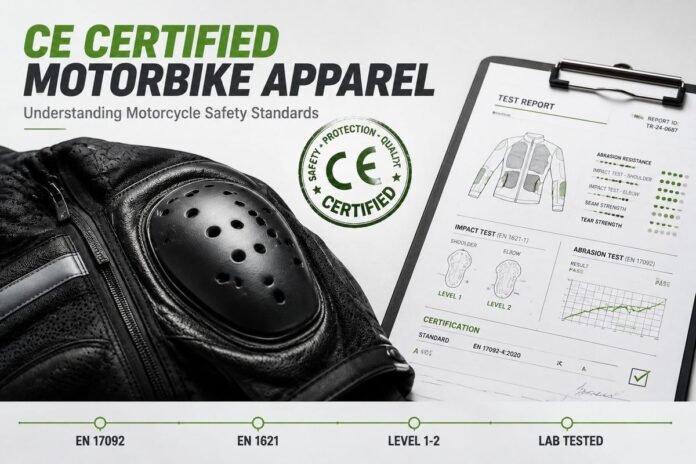
CE certification of motorbike clothing falls under the European Union Personal Protective Equipment Regulations, specifically EN 17092 standard for garments. EN 1621 is for armor inserts. These standards together define the measurable requirements of abrasion resistant, seam strength and impact energy absorbtion, transforming a subjective, “protective” looking garment into an engineering product.
A garment with a genuine CE certificate has been tested in a laboratory against performance standards, and is not just a piece of protective clothing based solely on its visual appearance. It is important for purchasers to know the difference, as two jackets that look similar can behave very differently during a crash, depending on their certification.
Understanding EN 17092: Garment-Level Certification
EN 17092 regulates motorbike clothing, and classifies it into different performance levels according to abrasion, tear strength and seam integrity in simulated sliding conditions. The standard applies to jackets, pants and suits. It tests how well the fabric and stitching hold up under controlled abrasion.
Classifications range from AAA (the highest level of protection) which is typically found in leather or heavy duty textile trackwear, to AA, which corresponds with lighter tour and commuter applications. When sourcing CE-certified motorbike clothing, buyers should verify the specific classification of the garment. A lower class rating does not necessarily indicate poor quality. It simply means that it is intended for a different use.
Understanding EN 1621: Armor Certification
EN 17092 certifies outer garment construction. EN 1621, however, certifies armor inserts at shoulders, elbows and hips. The standard is designed to measure how well armor can absorb and distribute impact energy. Levels 1 and 2 indicate increasing levels of protection from blunt force trauma.
As armor certification is often outsourced, a garment’s CE status will depend on the fabric being EN 17092, and separately the armor meeting EN 1621. Motorbike apparel brands should ask for certification documents of both the fabric and armor separately, as a general claim that a garment is “CE certified” does not confirm all elements within it meet their respective standards.
What Testing and Certification Really Mean
For CE-certified motorbike clothing, laboratory testing involves controlled abrasion rigs and impact rigging, as well as tear strength testing. These tests simulate actual crash situations under repeatable, measurable circumstances. The manufacturers submit samples of garments or armor components to accredited test bodies. These testing agencies issue certificates only when the products have met the thresholds set for the claimed level.
This requires that retesting is required whenever the manufacturer makes changes to fabric, armor, or construction details. Certification applies only to the tested configuration, not the entire garment. The certification status is not a company-wide accomplishment, but a specific product that may change if the manufacturer changes materials.
The Features of Genuine CE Certified Motorbike Clothing
When evaluating whether or not a product is truly CE-certified, brands should verify the following.
- EN17092 classification of garments, indicating the protection class (AA, A, or AA) that fabric and construction meet.
- Certification of armor to EN 1621 that confirms Level 1 or 2 protection for each location
- Test documentation accredited by an independent testing agency, rather than the manufacturer’s own internal claims
- Certification of components. Fabric and armor are verified separately, rather than assuming that one certification covers them both.
- Batch Consistency Confirmation. Since certification is based on a configuration which should not drift during bulk production
- Test triggers for retesting understood. Confirm the manufacturer tests when construction or materials change.
Application of CE Certification to All Product Categories
The certification requirements vary slightly depending on the type of garment. A motorbike jacket requires both EN 17092 material classification and EN1621 armor certification for the elbows and shoulders, while motorbike pants need the same standard with armor certification on the hips.
Full Motorcycle suits are a combination of both the certification and safety scopes. They often aim for AAA class due to their use on sport bikes or track rides. The CE standard for hand- and foot-protection is separate from the jacket level. Buyers should not assume that certification of accessories such as boots and gloves extends beyond their jacket.
Checklist for Buyers Before Sourcing
It is not enough to rely on a label or product description. The buyer should ask for the certification document referencing the EN 17092 level and EN 1621 class claimed along with the accreditation testing body’s name.
Asking the manufacturer how they handle retesting after fabric or armor component changes can also help you determine if certification is based on current production, rather than an old test result. Buyers can get a more accurate picture by comparing the motorbike catalogue with certification documents.
Last Thoughts
CE-certified motorbike clothing turns protection for riders into an enforceable, measurable standard, rather than just a visually assumed assumption. Understanding EN 17092 as well as EN 1621 can help brands find gear that truly protects those wearing it. By requesting real documentation and not just relying on labels, buyers can avoid liability risks associated with unsubstantiated protective claims.
Eco-Jersey produces motorbike clothing that is tested to meet CE standards for jackets, trousers, and complete suits. Browse the catalog for motorbikes or contact us to request a consultation so we can review your certification documents.
FAQs
How do EN 17092 & EN 1621 differ?
EN17092 certifies a garment’s outer fabric / construction to ensure abrasion & tear resistance. EN1621 certifies armor inserts for specific impact energy absorption.
What is the AAA classification for motorcycle apparel?
AAA represents a high protection level under EN 17092, and it’s usually associated with heavy leather or textile gear designed for track and sport riding.
Is CE certification applicable to all garments or only the armor?
Since these certifications are separate, genuine CE certified motorcycle apparel must meet both EN 17092 fabric requirements and EN 1621 armor specifications.
What documentation should a buyer request to confirm that a CE certificate is authentic?
The buyers must ask for the accreditation of the testing agency, as well as the class or level attained and the date the configuration tested was verified