
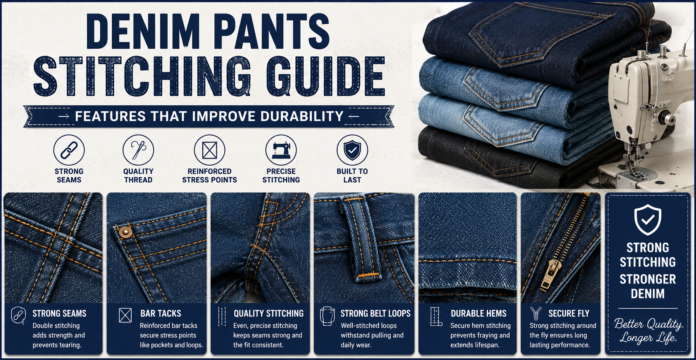
Denim may appear sturdy at first glance, but the true challenge is found at the seams. A good pair of pants should withstand the demands of everyday activities without the seams coming undone. The seams of denim help the fabric panels stay joined to one another. If sewing is poor, even the thickest denim can be unsightly and worn after a short time. Having a higher quality seam also contributes to a neater and cleaner pant. This is why a buyer should distinguish denim pants stitching quality by examining the stitching itself prior to judging the quality of denim by the fabric’s weight or color.
Denim Pants Stitching Basics
Denim pants stitching is how pants panels and parts are sewn together and how parts like seams and pockets are reinforced and secured. Denim pants have side seams, inseams, pockets, hems, belt loops, a waistband, and a fly. Each of these parts has a particular function. As such, each part must be constructed using a particular method. Some areas require certain types of seams, while others require certain types of seams and reinforced stitching. An analogy can be made to living things. Certain parts of a fabric body design given structure. Fabric gives flatness to a body, yet stitching animates it.
Strong Side Seams for Daily Wear
Since side seams connect the front and rear portions of the pant legs, they must be straight, firm and aligned/balanced. A well made durable denim pant’s side seam should not twist, pull, or gape open after the item has been laundered. Side seams for denim pants stitching should have even tension through the stitching on the seams as inconsistent tension creates weakness in the seams and the stitching. The line of stitches should be clean and even from the top to the bottom of the seam. If you want to see different denim pant styles in one place, the denim pants collection is a natural place to connect this topic with product variety.
Inseam Strength and Movement
The inseam is one of the most stressed seams on a pair of pants due to the inseam’s location from the crotch to the leg opening. Every time you walk, sit, or move in any way, the fabric in the trouser inseam moves, so the pants should be made with quality fabric and stitching. A rough inseam is most likely going to be uncomfortable and a weak inseam most likely going to easily tear away. Most quality denim pants stitching have a double or chain stitch, allowing for a strong yet smooth inseam.
Bar Tack Reinforcement
Bar tacks are an intensive grouping of stitches that are added to high-stress points of a garment. Though small, bar tacks add a large amount of structure and support to a stitch. denim pants stitching use bar tacks to reinforce the stitching at the corners of pockets, the corners of the loops, the ends of the zippers, and the fly. Those areas are some of the most stressed from daily use. Fabric without bar tacks on those areas would easily rip or fabric would come loose. Bar tacks captures the tension at that singular point. Buyers can easily examine if pants use bar tacks by looking at reinforced corners of the pockets.
Pocket Stitching That Stops Tearing
Pockets function as design details and functional features of denim. People use pockets to store hands, phones, keys, and wallets. Because of this, the stitching on denim pants stitching around pockets must be secure. Topstitching should be strong for the opening of the pockets. Bar tacks should be used at the corners of the pockets. For a style that shows how denim construction can support everyday use, denim cargo pants are a relevant example because cargo pockets need extra sewing control. When pocket stitching is weak, corners open first. When it is strong, the pocket keeps its shape and stays useful for longer.
Waistband and Belt Loop Stitching
The waistband keeps the pants up, and constant pulling means the stitching needs to be strong. Rolling or separating makes the waistband and pants looks bad. This part of the stitching also needs to be secure and stay flat. Belt loops are also designed to be pulled, so they need extra strength too. They need denim pants stitching top and bottom. Little gaps where the waistband and side and front seams join can cause big problems for the fit. If done well, the sewing in this area gives a secure fit.
Topstitching for Strength and Style
Canvas pants feature a topstitched seam line and improved aesthetic and functional support. Great topstitching ensures layers of denim pants stitching remain flat and holds seams securely in place. Pocket edges, yokes, hems, and even sides should have uniform and clean, straight patterns of topstitching. Poor topstitching may give a strong fabric a bargain appearance. Stitch lines quality and cleanliness assure customers of the quality of the sewing and, ultimately, of the denim. Topstitching combines style and functionality.
Simple Bullet Points Buyers Can Check
These points make denim pants stitching easy to understand before buying or approving production.
- Check pocket corners because they should have tight bar tacks.
- Check the inseam because it should feel smooth and secure.
- Check the waistband because it should stay flat and firm.
- Check belt loops because they should not lift or loosen.
- Check topstitching because straight lines show better sewing control.
- Check hems because they should not twist after washing.
- Check loose threads because too many loose ends show weak finishing.
These one-line checks help buyers judge quality quickly without needing deep factory knowledge.
Hem Stitching and Clean Finishing
Denim pants terminate in a hem at the bottom of each pant leg. This simple design element plays a crucial role in the overall appearance and long-term usability of the garment. The construction of hems in pant legs should ensure a flat and tidy design element remains secured. Weak hems can be opened after a couple of washes, and can drag unnecessarily at the pant leg openings. Secure hems ensure stitch lines are level and folds are even. For shorter denim styles, denim capri pants for women show why clean leg openings matter for both shape and appearance. A well-finished hem makes the pants look polished and helps them stay neat for longer.
Difference Between Weak and Durable Stitching
The main difference lies in performance after actual use. Weak stitches may look fine at first, but they can break after a few washes or after a bit of sitting, stretching, or after pockets are filled with items. Good stitches remain intact and help keep the fabric intact for further stitching. It also helps hold the shape of the pants. For brands, better stitches result in less complaints and improved trust while for customers, it results in better value for the expense. The best denim pants stitching are not made strong by fabric only. They are made strong by all the other elements working well and functioning as they should with strong fabric.
FAQs
What is denim pants stitching?
It is the sewing used to join and strengthen denim pants, including seams, pockets, waistband, hems, belt loops, and fly areas.
Why does denim pants stitching improve durability?
It improves durability because strong stitching holds fabric panels together and protects stress points from tearing during daily use.
Which stitching parts should buyers check first?
Buyers should check the inseam, side seams, pocket corners, waistband, belt loops, hems, and fly area first.
Are bar tacks important in denim pants?
Yes, bar tacks are important because they reinforce small stress points that face repeated pulling.
What makes durable denim pants different?
Durable denim pants have strong thread, reinforced seams, clean topstitching, secure bar tacks, and neat finishing.


