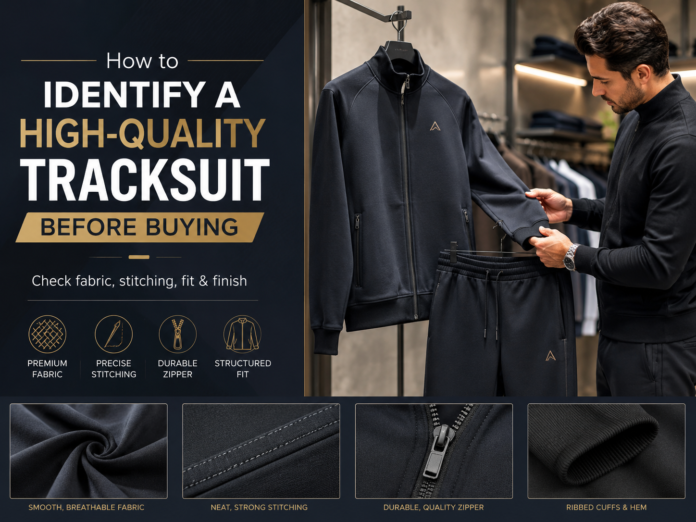
Not all tracksuits are created equal. Walk into any sportswear store or scroll through any online catalog and you’ll find tracksuits at every price point — from budget basics to premium pieces that cost significantly more. But price alone doesn’t reliably indicate quality. Knowing how to identify a high quality tracksuit before buying saves you from the frustrating experience of investing in a piece that deteriorates quickly, loses its shape after a few washes, or simply doesn’t feel as good in real life as it looked in the product photograph.
The good news is that once you know what to look for, spotting a genuinely high-quality tracksuit becomes much more straightforward. There are clear, specific indicators of quality that appear consistently across the best tracksuits — and equally clear warning signs that a tracksuit won’t deliver on its promise once you start wearing it regularly.
This guide covers every indicator worth checking before you buy — from fabric feel and construction details to fit assessment and care requirements — so every tracksuit purchase you make is one you’ll genuinely be satisfied with.
Why Tracksuit Quality Matters More Than Most People Realize
A tracksuit is one of the most frequently worn pieces in most casual wardrobes. It’s the piece you reach for on rest days, during workouts, for travel, for weekend errands, and for those days when comfort is the absolute priority. Because it gets worn so regularly, the quality of its construction and fabric affects your daily experience in a way that more occasional pieces simply don’t.
A high-quality tracksuit maintains its shape, color, and fabric feel across months and years of regular wearing and washing. A low-quality tracksuit starts to show its limitations quickly — pilling within a few washes, fading after repeated laundering, losing its shape at the knees and elbows, or simply feeling progressively less comfortable as the fabric breaks down.
Understanding how to identify a high quality tracksuit before buying is genuinely one of the most valuable purchasing skills you can develop for your casual wardrobe — and it’s a skill that saves money, frustration, and wasted time in the long run.
Why It Matters — Key Benefits
Knowing how to identify a high-quality tracksuit before buying delivers real, lasting benefits. Here’s why it matters:
- Better long-term value — A high-quality tracksuit worn regularly for years delivers far better cost-per-wear value than a cheap alternative that deteriorates in months.
- Consistent comfort throughout the day — Premium fabrics maintain their softness and comfort through long wearing periods in a way that cheaper materials simply don’t.
- Maintained appearance after washing — Quality construction and colourfast fabrics keep a tracksuit looking presentable wash after wash rather than fading and pilling quickly.
- Preserved fit over time — Well-constructed tracksuits maintain their original shape and dimensions across repeated wearing and washing cycles.
- Reduced replacement frequency — A quality tracksuit that lasts three to five years costs significantly less per year than replacing a cheap alternative annually.
- Greater styling versatility — High-quality tracksuits maintain the visual quality needed to work across casual, athleisure, and smart casual styling contexts.
- Genuine performance during activity — Quality fabrics and construction support real athletic movement rather than restricting it or creating discomfort during exercise.
Start With the Fabric: The Most Important Quality Indicator
The single most reliable indicator of tracksuit quality is the fabric — and assessing it properly is the most important step in how to identify a high quality tracksuit before buying. Everything about how a tracksuit performs over time is ultimately determined by the quality of its fabric — how it feels, how it washes, how it holds its shape, and how long it maintains the appearance and comfort that made you want it in the first place.
The most commonly used fabric in quality tracksuits is cotton fleece — either pure cotton or a cotton-polyester blend. High-quality cotton fleece feels dense, soft, and substantial in the hand — not thin, scratchy, or flimsy. The weight of the fabric should feel proportional to its intended use — a lightweight tracksuit appropriate for mild weather exercise should still feel substantial and well-made, not tissue-thin.
When you pick up a tracksuit in a store, squeeze the fabric gently and then release it. High-quality fabric springs back to its original form quickly — demonstrating the kind of fiber resilience that indicates good construction. Fabric that stays crushed or recovers slowly is a warning sign of lower quality fiber content that will lose its shape with regular wearing.
Rub the fabric surface gently with your thumb. Quality tracksuit fabric should feel consistently smooth and dense without snagging or immediately showing surface disturbance. If the surface pills or shows wear immediately from light rubbing, it will do the same after just a few washes in regular use.
Check the Fabric Weight and Density
Beyond the feel of the fabric, weight and density are important indicators in how to identify a high quality tracksuit that are worth assessing specifically. Fabric weight is measured in grams per square meter — GSM — and understanding the appropriate weight for a tracksuit’s intended use helps you evaluate whether a specific piece is appropriately constructed.
For everyday casual and athleisure tracksuits — the kind worn for daily activities, light exercise, and relaxed social occasions — a fabric weight of 280 to 350 GSM typically delivers the right balance of comfort, warmth, and structure. This weight feels substantial without being heavy and maintains its shape well through regular wearing.
For lightweight performance tracksuits designed for warmer weather exercise — running, cycling, or outdoor training — lighter fabrics in the 180 to 250 GSM range are appropriate and expected. These should still feel smooth, well-constructed, and consistently even across the entire surface — lightweight doesn’t mean poorly made.
Hold the tracksuit up to a light source and look at the fabric structure. High-quality fabric should show a consistent, even weave or knit structure without thin patches, inconsistent density, or visible weak points in the construction. Uneven fabric density is one of the most reliable indicators of lower quality materials that will deteriorate unevenly over time.
Examine the Stitching Closely
After fabric quality, stitching is the most important construction indicator in how to identify a high quality tracksuit. Even the finest fabric is undermined by poor stitching — and tracksuit stitching specifically needs to handle significant stress from athletic movement, regular washing, and the general demands of frequent casual wear.
Look at the stitching along all major seams — the side seams of the jacket, the inseam and outseam of the trousers, and the shoulder seams of the jacket. High-quality stitching is straight, even, and consistently tight along its entire length. Each stitch should be the same size and tension as every other stitch in the same seam — with no visible loose threads, skipped stitches, or areas of inconsistent tightness.
Turn the tracksuit inside out and examine the seam construction from the interior. Double-stitched or flat-felled seams indicate a higher quality construction approach that significantly increases the seam’s resistance to stress and wear. Single-layer seaming on high-stress areas like the crotch seam, underarm, and shoulder junction is a warning sign that the tracksuit may fail at these stress points sooner than expected.
Check the stitching at the end points of zips, waistbands, and cuffs — these junction areas receive concentrated stress during wearing and washing and are common failure points in lower quality tracksuits. High-quality construction reinforces these areas with bar tacks or extra stitching that prevents the seam from unraveling from the end points outward.
Assess the Zippers and Hardware
Zipper quality is a surprisingly reliable overall quality indicator in tracksuits — because manufacturers who invest in quality fabric and construction also tend to invest in quality hardware, while those cutting corners on fabric often cut corners on zippers too.
High-quality tracksuit zippers run smoothly and consistently from fully open to fully closed without catching, sticking, or requiring force at any point along their length. Pull the zipper slowly from bottom to top and back again before buying — any resistance, catching, or inconsistency is a warning sign of a zipper that will become increasingly problematic with regular use.
The zipper pull should feel substantial and well-attached — not lightweight or loosely connected to the slider mechanism. Lightweight, hollow-feeling zipper pulls are a common indicator of budget hardware that deteriorates quickly. YKK is the most widely recognized quality zipper brand — its presence on a tracksuit is a reliable quality signal, though it’s not the only quality zipper manufacturer worth knowing.
Check any additional hardware — drawstring toggles, velcro closures, snap buttons — for the same quality of construction. All hardware on a high-quality tracksuit should feel well-made and securely attached, functioning smoothly and consistently without any sign of weakness or poor attachment.
Evaluate the Waistband and Cuffs
The waistband and cuffs of a tracksuit tell you a great deal about overall construction quality and how the piece will hold up over time. These are the areas that undergo the most repeated mechanical stress during wearing and washing — and they’re where lower quality construction reveals itself most quickly.
A high-quality tracksuit waistband should be wide, even, and feel structurally substantial against the body. It should hold its shape when stretched and spring back cleanly when released — demonstrating the kind of elastic resilience that indicates quality construction. A waistband that feels thin, narrows unevenly, or doesn’t recover promptly from stretching will lose its shape quickly with regular wearing.
The rib knit construction of cuffs at the wrists and ankles should be dense and even — with consistent tension throughout the entire circumference of each cuff. Low-quality rib knit cuffs feel loosely constructed, spring back slowly from stretching, and begin to sag and distort after relatively little wear. High-quality cuffs maintain their original shape and compression for years of regular use.
Check that the waistband and cuffs are attached to the main body of the tracksuit with consistent, reinforced stitching that shows no signs of puckering, pulling, or uneven attachment. These junction points receive significant stress during wearing — and well-reinforced attachment is essential for long-term structural integrity.
Check the Fit Across Both Pieces Simultaneously
A tracksuit is a two-piece coordinated set — which means fit assessment in how to identify a high quality tracksuit needs to evaluate both pieces together rather than independently. The best fabric and construction in the world doesn’t make a tracksuit worth buying if the fit doesn’t work for your body across both pieces simultaneously.
The jacket should sit cleanly across the shoulders without pulling, bunching, or creating tension at the shoulder seams. The shoulder seam — where the sleeve meets the body of the jacket — should sit precisely at the edge of your shoulder, not dropping toward the upper arm or sitting awkwardly high toward the neck. This is the most structurally important fit point of the jacket and the hardest to manage when it’s wrong.
The jacket body should have enough room through the chest and torso to accommodate your natural range of movement — reaching, bending, and stretching — without pulling across the fabric or creating significant tension at the seams. A tracksuit jacket that restricts movement during athletic activity has failed at its most fundamental purpose.
The trousers should sit at the intended waist position — whether that’s the natural waist or the hip, depending on the tracksuit’s design — with enough room through the seat and thighs to move freely without restriction. The leg length should allow comfortable movement without excessive bunching at the ankle or creating tripping hazard length.
Our tracksuit for men and women’s tracksuit ranges are designed with precise fit consideration for both pieces — ensuring the jacket and trouser work together as a genuinely coordinated set rather than two pieces that happen to share a fabric.
Examine the Finishing Details
The finishing details of a tracksuit reveal a great deal about the overall quality level of its construction — because quality manufacturers pay attention to every element of the finished product, while budget manufacturers typically cut corners on the details that aren’t immediately obvious at first glance.
Check the interior finishing of the tracksuit — the inside surfaces of seams, the inside of pockets, and the lining of any hooded section. High-quality tracksuits show clean, even finishing on interior surfaces without loose threads, uneven seam allowances, or exposed raw edges. Interior finishing that looks rushed or uneven indicates an overall manufacturing approach that likely extends to less visible quality compromises throughout the garment.
Look at the pocket construction — are pockets evenly positioned on both sides of the jacket and trousers? Are the pocket openings reinforced at the corners to prevent tearing during use? Does the pocket lining fabric feel appropriate for the tracksuit’s overall quality level? These details matter because pockets undergo significant stress during regular wearing — and poorly constructed pockets are one of the most common practical failure points in lower quality tracksuits.
Check that logos, branding, and any decorative elements are cleanly applied — whether embroidered, printed, or heat-applied. High-quality logo application shows crisp edges, consistent color, and secure attachment without any sign of peeling, lifting, or uneven application.
Read the Care Label for Quality Signals
The care label of a tracksuit contains more quality information than most people realize — and it’s worth reading carefully as part of how to identify a high quality tracksuit assessment. High-quality tracksuits with premium fabric compositions typically have specific, detailed care instructions that reflect the manufacturer’s confidence in the garment’s construction and their investment in helping buyers maintain it correctly.
A care label that recommends cold water washing and air drying indicates fabric and construction that has been designed for longevity — the manufacturer wants the tracksuit to be cared for in a way that preserves its quality over time. A care label that simply says machine wash without temperature specification or drying guidance often indicates a less premium product where the manufacturer’s investment in post-sale performance is limited.
Check the fabric composition listed on the care label — it tells you exactly what you’re buying rather than relying on marketing descriptions. Quality casual tracksuits typically list cotton or cotton-polyester blend compositions in proportions that align with the premium feel of the fabric. Very high polyester content with minimal cotton — 90% polyester or above — often indicates a budget fabric construction that prioritizes cost over quality.
Consider Tracksuits for the Whole Family
Quality matters across all age groups — and the same principles that apply to adult tracksuit quality assessment apply equally to children’s tracksuits, with some additional practical considerations specific to children’s active wearing.
For children’s tracksuits specifically, fabric softness against sensitive skin takes on additional importance beyond the general quality indicators discussed throughout this guide. Children wear their clothing in direct contact with skin for extended periods — and a fabric that feels acceptable to an adult may be genuinely uncomfortable for a child with more sensitive skin.
Durability under heavy use is equally critical for children’s tracksuits — children subject their clothing to more intense physical stress than adults, and the stitching, fabric, and construction of a kids’ tracksuit needs to handle that level of active wear consistently. Our kids tracksuit range is designed with both fabric softness and construction durability specifically in mind — built to handle the genuine demands of active childhood wearing.
Conclusion
Knowing how to identify a high quality tracksuit before buying transforms every tracksuit purchase from a guess into a genuinely informed decision. Fabric weight and feel, stitching quality, zipper construction, waistband and cuff integrity, fit across both pieces, and finishing detail — these are the indicators that consistently separate tracksuits that deliver long-term value from those that disappoint quickly.
At Eco Jersey, we manufacture tracksuits for men, women, and children with genuine attention to every quality indicator covered in this guide — premium fabrics, precise construction, and finishing details that reflect a genuine commitment to lasting quality. Ready to find your perfect tracksuit? Browse our complete tracksuit collection and get in touch with our team today.
FAQs
What fabric makes the highest quality tracksuit?
High-quality cotton fleece — either pure cotton or a premium cotton-polyester blend — is the most reliable indicator of tracksuit quality for casual and athleisure wear. It feels dense and soft, maintains its shape through repeated washing, and improves in comfort over time with regular wearing.
How can I tell if a tracksuit zipper is high quality?
A quality zipper runs smoothly and consistently from fully open to fully closed without catching or requiring force at any point. The zipper pull should feel substantial and be securely attached. YKK is one of the most widely recognized quality zipper brands and its presence is a reliable positive signal.
Is a higher price always a reliable indicator of tracksuit quality?
Not always. Price can reflect brand premium, marketing costs, and retail markup rather than construction quality. The physical quality indicators covered in this guide — fabric feel, stitching quality, hardware construction, and finishing details — are more reliable quality indicators than price alone.
How do I check tracksuit quality when buying online?
Focus on detailed fabric composition information, customer reviews that specifically mention durability and washing performance, brand reputation for quality construction, and return policies that allow you to assess quality in person before committing to the purchase.