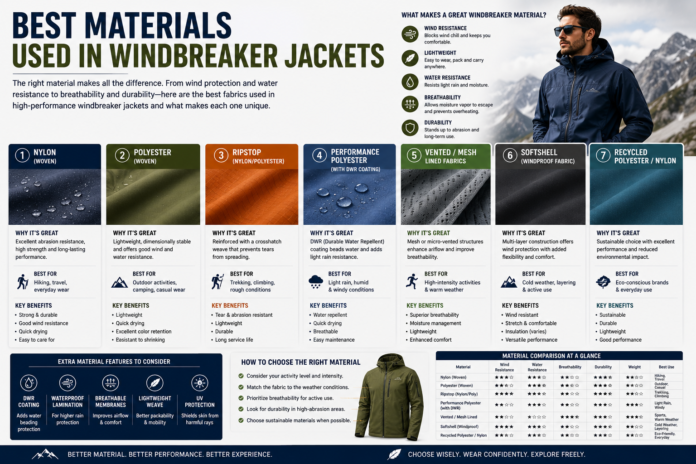
A windbreaker’s entire performance promise depends on one thing — the material it’s built from. The fabric determines how well it blocks wind, how much rain it resists, how light it packs, and how long it lasts across demanding outdoor use. Understanding the best materials used in windbreaker jackets helps brands make informed fabric decisions that translate directly into products customers trust — and helps outdoor enthusiasts choose jackets that genuinely perform rather than just look the part.
Here’s a complete breakdown of every major windbreaker material and what each one delivers.
Ripstop Nylon — The Classic Windbreaker Standard
Ripstop nylon is the most widely used face fabric in windbreaker manufacturing — and its commercial dominance reflects genuine performance merit rather than simply manufacturing convenience. The reinforced grid weave pattern — created by interlacing heavier threads at regular intervals through the base fabric — prevents small tears from propagating across the fabric surface. This distinctive crosshatch pattern is instantly recognizable and genuinely functional.
Nylon’s natural properties make it ideal for windbreaker applications. It is lightweight, packs compactly, dries quickly after moisture exposure, and maintains its structure across temperature extremes that affect other synthetic fabrics more significantly. Denier weight determines the performance balance between durability and packability — 20 denier ripstop nylon produces ultralight packable jackets, while 40 to 70 denier constructions provide meaningful abrasion resistance for more demanding outdoor applications.
A professional windbreaker jackets manufacturer specifies ripstop nylon denier based on intended use — ensuring ultralight running jackets use minimum-weight constructions while hiking and outdoor lifestyle jackets use heavier deniers that justify their slightly increased weight through significantly extended service life.
Polyester — Versatile and Color-Stable
Polyester serves windbreaker applications across multiple performance requirements — appearing in both face fabric and lining constructions depending on jacket design and intended use. Its key advantage over nylon in specific applications is superior color stability — polyester retains vibrant colorways across extended UV exposure and repeated washing significantly better than nylon alternatives.
This color stability makes polyester particularly valuable for fashion windbreakers where visual appeal across the jacket’s lifetime matters as much as technical performance. Bold color blocking, vibrant solid colorways, and printed graphic applications all maintain their visual impact significantly longer on polyester face fabrics than comparable nylon constructions.
Recycled polyester — produced from post-consumer PET plastic waste — delivers identical performance to virgin polyester while significantly reducing environmental impact. Sustainability-focused outdoor and lifestyle brands increasingly specify recycled polyester for windbreaker face fabrics — responding to growing consumer demand for environmentally responsible outdoor clothing without compromising the technical performance characteristics their customers depend on.
DWR Treated Fabrics — Surface Water Repellency
DWR — Durable Water Repellent — treatment isn’t a standalone fabric but an essential surface coating applied to windbreaker face fabrics that transforms their weather resistance performance. DWR causes water to bead and roll off the fabric surface rather than saturating it — maintaining both the fabric’s appearance and its breathability by preventing face fabric saturation that blocks moisture vapor transmission from inside the jacket.
Fresh DWR treatment performs impressively against light rain and moisture splash — keeping wearers comfortable during brief precipitation events without the weight and cost of full waterproof membrane construction. DWR performance degrades progressively through use, abrasion, and washing — requiring periodic refresh through tumble drying heat reactivation or specialist re-treatment products to maintain peak water repellency performance.
Modern fluorocarbon-free DWR formulations replace traditional C8 chemistry with more environmentally responsible alternatives that meet increasingly stringent regulatory requirements across European and North American markets — an important specification consideration for brands building waterproof clothing and windbreaker collections targeting environmentally conscious outdoor consumers.
Waterproof Breathable Membranes — Premium Weather Protection
Waterproof windbreakers bond thin breathable membrane films to lightweight face fabrics — creating jackets that genuinely stop rain penetration while remaining significantly lighter and more packable than full hardshell construction alternatives.
2.5-layer membrane constructions — where a membrane is bonded to the face fabric interior and protected by a printed pattern rather than a full lining fabric — produce the lightest possible waterproof windbreaker constructions. These ultra-compact jackets pack to remarkably small volumes while providing genuine waterproof protection that DWR treatment alone cannot reliably deliver in sustained precipitation.
2-layer constructions bond membrane to face fabric without a full interior lining — slightly heavier than 2.5-layer but more comfortable against the body during extended wear. These constructions suit waterproof jackets positioned between ultralight emergency layers and full hardshell performance — serving outdoor enthusiasts who need reliable waterproofing in a meaningfully lighter package than traditional 3-layer hardshell constructions provide.
Stretch Woven Fabrics — Mobility Meets Wind Defense
Stretch woven fabrics incorporate elastane or mechanical stretch constructions into windbreaker face fabrics — creating materials that provide full windproofing alongside the freedom of movement that high-intensity outdoor activities demand. These fabrics appear primarily in softshell jackets and performance-oriented windbreakers targeting running, climbing, and ski touring markets.
Four-way stretch constructions accommodate simultaneous horizontal and vertical stretch — critical for the multi-directional movement patterns that athletic outdoor activities impose constantly. The stretch performance allows jacket fit optimization for aerodynamic efficiency during running and cycling without restricting the body positions that climbing and skiing demand across varied terrain and technical challenges.
Mesh Linings — Comfort and Pack Structure
Interior mesh linings in windbreakers serve multiple functions simultaneously. They add a smooth, comfortable layer against the skin or mid-layer surface — preventing the clammy face fabric contact that unlined constructions create during movement. They also provide structural support that helps windbreakers maintain their shape during pack-down and deployment cycles.
Lightweight mesh constructions add minimal weight while significantly improving wearing comfort — making them standard construction in quality windbreakers across all but the absolute ultralight weight categories where every gram reduction justifies even slight comfort compromises.
Taffeta Linings — Premium Feel and Easy Donning
Taffeta polyester linings provide a slippery interior surface that allows windbreakers to slide easily over base layers and mid-layers during donning and removal — particularly valuable for quickly deployed emergency layers during activity. The smooth surface also feels premium against the skin — communicating quality that mesh-lined alternatives cannot replicate at first touch.
Outdoor jackets at premium price points often use taffeta lining specifically for the quality perception it creates during customer handling in retail environments — where the interior feel and visual quality of lining fabric significantly influences purchase decisions at the point of sale.
Seam Sealing Tapes — Construction Point Protection
Seam sealing isn’t a fabric but a critical construction material that determines whether waterproof windbreakers actually perform their weather protection promise in real conditions. Waterproof face fabrics and membrane constructions mean nothing if seam needle holes allow water entry through construction points.
Thermally bonded seam sealing tapes cover needle penetration points along critical seams — shoulders, hood attachment points, sleeve insertions, and pocket edges — preventing the moisture entry that unsealed seams allow during sustained rain exposure. Critical seam sealing distinguishes genuinely waterproof windbreakers from water-resistant alternatives that rely solely on DWR treatment for precipitation management.
Building Your Windbreaker Collection Around the Right Materials
The best materials used in windbreaker jackets serve different performance requirements across different windbreaker types and target markets. Ultralight ripstop nylon suits packable performance applications. Polyester suits fashion and color-focused lifestyle markets. Waterproof membranes suit complete weather protection requirements. Stretch wovens suit high-mobility performance applications.
Working with a professional outdoor jackets manufacturer who sources verified performance fabrics — with genuine technical credentials rather than unverified supplier claims — ensures your windbreaker collection delivers the performance promises your brand makes to customers who depend on it in real outdoor conditions.
Conclusion
Understanding the best materials used in windbreaker jackets — ripstop nylon, polyester, DWR treatments, waterproof membranes, stretch wovens, mesh and taffeta linings, and seam sealing systems — gives brands the technical foundation to build windbreaker collections that genuinely perform across their intended use cases. Every material decision communicates something about your brand’s commitment to quality and outdoor performance. Choose verified materials, partner with experienced manufacturers, and build windbreakers that earn the trust of customers who wear them when conditions actually demand reliable protection.
FAQs
What is the most important material property in a windbreaker jacket?
Windproofing is the core functional requirement — achieved through tightly woven face fabric constructions that prevent wind penetration regardless of whether waterproof membrane technology is also present in the construction.
Is ripstop nylon or polyester better for windbreaker manufacturing?
Both serve different needs. Ripstop nylon suits performance applications requiring packability and durability. Polyester suits fashion and lifestyle applications where color stability and sustainability credentials matter more than ultimate weight efficiency.
How long does DWR treatment last on windbreaker jackets?
DWR performance typically lasts 10 to 20 wash cycles before requiring refresh. Tumble drying on low heat reactivates existing DWR treatment. Specialist re-treatment sprays restore water repellency when tumble drying alone no longer maintains adequate beading performance.
Can windbreaker jackets with premium materials be produced under a private label?
Yes. Professional windbreaker manufacturers offer complete private label production with verified performance fabrics, DWR treatments, membrane technologies, custom colors, hardware, labels, and packaging — giving outdoor brands full technical and commercial control over their windbreaker collection.