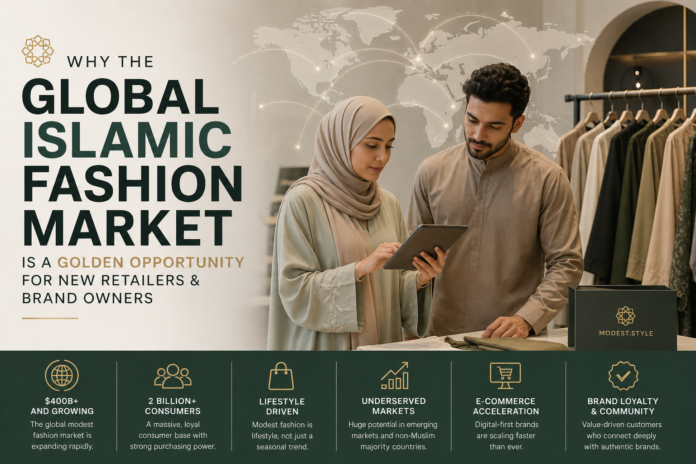
Some market opportunities come around once in a generation. The global Islamic fashion market is one of them. With hundreds of millions of Muslim consumers worldwide actively seeking stylish, high-quality modest clothing — and mainstream fashion consistently failing to serve them adequately — the gap between demand and supply represents one of the most significant commercial opportunities available to new retailers and brand owners today.
The Numbers Behind the Opportunity
The global Islamic fashion market generates hundreds of billions of dollars annually — and it continues growing faster than most mainstream fashion segments. The global Muslim population exceeds 1.8 billion people. A significant proportion of that population actively purchases modest clothing across casualwear, occasionwear, streetwear, activewear, and professional wear categories simultaneously.
These consumers are young, digitally connected, fashion-conscious, and chronically underserved by mainstream fashion brands that treat modest dressing as an afterthought rather than a genuine market priority. That underservice is precisely where commercial opportunity lives for new brand owners willing to enter with authentic commitment and genuine product quality.
Why Mainstream Fashion Keeps Failing This Market
Despite the market size, mainstream fashion brands consistently fall short in Islamic fashion. The reasons are revealing and they highlight exactly where new brands can win.
Generic modest adaptations feel inauthentic. When mainstream brands simply add sleeves to existing designs or drop hemlines without rethinking silhouette and construction, Muslim consumers recognize the lack of genuine commitment immediately and respond by supporting brands that actually understand their needs.
Regional and cultural nuance gets ignored. The global Islamic fashion market spans dozens of cultures, geographies, and interpretive traditions each with distinct preferences around silhouette, color, occasion, and coverage standards. Brands that treat all Muslim consumers identically consistently miss the mark across every market they attempt to serve.
Quality and modesty standards conflict. Many mainstream manufacturers lack the specific expertise needed to produce garments that are simultaneously modest, contemporary, and genuinely well-made. Fabric opacity testing, coverage-conscious pattern making, and modest movement testing require specialized knowledge that general apparel factories don’t automatically possess.
The Segments Driving Strongest Growth
New retailers entering this market find commercial opportunity across multiple product segments — each serving a distinct Muslim consumer need.
Modest Streetwear The fastest-growing Islamic fashion segment globally. Young Muslim consumers in Western markets — UK, USA, Europe, Australia are building personal style identities that combine contemporary streetwear aesthetics with full modest coverage. Longline hoodies, wide-leg joggers, and modest co-ord sets all perform strongly in this segment.
Modest Casualwear Daily modest dressing represents the highest volume purchase frequency in Islamic fashion. Muslim consumers buy modest casualwear constantly for work, family life, social occasions, and everyday movement. A reliable casual wear range built around genuine modest standards serves this consistent, repeatable demand effectively.
Modest Occasionwear Eid, weddings, religious celebrations, and formal social events create strong seasonal demand spikes for modest occasionwear. Brands that serve this segment well build intensely loyal customer bases because finding genuinely beautiful, appropriately modest occasion pieces remains genuinely difficult for most Muslim consumers in most markets.
Modest Activewear Muslim women who exercise, practice sports, or maintain active lifestyles need performance clothing that maintains full coverage during movement. This segment is significantly underserved representing a genuine white space opportunity for brands willing to develop technically sound modest activewear with proper coverage performance testing.
How to Enter This Market Successfully
Entering the global Islamic fashion market successfully requires more than good intentions and modest-length garments. It requires genuine commitment across product development, cultural understanding, and manufacturing expertise.
Choose one segment and serve it deeply. New brands that try to cover the full spectrum from abayas to modest activewear simultaneously typically serve no segment particularly well. Pick one consumer need, understand it thoroughly, and build products that genuinely solve it better than existing options.
Work with specialist manufacturing partners. General apparel factories without Islamic fashion expertise produce technically modest garments that still fail Muslim consumers — through inadequate fabric opacity, poor coverage during movement, or culturally inappropriate design choices. A dedicated Islamic fashionwear manufacturer brings the specific expertise this market requires.
Build with cultural authenticity. Muslim consumers recognize and reward brands that approach their market with genuine respect and cultural understanding — and they quickly identify and reject brands that treat Islamic fashion as a trend opportunity rather than a genuine service commitment.
Expand strategically as you grow. Once your initial segment gains traction, expand naturally into complementary categories. A modest streetwear brand adds tracksuits and fashion jackets. A modest casualwear brand expands into knitwear and coordinated sets. Each expansion deepens your customer relationship and increases lifetime customer value across your growing brand.
Working with a trusted fashionwear manufacturer who understands both modest fashion requirements and global production standards makes every stage of that expansion faster, more reliable, and more commercially successful.
Conclusion
The global Islamic fashion market represents a genuine golden opportunity — not because it’s fashionable to say so, but because the commercial fundamentals are undeniably strong. Massive consumer population. Strong purchasing power. Chronic underservice from mainstream fashion. Growing digital commerce infrastructure. Increasing consumer sophistication and demand for quality. New retailers and brand owners who enter this market with authentic commitment, genuine product quality, and the right manufacturing expertise don’t just find customers — they build loyal brand communities that sustain commercial success across years and decades rather than just seasonal trend cycles.
FAQs
How large is the global Islamic fashion market currently?
The global Islamic fashion market generates hundreds of billions of dollars annually and continues growing faster than most mainstream fashion segments — driven by a young, digitally connected, and chronically underserved Muslim consumer population worldwide.
Which geographic markets offer the strongest opportunity for new Islamic fashion brands?
Which geographic markets offer the strongest opportunity for new Islamic fashion brands?
Do I need specific manufacturing expertise to produce Islamic fashion collections?
Yes. Fabric opacity testing, coverage-conscious pattern making, and modest movement performance testing require specialized manufacturing knowledge that general apparel factories typically lack — making specialist modest fashion manufacturing partnerships essential for product quality and brand credibility.
Is modest streetwear a sustainable long-term market or just a passing trend?
Modest streetwear reflects a deep identity-driven consumer movement among young Muslim consumers globally — not a passing fashion trend. Its growth is sustained by cultural identity, community values, and genuine consumer demand rather than seasonal fashion