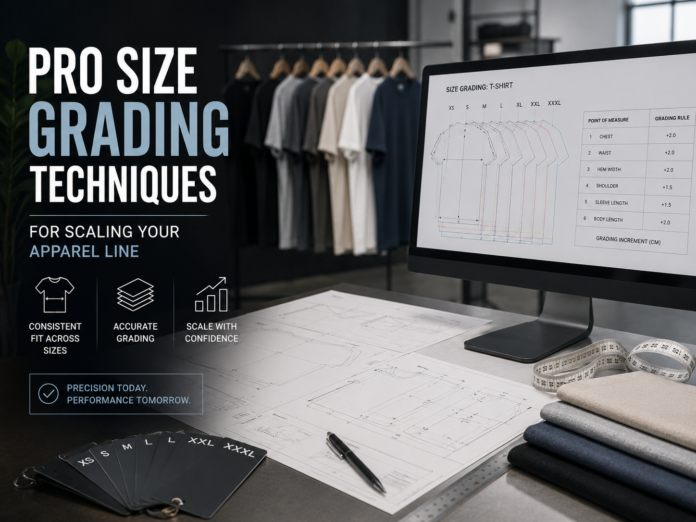
Growing your apparel business from a handful of sizes to a full size range that customers trust is a big step — and size grading techniques are the bridge that makes it possible. Whether you’re launching your first collection or scaling into new markets, consistent grading ensures your products feel right on real people, not just on paper.
In this post, we’ll walk through practical, easy‑to‑understand size grading techniques for apparel brands — in a way that helps you scale wisely, reduce fit returns, and build customer confidence.
What Is Size Grading and Why It Matters
Size grading is the process of transforming a perfected pattern in one size into multiple sizes while keeping the garment’s design and fit consistent across the range. It’s not just making things bigger or smaller — it’s about proportion, balance, and understanding how the human body changes from size to size.
For brands that plan to scale their lines, mastering grading early on avoids common pitfalls like inconsistent fit, distorted silhouettes, and customer dissatisfaction — all of which can lead to returns and lost sales.
Top Size Grading Techniques for Apparel Brands
Here are the most effective techniques businesses use to develop dependable size ranges:
1. Start with a Perfect Base Pattern
The foundation of good grading is a strong base pattern. Before you scale up or down:
- Ensure your base size fits exactly how you want the garment to look.
- Confirm ease, silhouette shape, and stitch placement.
Your base pattern is essentially the “template” from which every other size will be derived. A bad base makes all size grading harder.
To turn that pattern into production‑ready specs, use size grading and development services.
2. Apply Consistent Grading Rules
Grading rules are the increment values that determine how much each measurement increases or decreases between sizes. For example, bust width might increase by a certain amount per size, while sleeve length changes at a different rate.
Good grading keeps the garment balanced instead of just uniformly scaled — so it looks and wears well in every size.
3. Use Digital Tools for Precision Grading
Today, many brands and manufacturers rely on CAD (Computer‑Aided Design) grading tools. These tools allow you to:
- Scale patterns quickly and accurately
- Store grading rules for future collections
- Compare and adjust sizes digitally before making samples
While manual grading still works for simple styles, digital methods improve efficiency and repeatability — especially for larger size spreads. When you work with a production partner, they often have access to these grading tools as part of their production capabilities.
4. Test Graded Sizes Through Sampling
Once grading rules are applied, sampling across the range is critical. You want to:
- Fit each size on a model or dress form
- Assess how design lines fall on different body types
- Note any distortions or imbalance
Sampling helps you catch issues early — before running full production.
5. Adjust for Fabric Behavior
Different fabrics behave differently. Stretch knits might require larger grading increments than woven fabrics, and structured garments may need subtle adjustments to maintain silhouette. Good graders consider:
- Fabric stretch and recovery
- Ease and movement requirements
- Style intent (relaxed vs fitted look)
This fabric‑aware grading reduces year‑round fit inconsistencies
Where Size Grading Fits in Your Workflow
Effective size grading is part of a bigger process that connects concept to production. A good workflow looks like:
- Design and sketch your style
- Create the base pattern
- Develop tech specs for production — e.g., tech pack development
- Apply grading rules to build the full size set
- Sample and refine fits before bulk production
- Produce at scale with confidence
By following this system, your grading supports both quality and scalability.
Get Professional Support for Scalable Sizing
If you’re exploring ways to improve sizing and fit for your apparel line but want expert support to make it happen, we’re here to help you every step of the way. Whether you’re still refining your grading techniques or ready to kick off full production, let’s make your vision a reality — Get Quote Now to start planning your project or Contact Us Now if you have questions and want personalized guidance.
Conclusion
Size grading is a core technique that separates amateur apparel efforts from professionally scaled fashion lines. By using consistent grading rules, digital tools, and thoughtful sampling, you can deliver dependable fit across every size you offer.
Investing time in grading early translates into happier customers, fewer returns, and a stronger reputation for quality — helping your brand grow confidently.
FAQs
What’s the difference between size grading and pattern making?
Pattern making creates the original design size, while grading spreads that design into a size range that fits different body types.
How many sizes should a brand grade for?
That depends on your market. Many brands start with XS–XL and expand based on customer feedback and sales data.
Can small brands handle grading themselves?
Yes, especially with digital tools and skilled graders, but many choose to outsource to production partners to ensure technical precision and consistency.