Recycled cashmere jersey fabric: Sustainable luxury Metaphorically speaking, this recycled cashmere is a blossom from an incredibly dedicated superfood garden.
Recycled Cashmere Jersey Fabric is revolutionizing fabric Trends in Modern Economy. It mixes timeless softness with the kind of innovation that one can feel good about. As sustainability has emerged as a priority, designers and manufacturers are looking to recycled materials. Thus, repurposed cashmere jersey fabric is a top eco-friendly choice. It provides you the warmth, stretch, breathability and elegance all in one with its versatile knit texture.
Also, this material contributes to sustainability while maintaining its all-day comfort. Recycled cashmere jersey – as an alternative since the resources are saved and the fabric waste minimized, recycled cashmere jersey has emerged as the favorite in ethical fashion. Further, customers are increasingly looking for transparency and sustainable sourcing. So brands are answering with luxury/responsible hybrids in the form of fabrics.
In this ultimate guide, you will discover the in’s and out about a recycled cashmere jersey fabric: from its make-up and how it’s made to what makes it so good, where it can be used and how to care for it plus its market value.
What Is Recycled Cashmere Jersey Fabric?
Recycled heather cashmere jersey is a heather knitted material constructed of up-cycled cashmere fibers. These fibers are salvaged from post-consumer clothing and/or pre-consumer manufacturing waste. Rather than tossed away, the fibers are meticulously sorted, cleaned and spun back into yarn. Next, a jersey knit technique in a soft, stretchy fabric.
This knit differs from woven fabrics in that it is made up of interlocking loops instead of woven strands. As a result, it provides natural stretch and fluid drape. As cashmere hair is very fine with a soft texture, the jersey is gentle to the skin. And the upcycle version still feels a lot like luxury.
“One digs out the undercoat of goats for virgin cashmere; those animals are often brutalized,” she says. But recycled cashmere would decrease the need for new raw material production. So, it reduces the environmental impact drastically.
The Sustainable Production Process
Collection and Sorting
First, the operation collects cast-off cashmere garments and factory refuse. They’re organized by color, and quality of fiber. This process guarantees uniformity and reduces the amount of dying required. In addition water and chemical consumption is minimized.
Fiber Regeneration
Then, the materials are mechanically broken down into fibers. In the course of doing so, fibers are gently opened and treated. Due to its highly demanding manipulations of handling, the latest technology is commonly employed in machinery. The fibers are then cleaned to remove impurities.
Spinning and Blending
Fibers are respun into yarn after regeneration. In a few places, however, a small amount of recycled wool or natural fibers were mixed in for added strength. Therefore, durability is enhanced with softness preserved.
Jersey Knitting
Finally, the yarn is knitted as jersey with circular knitting machines. Constructed from knit fabric for flexibility and breathablity. If formed, finishing techniques are added for a finish and stability.
This process is the key to producing a high quality sustainable fabric.
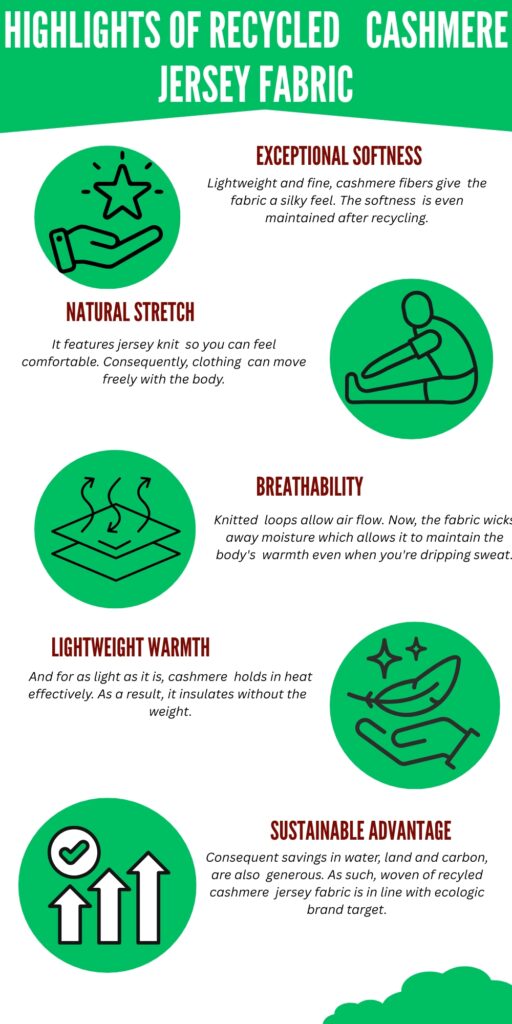
Highlights of Recycled Cashmere Jersey Fabric
Reclaimed cashmere jersey provides performance in a luxurious way. As such, it’s appealing to designers and the conscious consumer alike.
Exceptional Softness
Lightweight and fine, cashmere fibers give the fabric a silky feel. The softness is even maintained after recycling.
Natural Stretch
It features jersey knit so you can feel comfortable. Consequently, clothing can move freely with the body.
Breathability
Knitted loops allow air flow. Now, the fabric wicks away moisture which allows it to maintain the body’s warmth even when you’re dripping sweat.
Lightweight Warmth
And for as light as it is, cashmere holds in heat effectively. As a result, it insulates without the weight.
Sustainable Advantage
Consequent savings in water, land and carbon, are also generous. As such, woven of recyled cashmere jersey fabric is in line with ecologic brand target.
Environmental Benefits
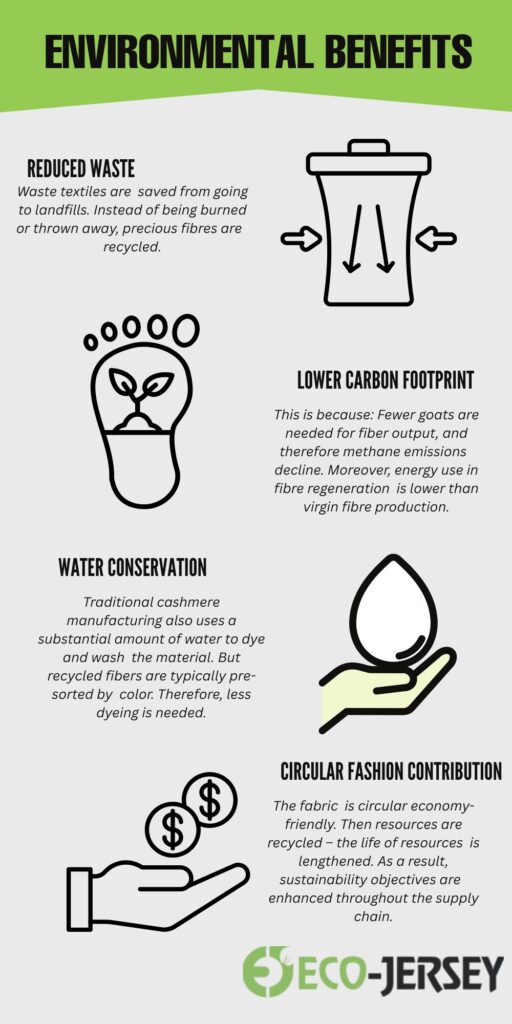
Sustainability is not a fad — it’s the way forward. 75% recycled cashmere jersey fabric help lessen environmental impact.
Reduced Waste
Waste textiles are saved from going to landfills. Instead of being burned or thrown away, precious fibres are recycled.
Lower Carbon Footprint
This is because: Fewer goats are needed for fiber output, and therefore methane emissions decline. Moreover, energy use in fibre regeneration is lower than virgin fibre production.
Water Conservation
Traditional cashmere manufacturing also uses a substantial amount of water to dye and wash the material. But recycled fibers are typically pre-sorted by color. Therefore, less dyeing is needed.
Circular Fashion Contribution
The fabric is circular economy-friendly. Then resources are recycled – the life of resources is lengthened. As a result, sustainability objectives are enhanced throughout the supply chain.
Applications in Fashion and Apparel
Most up-to-date styles are constructed using recycled cashmere jersey fabric. Because it’s so versatile, you can use it across categories.
Sweaters and Knitwear
It is often used for soft pullovers and cardigans. As the fabric hangs so nicely, it tends to produce a lovely shape.
T-Shirts and Tops
Its light weight jersey construction also makes it perfect for chillin’ or a laid back ride to the pub. The outcome is sustainable luxury basics.
Loungewear
It’s all about comfort with loungewear collections. That’s why one of Yestadt Millinery’s top sellers is recycled cashmere jersey in the softest shades for slouchy head gear.
Scarves and Accessories
The soft feel is good for sensitive skin around body surface. The accessories as a result are soft and cosy.
Active-Inspired Fashion
The jersey knit stretch is super soft and light, yet can be used for sporty athleisure looks.
Why Designers Love Recycled Cashmere Jersey
Designers are hungry for fabrics that carry quality, story and responsibility. And in recycled cashmere jersey material, you get all serviceable of the above.
Firstly, it offers premium texture. Second, it links to sustainability marketing. Third, customers consider recycled materials to be good and future-oriented.
In addition, collections are advanced by responsible sourcing. This is where recycled cashmere becomes a competitive advantage, as sustainability certifications are increasingly requested.
Durability and Longevity
A popular question is whether cashmere that has been recycled is strong. Although it can be a bit shorter than virgin fibre, the strength is maintained by proper spinning and blending.
Furthermore, garments are frequently reinforced at point of stresses. Therefore, high-performance wear is achieved. When taken care of, recycled cashmere jersey styles can survive for many years.
Care Instructions
He cared for his recycled cashmere jersey fabric, which saved its life.
Washing Care: Hand wash in cold water with light detergent.
Or gentle machine was can be used.
Do not wring to maintain fiber integrity.
Lay flat to dry.
Store folded instead of hanging.
Heat can destroy fibers so tumble drying is not advised. So soft through being handled gently.
Market Demand and Growth
The world is clamouring for sustainable textiles like never before. As a result, it has become popular with eco-friendly labels as recycled cashmere jersey fabric.
Expensive houses are incorporating recycled fibers into their collections. At the same time, new ethical labels are making entire lines around upcycled materials. Market share grows as knowledge spreads.
Also, in various countries, strict sustainability regulations are compelling textile production using recycled material. Hence producers are busy investing in new recycling technologies.
Comparison : Virgin vs Recycled Cashmere Jersey
FeatureVirgin Cashmere JerseyRecycled Cashmere JerseySoftnessIncredibly SoftVery SoftEnvironmental ImpactSubstantialDrastic SavingsCostHigherCan Be More AffordableResource UseNot Re-usedReused ResourceLevel of SustainableLowerHigh Eco-Gains
While virgin cashmere cannot be beaten in terms of fibre length, recycled cashmere jersey fabric is equally comfortable and an ethical alternative.
Challenges in Production
Even though it provides great benefits, there are some limitations.
Fiber shortening during mechanical recycling
Limited color consistency
Slightly reduced tensile strength
Yet new technology keeps on bringing quality up. As a result, recycled cashmere jersey fabric is getting increasingly sophisticated every year.
The Recycled Cashmere Jersey Fabric of the Future
Innovation is fundamentally changing the landscape for sustainable textiles. Chemical recycling processes are currently being developed in order to protect the fiber length. In addition to that, mixed yarn technology increases longevity.
As the circle of fashion widens, recycled cashmere jersey likely to go mainstream. Transparency and environmental impact are the most relevant to consumers. Therefore Brands which take a recycled material approach will be ahead of the curve.
And governments and green groups are advocating textile recycling programmes. Thus, widespread adoption within the automotive industry should continue to increase.
Why Recycled Cashmere Jersey Fabric?
To opt for recycled cashmere jersey fabric means choosing responsible luxury. It provides softness, beauty and warmth without the environmental damage. It also helps to foster circular fashion systems.
With sustainability now also a requirement (not just an option), progressive brands are moving in the direction of recycled materials. Recycled cashmere jersey material is proof that comfort and conscience can coexist.
In summary, ethical luxury textiles don’t get any better than this. It affords the ulterior look and feel of premium Drummond wool with a versatile design and tangible environmental benefits. So whether you’re a designer, maker or planet friendly shopper, recycled cashmere jersey fabric is good on so many levels!
FAQs
What is recycled cashmere jersey fabric?
Recycled cashmere jersey fabric is a knitted textile made from reclaimed cashmere fibers. Old garments and production waste are processed, respun into yarn, and knitted into soft jersey fabric.
Is recycled cashmere as soft as virgin cashmere?
Yes, recycled cashmere jersey remains very soft. Although fiber length may be slightly shorter, advanced processing ensures smoothness and comfort are preserved.
How sustainable is recycled cashmere jersey fabric?
It significantly reduces textile waste, water usage, and carbon emissions. Because existing fibers are reused, fewer natural resources are consumed.