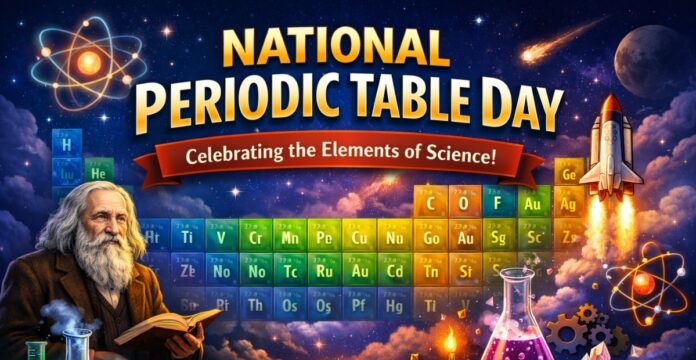
National Periodic Table Day recognizes one of the most important tools in science, the periodic table of elements. This holiday is about chemistry, discovery and the scientists that have helped us figure out the world at its tiniest scale.
National Periodic Table Day is hosted on February 7 of every year. This is the day when students, teachers and enthusiasts of science worldwide stop to study the elements that form everything around us.
What Is National Periodic Table Day?
National Periodic Table Day commemorates the creation of the periodic table and its significance. All known chemical elements are organized in a systematically logical way by the periodic table. It’s a tool that helps scientists understand how elements behave and interact.
This date was also chosen to celebrate Dmitri Mendeleev, the scientist who made the first functional periodic table in 1869. His work changed science forever.
Why the Periodic Table Matters
It’s more than a classroom chart, the periodic table. It is a major part of life.
Here’s why it matters:
It describes how substances behave in relation to each other
It aids researchers in finding new materials
PUBLISHED This supports medicine, technology and energy research.
It simplifies chemistry to make learning and understanding fun
The periodic table allows scientists to predict how elements will behave before they even have a chance to test them.
The Periodic Table – a short history
It was a long journey for the periodic table. Scientists initially had difficulty even arranging elements in order. And then Dmitri Mendeleev started arranging elements by atomic weight and found that they were cycling.
Crucially, he left space for as yet undiscovered ingredients. Subsequent scientists discovered those elements, luckily confirming his ideas were right. Today, all of the elements listed in the periodic table are arranged according to atomic number, which makes it even easier and more accurate.
How National Periodic Table Day Is Observed
People observe National Periodic Table Day in entertaining and educational ways.
Common activities include:
Classroom experiments and quizzes
Science fairs and exhibitions
Watching chemistry videos or documentaries
Creating colorful periodic table posters
Outlining element traits on social media
Such activities encourage students to like science, and develop their curiosity about it.
Interesting things about the Periodic Table
The periodic table is always surprising.
There are 118 known elements
Hydrogen is the lightest element
Oganesson is one of the heaviest
Some components are made in nature and some are synthesized by man
Gold and silver clothed man for millennia.
These are the kinds of facts that make studying chemistry interesting and more relevant.
Why This Matters for Students
National Periodic Table Day urges students to dive into science without fear. It’s a reminder that chemistry is not all about formulas. Instead, it’s about the nature of the world.
This day triggers future scientists, teachers and researchers. When students learn about elements, they lay knowledgable groundwork for careers in science.
How to Celebrate National Periodic Table Day
It’s not necessary to have a lab when you celebrate this day. Simple ideas work well.
You can:
Learn one new item/element and how to use it.
A child can study the periodic table with your help
Watch a science documentary
Share educational content online
If possible, go to a science museum
It all adds up; every little bit helps to disseminate science awareness.
Conclusion
On National Periodic Table Day, we are reminded that science often determines our lives in fascinating fashions. The periodic table unites education, revelation and innovation.” It helps us to relate to matter, and it inspires curiosity about the universe. Learn About: International Days And National Black HIV/AIDS Awareness Day