Many people still use the same logic they apply to choosing regular long pants or jeans when picking motorcycle riding pants, which is completely incorrect. The core purpose of riding pants is to protect key body parts such as the knees and hips. Therefore, the central requirement for a proper fit is to keep protective components in the correct position throughout the entire ride. This is exactly why we developed this dedicated purchasing guide: to simplify the complicated process of choosing the right riding pants for everyone. If the pants are too loose, the protective pads will slide right off the knees in the event of a crash and fail to serve their purpose at all.
Motorcycle Pants Fit Guide: Measure Your Body First
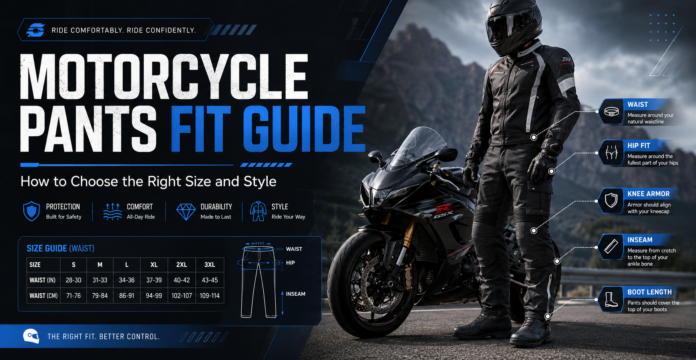
The first and most critical step when choosing motorcycle pants fit guide is to accurately measure your own body size first. Then measure the circumference of the widest part of your hips, and the inseam length from your crotch to your ankle, keeping the tape straight at all times. Record all these measurements and check them against the brand’s size chart to select the correct size. For example, Eco Jersey clearly requires customers to choose their size based on their personal body measurements, and separately lists the specific dimension data for each size of its bottoms. Riders comparing protective options can also look at these motorbike pants for men to understand how a tailored riding design may combine stretch,
Check the Waist Without Making It Too Tight
Waist circumference is the core dimension in the fitting guide for selecting motorcycle pants fit guide. Its core function is to secure the pants firmly in place, preventing the clothing from shifting during rides and compromising safety. For the waistband of a qualified pair of riding motorcycle pants fit guide, it should feel snug after being fastened, but not press tightly against the abdomen—you can breathe normally, and you will not feel strong restriction when leaning forward or sitting in a riding position. If the waistband shifts frequently while you walk, it is too loose;
Make Sure Knee and Hip Armor Sits Correctly
In this motorcycle pants fit guide purchasing guide written by our team, the core prerequisite for protective gear to function properly is that it stays in the correct position. You can test the fit of the pants by standing up and mimicking the knee-bending posture used when riding: the knee pads must fit naturally over the patella and must not shift;. For example, the women’s bottoms from Eco Jersey incorporate both waist circumference and hip circumference measurements, which can balance both wear comfort and the accuracy of protective gear positioning. Riders comparing female-specific options can view ladies motorbike pants as an example of protective motorcycle pants fit guide made with a more fitted riding shape.
Choose the Correct Leg Length
When choosing motorcycle riding pants, leg length is a core measurement that is most easily overlooked in fit guides, yet it is a key point that all practical buying guides must clarify. Many people think that motorcycle pants fit guide that look too long when a person is standing up do not fit properly. In fact, this extra length is intentionally designed to accommodate the bent knees of a rider. Conversely, pants that have a perfect length when standing will ride up far too much above the top of boots once the rider sits in riding position. If the pants are overly long, they will bunch and wrinkle around the ankles, knees, or inside the boots.
Pick a Style That Matches Your Type of Riding
When choosing motorcycle riding pants, you must not only look at size. The core requirement is that the pants must match your riding scenario and style to be suitable: for daily urban commuting, choose motorcycle jeans that balance everyday wearability and basic protection;; for track and sport riding, choose tight-fitting styles that reduce excess fabric. Motorcycle jeans are especially suitable for people who do not want to wear overly bulky, protective gear after finishing their ride. For example, these motorbike jeans show how a denim-style riding product can combine a casual appearance with motorcycle-focused construction.
Test Movement Before Deciding on a Size
In the motorcycle pants fit guide proposed by the authors of this paper, the core requirement is that a dynamic testing phase must be included. The core logic behind this is that riding motorcycle pants fit guide appear to fit well when a person is standing still will feel completely different during actual riding. This paper will present a full set of practical test movements, the key body areas that need focused monitoring, and qualifying fit standards. It will then add detailed rules that affect fit. Finally, it will circle back to the core claim: a good guide always focuses on the real-world performance of dynamic riding. Sizes must never be chosen only for a slim, stylish look.
Use These Quick Fit Checks Before Buying
This fitting guide for motorcycle pants fit guide includes simple inspection methods. Before purchasing, you can check the fit both while standing and in a seated riding position. You only need to leave a small amount of extra space to wear a thermal base layer underneath; do not leave excessive loose fabric. The final pair you choose should allow you to move freely, and keep its protective areas from shifting out of place.
- Waist: Secure around your body without painful pressure.
- Hips: Comfortable enough for sitting and bending.
- Knees: Armor stays centered when your legs are bent.
- Thighs: Fabric allows movement without excessive loose material.
- Inseam: Length works properly in the riding position.
- Boot area: Pants meet your riding boots without awkward bunching.
- Movement: You can sit, bend, walk, and raise your legs comfortably.
- Armor: Protective inserts remain in the intended position.
These one-line checks can save you from choosing pants based on appearance alone and make the motorcycle pants fit guide useful even when you are trying several products quickly.
Think About Weather, Layers, and Comfort
To choose motorcycle riding pants that fit properly, you must first include weather and use scenario as core preconditions for your selection: in cold weather, reserve enough space to fit thermal base layers, to avoid tightness around the knees and hips; in hot weather, prioritize breathable styles with ventilation designs. For motorcycle pants fit guide that come with detachable waterproof or thermal liners, you must test the fit and space both when the liner is installed and when it is removed. For riders taking long-distance motorcycle pants fit guide, do not only evaluate how the pants feel during a short try-on.
Avoid Common Motorcycle Pants Sizing Mistakes
When many motorcyclists choose riding pants, the first common pitfall they easily fall into is directly applying the size of their everyday jeans to motorcycle pants fit guide. The correct approach is to carefully check the official size chart of the brand every time they make a purchase. After all, motorcycle pants fit guide from different brands, with different styles, cuts, and fabrics all have different fit standards. In addition, there are three other common misconceptions to avoid: buying pants that are too tight just to look good when standing up, neglecting the positioning of protective gear,
How tight should motorcycle pants be?
They should feel secure without stopping normal movement. Your waist should remain comfortable, and the knee and hip protection should stay in the correct place when you bend your legs.
Should I buy motorcycle pants one size larger?
Not automatically. Start with your real waist, hip, and inseam measurements and compare them with the brand’s size chart. Choose extra room only when you need it for layers or the manufacturer’s fit advice recommends it.
Can motorcycle pants be worn over normal clothes?
Some overpants are designed for this purpose, while closer-fitting jeans and riding pants are usually worn as the main trousers. Always check the intended design before selecting your size.
What style is best for everyday riding?
Motorcycle jeans can work well for casual city riding, textile pants can suit touring and changing weather, and ventilated designs can be useful in warmer conditions.