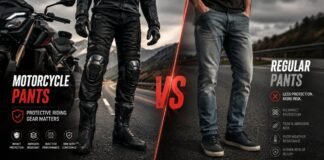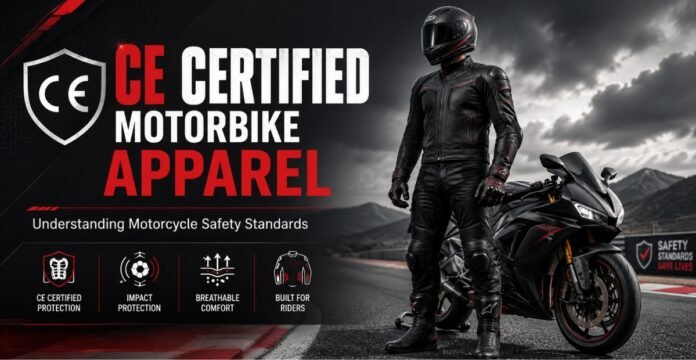
CE certified motorbike apparel denotes riding attire that provides protection and that has undergone testing and certification against the relevant European PPE standards. A CE marking signals that the apparel has met a minimum standard; however, motorbike apparel certified by CE should be associated with a safety standard and protection class. Riders should not rely solely on the CE marking. Instead, apparel should include labeling and protection class information. Apparel that is certified by CE provides protection class and manufacturer information, which assists people in comparing and determining the intended protection of the apparel.
Why CE Certified Motorbike Apparel Matters
A motorcycle rider can slide, hit the road, or strike another object during a crash. CE certified motorbike apparel is designed with these risks in mind. Protective garments may be tested for abrasion resistance, seam strength, tear strength, fit, and the correct placement of impact protectors. This is why CE certified motorbike apparel should not be treated as ordinary clothing with padding added. A properly designed product uses protective materials, strong construction, and suitable armor together. Riders choosing complete motorbike apparel should compare the certification details with the type of riding they plan to do because city commuting, touring, and faster road riding can place different demands on protective clothing.
EN 17092 and Motorcycle Protective Clothing
The EN 17092 series is a crucial standard for European motorcycle protective clothing. It consists of jackets, pants, and one or two piece suits and has parts that define classes such as AAA, AA, A, B and C. CE certified motorcycle apparel tested to EN 17092 is not evaluated by the thickness of the fabric alone. The standard considers various performance aspects that indicate whether the garment will hold together to protect key areas during a fall. Therefore, CE certified motorcycle apparel can be made of leather, modern textiles, reinforced fabrics, stretch fabrics and combinations of these.
Understanding AAA, AA, A, B, and C Classes
The class shown on CE certified motorbike apparel tells the rider about the garment’s intended protection level under EN 17092. AAA is the highest protective class in this series and is normally used for garments designed for more demanding riding conditions. AA offers a strong balance between protection, flexibility, and everyday comfort. A provides a lower level of protection but can allow lighter and more flexible clothing. Class B garments provide abrasion protection but do not include the same required impact protectors as the higher classes. Riders looking at motorcycle suits should always check the stated class because two suits that look similar may offer different tested protection levels.
How Motorcycle Armor Standards Work
CE certified motorcycle apparel contains armor that may be removable or built-in and located at various positions on the garment (e.g., shoulders, elbows, knees, hips, chest, and/or back). Motorcycle armor is typically evaluated for compliance with the EN 1621 series of standards. Armor may be rated, as well as the outer garment in which the armor is located. For example, a jacket may have tested shoulder and elbow armor, and the outer jacket may have a separate EN 17092 evaluation. Thus, there are two ways to assess CE certified motorcycle apparel.
Important Checks Before Buying Protective Gear
When comparing CE certified motorbike apparel, riders should check several details before choosing a product.
- Check the CE marking and full safety standard shown on the label.
- Look for the EN 17092 class such as AAA, AA, or A.
- Check which shoulder, elbow, knee, hip, chest, or back protectors are included.
- Read the EN 1621 markings shown on removable armor where applicable.
- Make sure the garment keeps armor in the correct position.
- Inspect seams, zippers, fasteners, and high-risk abrasion areas.
- Read and follow the manufacturer’s washing and care instructions.
- Replace damaged CE certified motorbike apparel after a serious crash or when important protective parts become badly worn.
Abrasion Resistance and Strong Construction
Abrasion resistance is one of the most important jobs of CE certified motorbike apparel. During a road slide, the outer material can rub against a rough surface with significant force. Protective clothing therefore needs strong material, secure seams, and construction that reduces the risk of the garment opening or wearing through too quickly. CE certified motorbike apparel may use stronger materials around higher-risk areas such as the knees, hips, seat, shoulders, and elbows. Riders comparing motorcycle pants should look beyond appearance and comfort and check whether the stated certification matches their expected riding conditions. Protective trousers should also fit securely enough to keep knee and hip protection in the intended position.
Fit Can Change How Protection Works
Fit can greatly change protection. Even the best CE certified motorcycle apparel cannot serve its purpose without a good fit. For example, if armor on apparel has shifted away from the elbow, that apparel provides no protection for the elbow in the event of an impact. Also, clothing that is very loose can shift and change its position during a slide. However, an extremely tight fit can limit a rider’s comfort and concentration. Apparel of this type should allow riders to move naturally. CE certified motorcycle apparel should also allow riders to easily reach the handlebars.
CE Marking Does Not Mean “Crash Proof”
Certain items of CE certified motorcycle clothing can help lower some of the dangers of motorcycle riding, but they cannot guarantee the rider of a motorcycle stays completely safe from injury. Certification of a product means that the product has been evaluated against set standards, but certification cannot guarantee that a product will result in a safe conclusion to every incident. The speed of a crash, the surface of the road, the various impacts that could occur, other vehicles, roadside or other obstacles, and even the rider’s position or posture can all influence the outcome of an incident.
How to Read the Label on CE Certified Motorbike Apparel
A CE certified motorbike apparel label should have more than a CE symbol. CE certified motorbike apparel labels should contain the product identification, CE mark, European standard, garment class, size, and manufacturer instructions. Along with the size and manufacturer instructions, garments labeled EN 17092 should have a class marking to show which protective category the garment belongs. CE certified motorbike apparel may also have additional labels for armor incorporated in the apparel. Since impact protectors are evaluated separately, armor also undergoes its own evaluation.
Conclusion
Since CE certified motorbike apparel offers an alternative, consumer purchasing decisions based on looks, price, or advertising ploys are no longer as necessary. A more comprehensive approach looks at the CE marking alongside the complete EN standard and the product’s garment class, the armor rating, the product’s construction, and the product’s fit. Motorbike apparel rated in classes AAA, AA, and A provides a wider array of protective clothing options for the consumer. Apparel rated in classes B and C provide a narrower scope of protective clothing options, and consumers should understand these limitations.
FAQs
What does CE mean on motorbike apparel?
CE marking shows that the product is intended to meet applicable European safety requirements. Riders should also check the specific standard and protection class because the CE mark alone does not explain the garment’s full protection level.
Is AAA better than AA motorcycle clothing?
AAA is the highest protection class within the EN 17092 garment classification system. AA offers a lower level than AAA but can provide a practical balance between protection, comfort, weight, and movement for many road riders.
What is EN 17092 for motorcycle clothing?
EN 17092 is a European standard series for protective garments used by motorcycle riders. It includes testing and requirements for classes AAA, AA, A, B, and C.