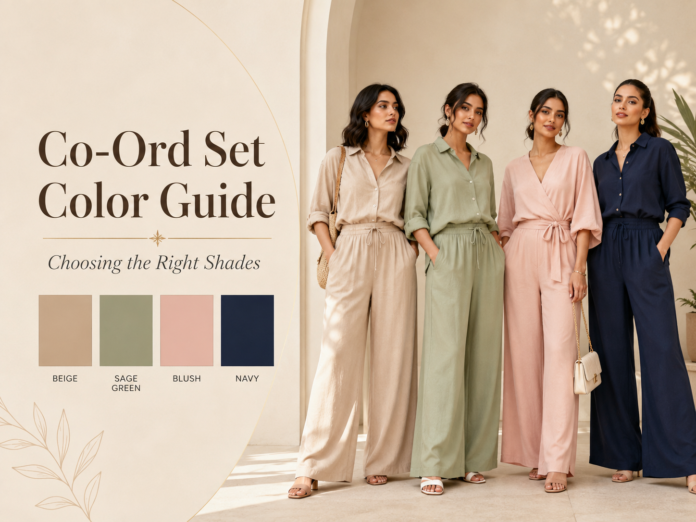
Color is one of the most powerful decisions you make when choosing a co-ord set. Get it right and the set becomes one of those pieces you reach for constantly — it photographs well, it suits you, and it works across multiple occasions with minimal effort. Get it wrong and even a beautifully made co-ord in a perfect silhouette ends up sitting unworn because something about the color just doesn’t click.
This co ord set color guide breaks down everything you need to know about choosing shades that genuinely work for your skin tone, your wardrobe, your lifestyle, and the specific occasions you’re dressing for. Whether you’re buying your first co-ord set or expanding an existing collection, color clarity makes every decision easier and every purchase more satisfying.
Why Color Choice Matters More in Co-Ord Sets
Color choice matters in all clothing — but it carries extra significance in co-ord sets for a specific reason. When you’re wearing a matching set, the color covers a larger continuous surface area than any individual garment would. It’s the dominant visual element of the entire outfit — not just an accent or a detail, but the primary statement the outfit makes.
This means a color that slightly doesn’t work for you in an individual piece becomes more apparent in a co-ord. Conversely, a color that genuinely suits you becomes more powerful and impactful in a co-ord than it would be in a single garment. Understanding this amplification effect is the foundation of any useful co ord set color guide — because it explains why getting color right in a co-ord is worth more thought than it might be for individual pieces.
Why It Matters — Key Benefits
Having a clear approach to co-ord set color selection delivers real, lasting benefits across your wardrobe. Here’s why it matters:
- More consistent wearing — Co-ords in colors that genuinely suit you get worn regularly rather than sitting unworn because something feels off every time you put them on.
- Better complexion enhancement — Colors chosen to complement your skin tone make you look healthier, more vibrant, and more rested naturally.
- Stronger wardrobe integration — Colors chosen with your existing wardrobe in mind work with other pieces you already own rather than sitting as isolated, hard-to-coordinate items.
- More confident outfit decisions — Understanding which colors work for you removes uncertainty from getting dressed and replaces it with genuine style confidence.
- Better value from every purchase — Co-ords in the right colors get more wears and stay relevant in your wardrobe longer than those bought without color consideration.
- Stronger visual impact — A well-chosen color creates a more striking, memorable impression than a color chosen purely by chance or trend.
- Easier styling versatility — Individual co-ord pieces in well-chosen colors work as separates with more of your existing wardrobe items — maximizing the value of every purchase.
Understanding Your Skin Tone First
The most practically useful starting point in any co ord set color guide is understanding your own skin tone — because color looks genuinely different against different skin tones, and understanding this relationship helps you build a consistent framework for confident color choices.
Skin tones are broadly categorized as warm, cool, or neutral — based on the underlying undertone of the skin rather than its surface depth or darkness. Warm undertones have a golden, yellow, or olive quality. Cool undertones have a pink, red, or blue quality. Neutral undertones fall somewhere between the two without strongly expressing either.
A quick way to identify your undertone is to look at the veins on the inside of your wrist in natural light. Veins that appear greenish suggest warm undertones. Veins that appear bluish or purplish suggest cool undertones. Veins that appear both or neither suggest neutral undertones.
Understanding your undertone gives you a reliable filter for co-ord color selection — not a rigid rule that eliminates every color outside a specific range, but a useful starting framework that helps you identify which colors are likely to enhance your appearance and which might work against it.
Colors That Work for Warm Skin Tones
If you have warm undertones, the color families that tend to complement your complexion most naturally are equally warm — earth tones, rich neutrals, and warm saturated colors that share the golden or olive quality of your skin’s undertone.
Terracotta is one of the strongest co-ord colors for warm skin tones — the warm, reddish-brown quality of terracotta creates a harmonious resonance with golden and olive complexions that looks genuinely vibrant and healthy. Terracotta co-ords have become one of the most popular color choices in contemporary fashion precisely because of how broadly flattering they are across warm skin tone ranges.
Camel and warm tan shades work beautifully for warm skin tones — creating a tonal harmony that feels luxurious and sophisticated without requiring complex color coordination. A camel co-ord on a warm skin tone creates a cohesive, elegant appearance that photographs particularly well in natural light.
Olive green is another strong choice — its warm, muted quality complements golden and olive complexions harmoniously. Rust, burnt orange, and warm mustard yellow all share this warm color family quality that works naturally with warm undertones. Rich warm browns and deep chocolate tones also complement warm skin tones with a grounded, luxurious quality that feels both sophisticated and natural.
Our women’s co-ord set range includes options across this full warm color palette — from terracotta and rust to camel and olive — for buyers who want colors that genuinely enhance their complexion.
Colors That Work for Cool Skin Tones
Cool skin tones — with their pink, red, or blue undertones — are typically complemented by colors that share a cool quality, creating a harmonious relationship between the clothing color and the skin’s natural undertone.
Navy is one of the most universally flattering colors for cool skin tones — its deep, cool blue quality creates a clear, vibrant contrast with fair or pink-undertoned complexions that looks sharp and polished. Navy co-ords are also exceptionally versatile from a wardrobe integration perspective — they work with an enormous range of other colors and styles. A navy co-ord is one of the safest and most consistently satisfying color choices for cool skin tones across virtually any occasion.
Burgundy and wine tones are equally strong for cool complexions — their deep, cool red quality creates a rich contrast that enhances cool skin tones beautifully, particularly in autumn and winter styling contexts. A burgundy co-ord on a cool skin tone creates a genuinely striking appearance that photographs with exceptional depth and richness.
Emerald green, forest green, and cool-toned teal all complement cool complexions naturally — the blue undertones in these colors resonate harmoniously with the cool quality of the skin. Lavender, dusty rose, and soft lilac all bring a softer, more delicate color option for cool skin tones that works beautifully in spring and warm weather co-ord styling. Charcoal and cool grey co-ords create a sophisticated, monochromatic effect that works particularly well with fair, pink-undertoned complexions.
Colors That Work for Neutral Skin Tones
Neutral skin tones have the greatest color flexibility of any undertone category — most color families work reasonably well without creating the undertone clash that can make certain colors look unflattering against strongly warm or cool complexions.
This flexibility is genuinely a styling advantage — neutral skin tones can experiment across the full spectrum of co-ord colors with more confidence than either warm or cool skin tones. Both warm earth tones and cool jewel tones tend to work, as do most neutral shades and classic basics.
The most practically useful approach for neutral skin tones is to choose co-ord colors based primarily on wardrobe integration and personal preference rather than complexion compatibility — since most colors are relatively compatible. Starting with versatile neutrals like white, cream, stone, or soft grey creates a strong foundation. Adding co-ords in both warm and cool accent colors expands the range while maintaining the flexibility that neutral undertones naturally enjoy.
The Versatility of Neutral Co-Ord Colors
No co ord set color guide is complete without a dedicated section on neutral co-ord colors — because neutrals are the foundation of the most consistently wearable and versatile co-ord wardrobes regardless of skin tone or personal color preference.
White co-ord sets are among the most striking and visually impactful options available — clean, fresh, and naturally attention-drawing in a way that few other colors match. White works across virtually all skin tones, creating a bright, open appearance that photographs beautifully in natural light. White co-ords are particularly strong in spring and summer styling contexts and for occasion-appropriate casual and smart casual wear.
Cream and ivory co-ords bring a softer, warmer quality than pure white — slightly more forgiving across different skin tones and slightly more versatile across different occasion contexts. A cream linen co-ord is one of the most effortlessly elegant warm weather outfit choices available.
Black co-ord sets offer the ultimate in simplicity and styling confidence. Black is universally flattering, infinitely versatile, and creates a strong, deliberate visual statement in any context. A well-made black co-ord is a wardrobe anchor that works across casual, smart casual, and dressed-up occasions with simple styling adjustments.
Stone, sand, and greige — the muted, warm neutrals that sit between white and tan — have become increasingly popular in contemporary fashion and work beautifully as co-ord colors across all skin tones. These colors feel sophisticated and considered without the visual boldness of stronger color choices. Our complete co-ord set collection covers all of these neutral options alongside bolder color choices — giving buyers the full spectrum of co-ord color possibilities.
Bold Color Choices: When and How to Wear Them
Beyond neutrals and skin-tone-specific colors, co ord set color guide conversations always include the question of bold, saturated colors — and when they work most effectively in co-ord styling.
Bold colors in co-ord sets make an immediate and memorable visual statement. A cobalt blue co-ord, a vivid red matching set, a bright yellow two-piece — these are outfits that draw attention and communicate confidence in a way that neutral or muted color choices simply don’t. They photograph with exceptional impact and create genuinely memorable impressions at events and in social settings.
The key to wearing bold color co-ords successfully is keeping everything else in the outfit simple. When the co-ord color is making a strong statement, footwear, accessories, and layering pieces should all be understated and neutral — allowing the color to be the clear focal point of the look. Competing bold elements alongside a bold co-ord color create visual chaos rather than impact.
Bold color co-ords also work best when the color genuinely suits your skin tone. A vivid color that clashes with your complexion looks jarring at close range regardless of how striking it might appear in product photography. Testing bold colors in natural light before purchasing is always a worthwhile step.
Patterns and Prints: Color Considerations
Patterned and printed co-ords add another layer of complexity to the co ord set color guide conversation — because patterns involve multiple colors simultaneously, and how those colors interact with each other and with your skin tone determines the overall success of the choice.
The dominant color in a pattern — typically the background color or the most frequently appearing color in the print — has the greatest impact on how the overall pattern reads against your complexion. Applying the same skin tone considerations to the dominant color of a pattern as you would to a solid color gives you a reliable framework for evaluating patterned co-ords.
Classic patterns like stripes, checks, and geometric prints in neutral color combinations — navy and white, black and cream, grey and white — are the most universally flattering and versatile patterned co-ord choices. They work across all skin tones and integrate naturally into a wide range of wardrobe contexts without the coordination challenges that more complex multi-color patterns can create.
Bold floral or abstract prints in rich multi-color combinations make a stronger visual statement but require more careful consideration of how all the colors in the print interact with your specific complexion. When a bold print works for you, it creates genuinely stunning co-ord outfits. When it doesn’t, the mismatch is immediately apparent.
Co-Ord Color Choices for Men
Men’s co-ord color selection has evolved significantly as the men’s co-ord market has grown — moving beyond the basic grey and black matching tracksuits that once dominated the category into a genuinely diverse range of color options that reflect the broader expansion of men’s fashion interest.
Neutral co-ords remain the strongest and most consistently wearable foundation for men’s co-ord wardrobes. Navy, olive, stone, and off-white co-ords all work beautifully across a wide range of skin tones and integrate naturally into most men’s casual and smart casual wardrobe contexts. These colors communicate style confidence without requiring the level of styling commitment that bolder choices demand.
Earth tones have become particularly strong in contemporary men’s co-ord fashion — terracotta, rust, camel, and warm brown sets align naturally with the outdoorsy, utilitarian aesthetic that has become increasingly mainstream in men’s casual fashion. These colors photograph well outdoors and feel genuinely current without being trend-dependent.
Our co-ord set for men range covers both classic neutrals and contemporary earth tones — giving men the full range of color options to build a co-ord wardrobe that genuinely suits their aesthetic and lifestyle.
Color Choices for Kids’ Co-Ord Sets
For children’s co-ord sets, color selection combines some of the aesthetic considerations of adult co-ord choices with practical factors specific to children’s clothing. Bright, cheerful colors and playful patterns work beautifully for young children — appealing to kids’ natural attraction to vivid color while creating outfits that feel fun and age-appropriate.
Primary and secondary colors — bright red, royal blue, sunshine yellow, grass green — are perennially popular for younger children’s co-ords. They’re visually appealing to children, photograph well in family and individual portraits, and communicate the playful energy of childhood naturally.
For older children whose preferences are becoming more developed and fashion-conscious, slightly more sophisticated color choices work well — dusty tones, muted pastels, and the same neutral foundations that work in adult co-ord wardrobes but in proportions and silhouettes designed for young wearers.
Practically, mid-tones and slightly deeper colors are more forgiving than very pale or white children’s co-ords — they hide the inevitable marks of active play better and maintain their appearance through the frequent washing that children’s clothing inevitably requires. Our kids co-ord set range offers a range of colors designed with both the aesthetic and practical needs of young wearers in mind.
Building a Cohesive Co-Ord Color Wardrobe
The most practically useful application of this co ord set color guide is using color principles to build a co-ord wardrobe where individual sets work together rather than existing as completely unrelated standalone purchases.
The most effective approach is anchoring the co-ord collection in two or three neutral foundation pieces that work across the broadest range of occasions and styling contexts. A white or cream co-ord, a navy or black co-ord, and a neutral earth tone co-ord form a strong foundation from which virtually any occasion can be dressed.
From that neutral foundation, adding one or two pieces in colors that specifically suit your skin tone expands the collection’s personality and visual interest. Finally, one bold color or pattern choice — chosen specifically for occasions where a stronger visual statement is wanted — completes a co-ord wardrobe that feels cohesive, considered, and genuinely versatile.
Conclusion
A clear co ord set color guide transforms co-ord shopping from a process driven by what looks good on a hanger into one driven by what genuinely works for your specific complexion, wardrobe, and lifestyle. Understanding your skin tone, working with proven color principles, and building a cohesive color foundation gives you the confidence to choose co-ords that get worn consistently and look genuinely great every time.
At Eco Jersey, we manufacture co-ord sets for men, women, and children across a comprehensive range of colors — from versatile neutrals to bold statement shades and everything in between. Ready to find your perfect color? Browse our complete co-ord set collection and get in touch with our team today.
FAQs
How do I choose a co-ord set color that suits my skin tone?
Start by identifying your skin undertone — warm, cool, or neutral. Warm undertones are complemented by earth tones like terracotta, camel, and olive. Cool undertones work well with navy, burgundy, and emerald. Neutral undertones have the greatest flexibility across both color families.
Are neutral co-ord sets more versatile than bold colors?
Generally yes — neutral co-ords in white, black, navy, and earth tones integrate with a wider range of wardrobe pieces and work across more occasions. Bold colors make a stronger visual impact but require more careful styling and suit fewer everyday contexts.
Can I wear any color co-ord set regardless of my skin tone?
You can wear any color with confidence — skin tone guidelines are a helpful framework, not a rigid rule. However, colors that align with your undertone tend to enhance your appearance more naturally, while mismatched undertones can create a slightly unflattering effect at close range.
What co-ord colors work best for children?
Bright primary and secondary colors work beautifully for young children — they’re visually appealing and age-appropriate. For older children, more muted tones and classic patterns offer a slightly more sophisticated option. Practically, mid-tones hide everyday marks better than very pale or white children’s co-ords.