Before launching or expanding a denim brand, consider private label vs white label denim. Both models can launch products, but are completely different, and can cost you time, money, and brand equity if the wrong one is chosen for the business stage.
Understanding the difference between private and white label denim is the goal of this guide. It outlines both models, and helps you choose the correct option for your brand.
What Is Private Label Denim?
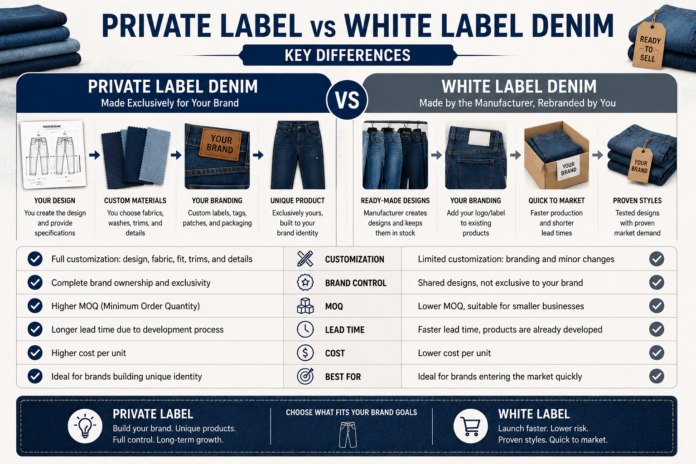
Private label denim means that a brand collaborates directly with a manufacturer to make jeans to that brand’s full specifications. Full creative control from the brand means they get to decide everything from the type of fabric used, fit, wash, sewing construction, to labeling, including branding woven on labels and the lining of pockets.
Private label denim brands get all the design and sell all the production. No one but that brand sells the jeans. That brand’s label is the only one the manufacturer puts on it.
This is the model used by established denim labels, growing fashion brands, and any business that wants a product with genuine differentiation in the market. Working with a specialist private label denim manufacturer gives brands full creative and commercial control over every garment they put their name on.
What Is White Label Denim?
White label denim changes the rules. In this setup, a company designs and produces a basic piece of clothing like pants or shorts, and sells that same piece to different companies. Each of those companies can then place their own label and branding on the piece of clothing. Because of this, the clothing piece sold to each company is the same or only slightly altered from company to company.
White label denim is beneficial to companies looking to market clothing quickly, have tight budgets, or want to test the waters on selling a new clothing product, like a new clothing piece, without investing in making a totally custom product. It is fast and easy to implement, but significantly limits what a company can do. These limitations are necessary to understand before deciding to use this type of product.
Private Label vs White Label Denim — The Core Differences
Difference 1: Product Ownership and Exclusivity
This describes the most basic difference between private label and white label denim. Private label means that the product is yours and yours alone. The fit, the fabric, the wash, the construction; everything that goes into making that product is done specifically for the brand. No other company can purchase the same garment from the same manufacturer and simply place a different tag on it.
With white label denim, that exclusivity is not really guaranteed. Other brands can sell a garment that is structurally the same as yours. This is what makes it noticeably difficult to differentiate your product from that of your competitors.
So, for brands that want to build brand equity for the long-term, private label is the better option. For brands that want to enter a market quickly while making less of a financial investment in the initial product development, white label is the best choice.
Difference 2: Development Time and Cost
Private label versus white label denim differ greatly in dev time and initial investment.
Establishing a private label involves all the building blocks to create a complete product — tech packs, samples, fit testing, washes, and approvals. This process is costly and time consuming, spanning eight to sixteen weeks, and is only feasible with sampling. A well-crafted product is the payoff.
White label denim has you begin the process much further down the pipeline. Samples already exist for you to choose from, and you have the option to design your product and brand, before moving directly to production. For a brand needing to launch product quickly, this option accelerates time to market to four to six weeks.
Difference 3: Brand Differentiation Potential
The most noticeable difference between private label and white label denim is the ability to differentiate in the market. Private label denim allows brands to create their own signature fits, exclusive wash treatments, unique fabric constructions, and distinguishing design elements. These cannot be copied by competitors without undergoing the development process themselves.
For example, a brand building a denim jeans range with a proprietary mid-rise slim fit and a specific vintage wash treatment owns that product identity completely. Customers recognise it. Retailers value it. Competitors cannot copy it exactly.
White label denim cannot deliver that level of differentiation. The product is fundamentally generic — even with your branding applied.
Private Label vs White Label Denim — Pros and Cons
Understanding private label vs white label denim requires an honest look at both sides. Here are the key advantages and limitations of each model:
Private Label Denim:
- Full product ownership and exclusivity: Your fit, your fabric, your wash, your brand. Nobody else sells the same garment. This builds genuine long-term brand equity and customer loyalty that white label simply cannot replicate.
- Complete creative control across all categories: From denim jackets to denim shirts and denim overalls, every style in a private label range can carry distinctive design details that set your brand apart across the full collection — not just in a single hero product.
White Label Denim:
- Faster time to market with lower upfront cost: No full development cycle means you can launch in weeks rather than months. This suits brands testing a new denim category, pop-up retail concepts, or businesses that need product quickly without heavy sampling investment.
- Lower minimum order quantities in many cases: Because the base garment already exists, some white label suppliers offer lower MOQ entry points than private label manufacturers — making it more accessible for brands at the very early stage of building a denim range.
Which Approach Suits Your Brand Stage?
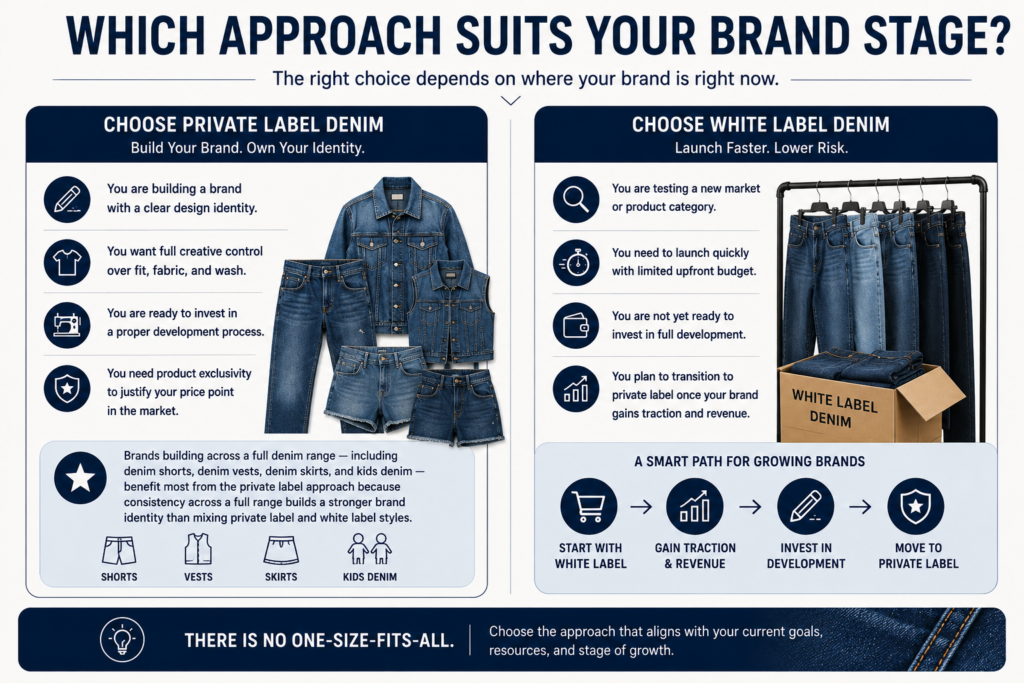
The private label vs white label denim decision depends heavily on where your brand is right now — not where you plan to be in five years.
Choose private label denim if: You are building a brand with a clear design identity. You want full creative control over fit, fabric, and wash. You are ready to invest in a proper development process. You need product exclusivity to justify your price point in the market.
Brands building across a full denim range — including denim shorts, denim vests, denim skirts, and kids denim — benefit most from the private label approach because consistency across a full range builds a stronger brand identity than mixing private label and white label styles.
Choose white label denim if: You are testing a new market or product category. You need to launch quickly with limited upfront budget. You are not yet ready to invest in full development. You plan to transition to private label once your brand gains traction and revenue.
Private Label vs White Label Denim in Streetwear
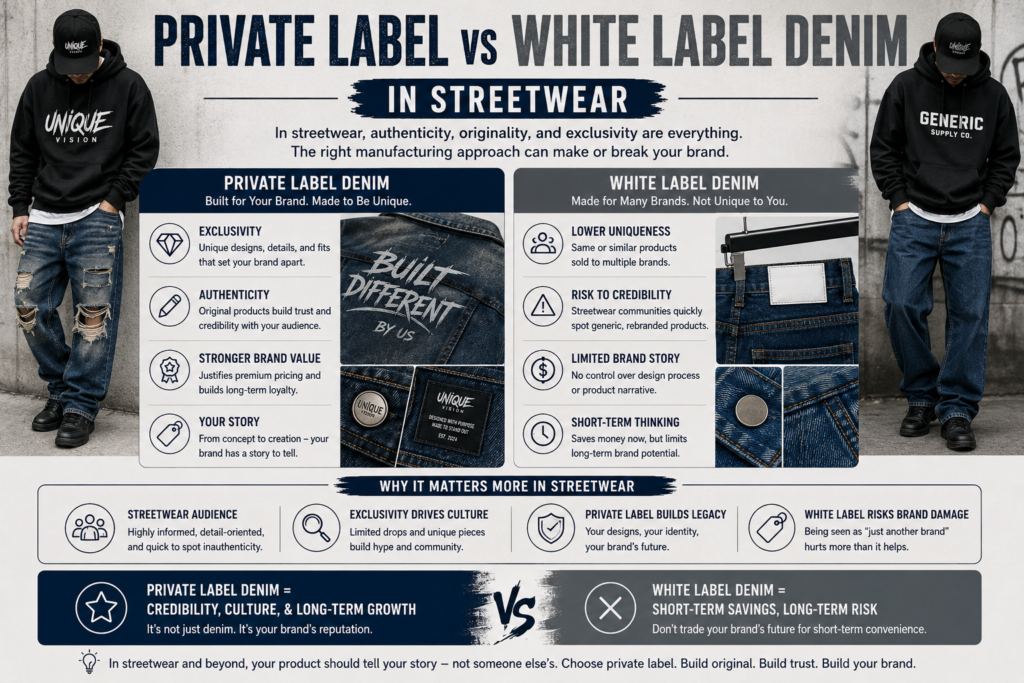
The streetwear market presents a particularly interesting case in the private label vs white label denim debate. Streetwear consumers are highly attuned to authenticity and product originality. They research brands, recognise generic constructions, and value exclusivity strongly.
Therefore, brands building in the streetwear denim space almost always need private label production to build credibility with their audience. A streetwear brand selling white label denim with a different label applied risks immediate recognition from its core customer base — which damages brand perception far more than the money saved on development.
Furthermore, denim apparel brands across all categories — from premium fashion to everyday casualwear — increasingly find that consumers expect product stories. Private label manufacturing gives brands those stories. White label does not.
Final Thoughts
The difference between a private label denim brand and a white label denim brand is ultimately about the focus of your business and where you are at in your company’s development. White label denim brands allow you to get to the market the fastest with the least amount of risk. Private label brands are focused on creating brand loyalty and trust with a product that cannot be otherwise sourced.
Most premium denim brands launch on a white label and then transition to a private label once their product gains traction in the market to support the transition. The best approach is to make the transition consciously, understanding the tradeoff of each approach, instead of assuming the least costly approach is the best.
FAQs
What is the main difference between private label vs white label denim?
label denim is developed exclusively for one brand — with custom fit, fabric, wash, and branding. White label denim is a pre-made generic garment that multiple brands can purchase and apply their own label to.
Is private label denim more expensive than white label?
upfront development investment — sampling, tech packs, and fit testing. However, per-unit costs at scale are often comparable. The real difference is the development cost and timeline, not necessarily the bulk production price.
Can small brands access private label denim manufacturing?
Yes. Many manufacturers offer private label denim production at relatively accessible MOQs for brands at the early growth stage — particularly for brands with clear design specifications and a structured development process.
Does white label denim work for building a long-term brand?
It can work as a starting point. However, white label denim limits brand differentiation because other brands may sell identical products. Most brands building long-term market presence transition to private label production as they grow.
Which model is better for a streetwear denim brand?
Private label is strongly preferred for streetwear denim. Streetwear consumers value authenticity and product originality highly — which means a generic white label product is very difficult to position credibly in that market.