When you pick up a leather bag that feels just right — firm yet supple, structured yet comfortable — you are holding the result of dozens of carefully made decisions. Every stitch, lining, zipper, and panel reflects a choice the manufacturer made long before the bag ever reached your hands. Understanding what goes into a high quality leather bag helps you shop smarter, source better, and appreciate craftsmanship on a whole new level.
The Leather Itself: Where Everything Begins
The single biggest factor in any high quality leather bag is the type of hide used. Not all leather is created equal, and the difference between grades is enormous.
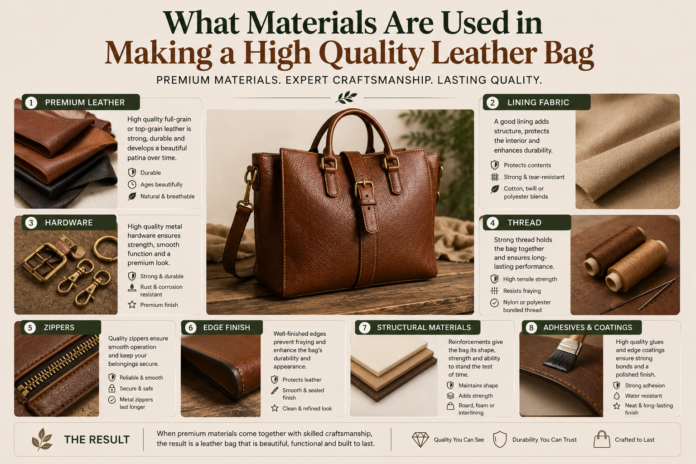
Full-grain leather is widely considered the finest option available. It retains the complete outer layer of the hide, including all natural markings and grain patterns. This makes it exceptionally durable and gives it a character that improves with age — developing what leather lovers call a “patina.” If you have ever seen a leather bag that looks better after ten years than it did on day one, it was almost certainly made from full-grain leather.
Classified by processing criteria, leathers used in the leather goods sector fall into two main categories: Top-grain leather retains the surface layer of raw hide, and is a high-end material that not only has excellent color retention, but also features natural, aesthetically pleasing inherent grain. Many people mistakenly assume that leather
materials labeled “genuine leather” are of superior quality, but in reality, this type of genuine leather is essentially low-grade split leather. When categorized by the source of raw hide, cowhide has high strength and is
easy to source, making it the most commonly used material for luggage and bags; lambskin has a soft texture, making it suitable for fashionable leather goods; goatskin has a pebble grain that can hide scratches, making it suitable for everyday-use luggage and bags.
High Quality Leather Bag Materials: Hardware and Fastenings
for high-quality leather bags is leather. In fact, the strength of any bag is determined by its weakest component. For most bags, the critical weak point is hardware—that is, all the metal parts used to secure the bag body and maintain its
functions. Solid brass is the top choice for zippers, D-rings, buckles, and lock clasps: it resists corrosion, retains its plating well, and its weight conveys a solid, premium quality feel. Zinc alloy is a low-cost alternative; if its plating is properly applied, it is fully
sufficient for daily use. Zippers from Japan’s YKK are used in nearly all high-end bags, and their smooth operation greatly improves the user experience. Choosing the right hardware is the core of making a high-quality bag.
The way hardware is attached is equally important. Riveted attachments are far more reliable than stitched ones for high-stress connection points like strap rings. A leather jacket manufacturer who understands structural stress applies the same logic to bag construction — reinforcing load-bearing points where the material faces repeated strain.
Linings, Thread, and Internal Structure
leather handbag, do not rush to examine its exterior first—its internal craftsmanship best reflects a brand’s overall production philosophy. The
linings of premium leather goods are most often made of suede, cotton twill, or polyester microfiber. These materials protect the items stored inside from abrasion by rough edges, maintain the bag’s structural shape, and enhance its overall texture. Cheap linings, by contrast, are a
cost-cutting choice: they are prone to damage and cannot support the bag’s form. The stitching used in quality bags is waxed nylon or polyester thread, which is moisture-resistant, load-bearing, and does not fray. The saddle stitch technique ensures that even if one section of the seam is cut, the entire line of stitching will not unravel; machine-made lockstitch, however, fails along its full length if just one thread loop breaks.
Internal structure is achieved through interfacing and stiffeners. Cardboard-backed panels give a base shape but deteriorate with moisture. High-end bags use thermoplastic stiffeners or layered leather panels that maintain their shape for years. This is the same attention to form that goes into a well-made leather coat — the silhouette holds because the underlying construction supports it.
Straps, Handles, and Reinforcement
The strap is where a bag’s construction faces its greatest test. Every time you lift the bag, the full weight transfers through the handle or shoulder strap into the body panels. A weak connection here means the bag fails — often quickly.
Quality straps are made from thick, vegetable-tanned leather — the same tanning method used in traditional leather belt manufacturing. Vegetable tanning uses natural tannins from bark and plants rather than chemicals, producing leather that is firmer, more resistant to stretching, and ages beautifully.
The quality evaluation criteria for leather luggage and bags proposed in this study are structured following a logical sequence that progresses from core functional requirements to supplementary aesthetic specifications: First, three requirements for load-bearing components are clearly defined: adjustable shoulder straps must be fitted with sturdy, smoothly operating sliders; the connection points of
fixed carry handles must be reinforced with double or triple stitching; after hardware is attached, reinforcement patches made of leather or fabric must be added to distribute the load and prevent tearing of the bag’s outer panel. Next, standards for comfort-focused components are supplemented: padded shoulder straps, which are commonly used
Finishing Treatments and Edge Work
must adopt a structure with an outer layer of leather or suede and an inner core of foam or gel, and the quality of both the padding layer and the outer leather equally impacts the comfort of the bag during long-term use. Finally, the qualifying requirements for surface finishing processes are sorted out: the three edge treatment techniques of
sanding and polishing, edge oil coating, and folded-edge stitching all require substantial time and labor. Untreated raw edges will fray and crack with regular use; leather conditioning oil maintains the softness of the leather, and some variants can also enhance the material’s color; wax sealing provides protection against mild moisture; matte finishes create a low-profile appearance, while glossy and glazed finishes are suited for formal-style leather bags.
This finishing philosophy carries across all leather categories — the same care that makes a fine leather vest feel polished applies directly to bag construction. A manufacturer who understands finishing across product types brings that knowledge to every piece they produce.
Sustainable and Alternative Materials
sustainable transformation trends of the leather goods industry. Currently, the industry’s attention to sustainable procurement and alternative materials continues to grow. Producers that prioritize environmental protection have widely adopted three types of measures:
chrome-free tanning, recycled linings, and responsible raw hide sourcing. Plant-based leathers made from cacti, mushroom mycelium, and apple waste have also entered the high-end market. While they cannot yet match the durability of traditional full-grain leather across all use scenarios, they feature a fast iteration speed and meet the demands of eco-friendly buyers who pursue high quality.
Some manufacturers now produce leather gloves and accessories under the same sustainability standards, allowing brands to offer a cohesive, responsibly made product range from a single source.
Why the Full Supply Chain Matters
A high quality leather bag is not the product of one good decision. It is the result of dozens of correct choices made across the entire supply chain — from the grade of hide selected to the type of thread used to close the lining. When any one of those choices is compromised, the final product suffers.
This is why experienced buyers and brands look carefully at manufacturer capabilities. A factory that produces leather skirts alongside bags demonstrates command across different leather applications — different thicknesses, construction methods, and finishing requirements. Similarly, a facility capable of crafting precision items like leather aprons has the attention to detail that translates directly into higher quality bag output.
When evaluating a potential manufacturing partner, look beyond their product photos. Ask about material sourcing, tanning methods, hardware suppliers, and quality control processes. The answers will tell you everything about what kind of high quality leather bag you can expect them to deliver.
Conclusion
High-quality leather bags are made with premium materials to ensure durability, comfort and timeless style. Every component of the bag, from full-grain and top-grain leather, to durable zippers, soft linings and solid metal hardware plays a role in its overall quality. The bag’s appearance and durability are improved by carefully selected materials. If you are looking for a bag to use in fashion, for travel or daily life, a high-quality leather bag will provide long-term value and reliability.
FAQs
What is the best type of leather for a bag that will last decades?
Full-grain leather is widely considered the most durable option. It retains the complete natural grain of the hide, develops a beautiful patina over time, and holds up to decades of daily use when properly cared for.
Is genuine leather the same as real leather?
Not exactly. “Genuine leather” is a trade term that refers to lower-quality split leather layers, not the premium outer hide. All leather is technically real, but genuine leather is a much lower grade than full-grain or top-grain.
How do I know if a leather bag has quality hardware?
Check for smooth zipper action, solid weight in rings and clasps, and corrosion-resistant finishes. YKK zippers and solid brass metal components are strong indicators of quality hardware in any high quality leather bag.