Compression wear fails for one of two reasons. Either the fabric was wrong from the start, or the finishing and testing steps were skipped during development. Both problems are avoidable. Both are expensive when they reach your customer.
Finishes and washing tests are the two most overlooked quality tools in compression garment manufacturing. Brands that take them seriously produce garments that hold their shape, color, and compression level wash after wash. Brands that skip them learn the hard way — through returns, bad reviews, and unhappy customers.
This guide covers everything you need to know about durable finishes and washing tests before your next compression collection goes into bulk production.
Why Finishes and Washing Tests Matter More in Compression Wear
Standard activewear faces regular washing. Compression wear faces something harder. Because compression garments apply constant physical pressure to the body, the elastic fibers inside the fabric are always under tension — during wear and even during storage. This continuous stress accelerates fiber fatigue over time.
Add frequent washing to that equation and you have a product that degrades faster than almost any other activewear category if the fabric and finishes are not up to standard. Therefore, finishes and washing tests are not optional extras for compression brands. They are the foundation of a durable, market-ready product.
This applies equally whether you are building a performance compression range for serious athletes or a softer compression line for yoga wear customers who prioritize comfort and longevity in equal measure.
Key Durable Finishes for Compression Garments
Anti-Pilling Finish
Pilling — the formation of small fiber balls on the fabric surface — is one of the most common customer complaints in compression wear. It happens because loose fiber ends work their way to the surface through friction during wear and washing.
An anti-pilling finish binds those loose fiber ends to the fabric structure, significantly reducing surface pilling through extended use. This finish is especially important for gym wear compression styles that face high surface friction against gym equipment, training mats, and clothing layers during workouts.
Without this finish, even a high-quality nylon-spandex fabric can look worn and rough after twenty to thirty wash cycles — which is completely unacceptable in a product category where customers pay premium prices.
Moisture Management Finish
A moisture management finish pulls sweat away from the skin and disperses it across the fabric surface for faster evaporation. In compression wear, this finish is critical because the garments sit tightly against the body during intense physical activity.
However, the key word here is durable. Many basic moisture management finishes wash out within fifteen to twenty cycles — which means the garment loses its functional benefit well before it reaches the end of its useful life.
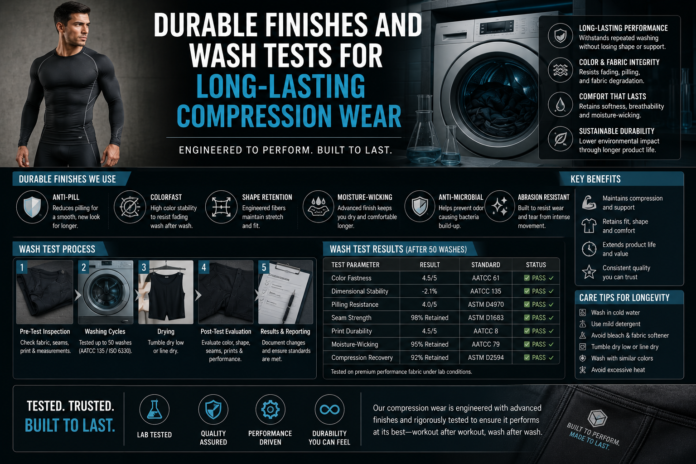
Therefore, always specify a durable moisture management finish rated to a minimum of fifty wash cycles. Then verify that rating through finishes and washing tests on fabric swatches before approving any material for production. A finish that cannot survive fifty washes has no place in a serious compression collection.
Additional Finishes Worth Specifying
Beyond anti-pilling and moisture management, several other finishes add meaningful value to compression garments depending on your target market:
- UV protection finish: Essential for outdoor compression styles used in running, cycling, or triathlon. A UPF 50+ rated finish blocks harmful ultraviolet radiation and should maintain that rating through at least thirty wash cycles. Brands building outdoor fitness apparel compression ranges should make this finish a standard specification across all exposed styles.
- Anti-odor finish: Compression garments trap heat and sweat during intense activity, creating ideal conditions for odor-causing bacteria. An anti-odor or antimicrobial finish inhibits bacterial growth on the fabric surface, keeping garments fresher between washes. Like moisture management, always verify the durability of this finish through washing tests — not just the manufacturer’s specification sheet.
Washing Tests Every Compression Brand Should Run
H3: Dimensional Stability Washing Test
This is the most important finishes and washing tests procedure for compression wear specifically. Dimensional stability testing measures how much the garment shrinks or stretches after a defined number of wash cycles — typically tested at twenty, thirty, and fifty cycle intervals.
Why does this matter so much? Because compression levels depend entirely on precise dimensions. A garment that shrinks 5% after twenty washes now applies a different pressure than it did when new. That shift changes the product’s performance — and customers who buy compression wear for specific athletic or recovery benefits will notice immediately.
Every compression fabric must pass dimensional stability testing within a defined tolerance — typically no more than 3–5% change in either direction — before it is approved for bulk production.
H3: Colorfastness Washing Test
Finishes and washing tests for colorfastness evaluate how well the dye holds through repeated laundering. Compression fabrics — particularly dark colors like navy, black, and charcoal — are prone to fading if dye fixation was not carried out correctly during manufacturing.
The test rates color retention on an international grey scale, from grade 1 (severe fading) to grade 5 (no change). For activewear and compression wear, a minimum grade of 4 is the industry standard. Anything below that is not acceptable for a market-facing product.
Furthermore, colorfastness to perspiration testing is equally important for compression wear. Because these garments come into frequent contact with sweat during intense activity, brands should run both wash and perspiration colorfastness tests during fabric approval — not just one or the other.
[Image Placement: A washing test result board showing compression fabric swatches graded against a colorfastness grey scale after multiple wash cycles in a quality control setting] Alt Text: Colorfastness washing test results for compression wear fabric showing grey scale grading after multiple wash cycles in quality control
H3: Elastic Recovery Test
This test stretches the compression fabric to a defined extension, holds it under tension for a set period, and then measures how completely it returns to its original dimensions after release.
High elastic recovery is the defining performance property of any compression fabric. A fabric that passes elastic recovery finishes and washing tests at fifty cycles has demonstrated that it will maintain its compression performance through real-world use — not just when it comes off the production line.
Brands that skip this test frequently discover the problem at the worst possible time: when customer reviews start mentioning that the garment feels loose after a few months of regular use.
H3: Seam Strength Test
Compression garments place far greater stress on seams than standard activewear because the fabric is always under tension during wear. Seam strength testing pulls seams apart under controlled force to verify they meet minimum strength standards before bulk production begins.
This test is especially critical for compression wear styles with flatlock or coverstitch construction at high-stress points — inner thighs, gussets, and waistband joins. Seam failures in compression garments tend to be sudden and complete, which makes them one of the most damaging quality issues a brand can face in this category.
How to Build Finishes and Washing Tests Into Your Development Timeline
The most effective approach is to run finishes and washing tests at two separate stages — not just one.
Stage One — Fabric Swatch Approval: When you receive fabric swatches from a supplier, immediately run them through a twenty to fifty cycle wash test. If the fabric fails dimensional stability, colorfastness, or elastic recovery at this stage, you find out before investing in patterns, samples, and production commitments. This is by far the cheapest point to catch a fabric problem.
Stage Two — Pre-Production Sample Approval: After sampling is complete and fit is approved, run the final garment through a complete finishes and washing tests cycle before releasing bulk production. This confirms that the finished garment — including all seams, applied finishes, trims, and labels — performs correctly after laundering, not just the base fabric in isolation.
Brands building out a full activewear range that includes compression alongside other categories should apply the same two-stage testing discipline across all product types. Consistency in testing standards produces consistency in product quality — and that consistency is what builds a brand customers return to.
For brands that also produce broader fitness apparel collections, establishing one unified wash testing protocol across all styles simplifies quality management significantly as production volumes grow.
Final Thoughts
Finishes and washing tests are not technical formalities. They are the practical tools that determine whether your compression garments perform for one season or five years. Brands that invest in proper finishing specifications and thorough pre-production testing produce garments their customers trust, reorder, and recommend.
Specify your finishes clearly in every tech pack. Test your fabrics before sampling. Test your samples before bulk production. Set minimum passing standards and hold every supplier to them.
That discipline is what separates a compression collection built to last from one that quietly disappoints.
FAQs
What are durable finishes in compression garment manufacturing?
Durable finishes are chemical treatments applied to fabric after knitting and dyeing. They add functional properties — such as anti-pilling, moisture management, UV protection, or anti-odor — and maintain those properties through repeated washing cycles.
How many wash cycles should compression fabric go through during testing?
A minimum of fifty wash cycles is the industry standard for performance compression wear. Testing at twenty and thirty cycle intervals as well helps brands identify exactly when fabric performance begins to decline.
What does a dimensional stability washing test measure?
It measures how much a compression garment shrinks or stretches after washing. Because compression levels depend on precise dimensions, garments must maintain their original measurements within a defined tolerance — typically 3–5% — after repeated laundering.
Why is colorfastness testing especially important for compression wear?
Compression garments are worn during intense activity and washed very frequently. Both perspiration and repeated laundering accelerate color fading, making high colorfastness ratings — minimum grade 4 on the grey scale — essential for market-ready compression products.
When should brands run finishes and washing tests — before or after sampling?
Both. Run washing tests on fabric swatches during swatch approval to catch material problems early. Then run a final test on pre-production samples to confirm that the complete finished garment — including seams, trims, and applied finishes — performs correctly after laundering.