Fabric choice makes or breaks a compression garment. A poorly chosen fabric loses its shape after a few washes, offers uneven pressure, and frustrates the end customer. A well-chosen fabric, on the other hand, supports performance, holds its compression level wash after wash, and keeps the wearer comfortable through intense physical activity.
This compression fabric guide walks you through everything you need to know — knit structures, compression levels, and blend options — so you can make confident decisions when developing your collection.
Why Fabric Choice Matters So Much in Compression Wear
Compression garments work by applying graduated pressure to the body. That pressure improves circulation, reduces muscle vibration during exercise, and speeds up recovery afterward. However, none of those benefits are possible without the right fabric construction underneath.
Therefore, before you finalize any design, the fabric decision must come first. This is especially true for brands working in the compression wear space, where performance expectations from customers are high and fabric failures are immediately noticeable.
Knit Structures Used in Compression Fabrics
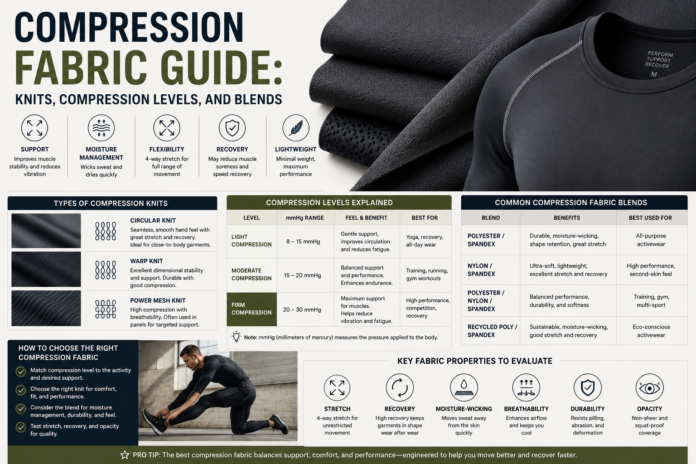
The knit structure of a compression fabric determines how evenly it distributes pressure across the body. Not all knits perform equally. Here are the three most important types:
Circular Knit Circular knit is the most common structure in everyday compression wear. It produces a smooth, consistent fabric with good stretch recovery. It works well for lighter compression garments like training tights, base layers, and everyday fitness leggings. However, it offers less precise pressure graduation compared to more specialized constructions.
Warp Knit Warp knit fabrics are engineered for medical-grade and high-performance compression. They offer superior dimensional stability, excellent shape retention, and very consistent pressure distribution. As a result, warp knit is the preferred structure for professional sports compression, recovery garments, and any product where consistent mmHg ratings matter.
Flat Knit Flat knit compression fabrics allow for shaped, contoured construction — particularly useful for compression sleeves, calf guards, and graduated stockings. They are less common in full-body activewear but highly relevant for targeted recovery products.
[Image Placement: Side-by-side diagram comparing circular knit, warp knit, and flat knit compression fabric structures under magnification] Alt Text: Compression fabric knit structure comparison showing circular knit, warp knit, and flat knit under close-up view
Understanding Compression Levels
Compression garments are typically classified by the amount of pressure they apply, measured in millimetres of mercury (mmHg). Understanding these levels helps brands position their products correctly and choose appropriate fabrics for each range.
Here is a practical breakdown:
- Light compression (8–15 mmHg): Suitable for everyday wear, mild fatigue relief, and general fitness use. These garments feel comfortable for extended wear and suit a broad consumer audience. Fabrics at this level need good stretch and breathability but do not require highly engineered knit structures.
- Moderate compression (15–20 mmHg): The most popular range for sports and fitness apparel brands. This level supports muscles during moderate-to-intense activity, reduces vibration, and assists with light recovery. Fabric at this level must balance compression consistency with freedom of movement.
Additionally, medical-grade compression ranges (20–30 mmHg and above) exist for clinical applications. Most activewear brands work within the 8–20 mmHg range for sports and lifestyle compression products.
Compression Fabric Guide Blends for Compression Garments
Blend composition directly affects how a compression fabric performs. No single fiber does everything well, which is why most high-quality compression fabrics combine two or more fibers to balance different performance properties.
Nylon and Spandex (Elastane) This is the industry standard blend for compression wear. Nylon provides strength, durability, and a smooth surface feel. Spandex provides the stretch and recovery that creates and maintains compression. A typical ratio ranges from 70–80% nylon to 20–30% spandex, depending on the compression level required.
Polyester and Spandex Polyester blends are widely used in gym wear and training compression. Polyester offers excellent moisture-wicking properties, holds color well, and is more cost-effective than nylon. However, it has a slightly rougher hand feel compared to nylon blends.
Recycled Fiber Blends Many brands today choose recycled nylon (such as ECONYL) or recycled polyester blended with spandex. These sustainable options perform comparably to virgin fiber blends while significantly reducing environmental impact — an important consideration for brands building responsible product lines in the activewear space.
Additional Fabric Properties to Consider
Beyond knit structure and blend, several additional fabric properties affect compression garment performance:
Moisture management is critical. Compression garments sit close to the skin during intense activity, so fabrics must wick sweat away from the body efficiently. Furthermore, UV protection matters for outdoor compression products — especially for running and cycling gear. Anti-odor treatments, flatlock seam compatibility, and colorfastness under repeated washing are also worth specifying clearly in your tech pack before production begins.
Final Thoughts
Choosing the right compression fabric is not a single decision — it is a series of connected choices about knit structure, compression level, blend composition, and performance properties. Each choice affects how the finished garment performs, how long it lasts, and how satisfied your customers feel wearing it.
Take time with your fabric selection. Test samples thoroughly. And work with a manufacturing partner experienced in compression garment construction to ensure the fabric you choose performs the way you intend it to.
FAQs
What is the best fabric blend for compression wear?
Nylon-spandex blends are the most widely used for compression garments. They offer excellent strength, stretch, and recovery. Polyester-spandex blends are a cost-effective alternative with strong moisture-wicking properties.
What does mmHg mean in compression garments?
mmHg stands for millimetres of mercury — the unit used to measure the pressure a compression garment applies to the body. Higher numbers indicate greater compression force.
Which knit structure is best for high-performance compression wear?
Warp knit offers the most consistent pressure distribution and dimensional stability, making it the preferred choice for sports and medical-grade compression garments.
Can compression fabrics be made from sustainable materials?
Yes. Recycled nylon (such as ECONYL) and recycled polyester blended with spandex perform comparably to virgin fiber blends while reducing environmental impact significantly.
How much spandex content is needed for effective compression?
Most compression fabrics contain between 20–30% spandex. Higher spandex content increases compression and stretch recovery, while lower content reduces the compression level and increases fabric stability.