What Is Genuine Leather?
Definition of Genuine Leather
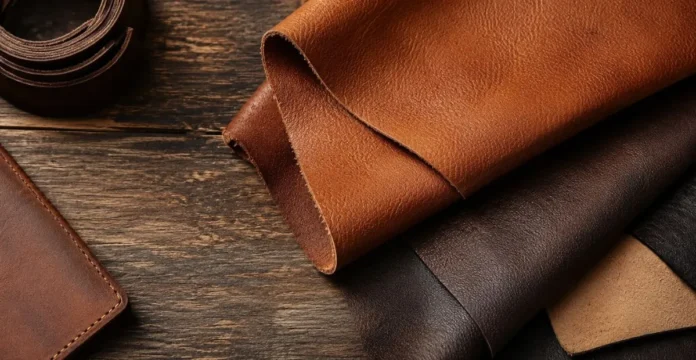
Genuine leather is made from animal hide and it is real leather. In the production of genuine leather, cowhide tends to represent the majority of production, although buffalo, goat and sheep hides also appear in production.
Genuine leather is a specific leather grade in the industry, although the term can also refer to leather produced from lower hide layers as opposed to the higher, premium layers.
Why Genuine Leather Confuses Buyers
From the name, buyers tend to associate ‘genuine’ with premium quality. This is not the case, as the term is often misunderstood in the leather industry.
In the hierarchy of leather quality, genuine leather is right below full grain leather and top grain leather. However, genuine leather is comprised of real animal fibers and the natural leather structure.
Common Animal Hides Used
Cowhide
Cowhide remains the most common source because it offers strength and is the most affordable.
Buffalo Hide
Buffalo leather is thicker and often tougher compared to cowhide. Due to this, its use is more common in the production of goods that need to be rugged.
Goat Skin
The goat skin exhibits a supple hand and is one of the more pliable leathers; the goat skin has a good grain definition.
Sheep Skin
The sheep skin has a silky and very delicate hand and is therefore favored by many manufacturers for fashion items.
Marketing vs. Industry Language
In the leather industry, the term ‘genuine leather’ is often used to describe proprietary leather that has been corrected in some way. The marketing industry, however, uses the term to mean something is real, rather than for positional strategy.
This has led many to the incorrect assumption that genuine leather is synonymous with luxury leather.
Read More>> All Types of Leather.
Is Genuine Leather Real Leather?
Yes, it is real leather; it is true animal skin, as opposed to materials that are not of animal origin and are of a synthetic nature.
Why People Think Genuine Leather Is Fake
Buyers often confuse genuine leather with faux leather because it is often associated with inexpensive products. In addition, aggressive marketing has blurred the distinctions and/or grades of leather.
Why Genuine Leather is Less Expensive
Genuine leather is made from lower layers of the hide; the superior top layer has been removed.
Is Genuine Leather Synthetic?
No, it is of animal origin; however, many products have what are termed as top coats, pigments and/or finish layers of polyurethane.
Is Genuine Leather Good?
For everyday items, it offers reasonable quality for the price. Also, when compared to top grades of leather, lower grades of leather generally lack the rustic quality, the aged character and luxurious prestige associated with premium leather.
Genuine Leather vs Full-Grain Leather
Durability
Genuine Leather
- Not as durable because of the extensive sanding and surface processing that the manufacturers employ.
- Lasts fewer years with extensive daily use.
Full-Grain Leather
- Strong since the entire natural grain layer is present.
- Develops enhanced character with age.
Appearance
Genuine Leather
- Artificial grain textures are added by manufacturers to create a more uniform appearance.
- Smooth and less natural appearance.
Full-Grain Leather
- Exhibits original natural blemishes and authentic markings of the hide.
- Appears more opulent and luxurious.
Texture
Genuine Leather
- Texture feels more artificial because of the sanding and finishing treatments.
- Softer to touch initially.
Full-Grain Leather
- The texture becomes firmer and denser.
- Naturally changes with age.
Aging & Patina
Genuine Leather
- Develops a small patina with time.
- Unevenly wears out over time.
Full-Grain Leather
- Develops character as deep patina develops.
- Aging gracefully improves the visual appeal significantly.
Price
Genuine Leather
- Cost effective mass produced leather.
- Fitting for cost conscious consumers.
Full-Grain Leather
- More costly because of the high quality of the leather.
- Mostly found in high-end products.
Water Resistance
Genuine Leather
- Provides a minor resistance due to the coatings.
- Exposure to moisture leads to cracking.
Full-Grain Leather
- Natural fibers maintain durability better over time.
- Conditioning optimizes moisture resistance.
Lifespan
Genuine Leather
- Depends on usage and care, but usually lasts 3-10 years.
Full-Grain Leather
- Lasts several decades with appropriate upkeep.
Genuine Leather vs Full-Grain Leather Table
| Feature | Genuine Leather | Full-Grain Leather |
|---|---|---|
| Material Source | Lower hide layers | Top hide layer |
| Durability | Moderate | Excellent |
| Surface | Sanded and coated | Natural grain |
| Patina | Limited | Rich patina |
| Texture | Processed feel | Natural feel |
| Price | Affordable | Premium |
| Lifespan | 3–10 years | 20+ years |
Genuine Leather vs Top-Grain Leather
Surface Correction
Genuine Leather
- They sand the surface heavily.
- Manufacturers often emboss the surface to imitate natural grain patterns.
Top-Grain Leather
- Surface corrections provide a balance between consistency and natural appearance.
- Natural appearance prevails.
Softness
Genuine Leather
- Softer feel due to coatings and treatments.
Top-Grain Leather
- Smoother, more refined, and stronger.
Durability
Genuine Leather
- Moderate durability for many goods.
Top-Grain Leather
- Greater durability due to the top grain.
Luxury Perception
Genuine Leather
- It has a mid-range perception of leather quality.
Top-Grain Leather
- Premium perception in luxury goods.
Common Products of Genuine Leather vs Top-Grain Leather
Genuine Leather
- Wallets
- Fashion belts
- Budget shoes
- Affordable furniture
Top-Grain Leather
- Luxury handbags
- Premium jackets
- High-end furniture
- Designer accessories
Genuine Leather vs Top-Grain Leather Comparison
| Feature | Genuine Leather | Top-Grain Leather |
|---|---|---|
| Grain Layer | Lower layers | Upper grain layer |
| Surface Finish | Heavy correction | Light correction |
| Feel | Softer initially | Smooth and refined |
| Durability | Moderate | High |
| Prestige | Mid-range | Premium |
| Cost | Lower | Higher |
Genuine Leather vs Bonded Leather
Material Composition
Genuine Leather
Genuine leather comes from layers of animal hides. Because of this, they contain natural leather fibers throughout. Manufacturers may apply surface coatings for aesthetic consistency.
Bonded Leather
Bonded leather is a composite of leather adhered with synthetic substances, such as polyurethane or latex. This creates a leather-like material that contains both leather fibers and synthetic binders. When you buy a bonded product, you’re often getting more synthetic material than leather.
Durability
Genuine Leather
Genuine leather is generally more resilient. As long as the leather is well maintained, it can last a significant amount of time. There’s still a considerable variation between different brands.
Bonded Leather
Bonded leather is less durable. Since the synthetic material can break down when exposed to heat or friction, bonded products can fail within a short period.
Appearance
Genuine Leather
Genuine leather is more flexible than bonded leather because it shows more depth. Genuine leather is processed, but still retains some of the hide’s texture. It is common to see wrinkles and texture on genuine leather.
Bonded Leather
Bonded leather is more artificial than genuine leather. Manufacturers attempt to imprint synthetic grain patterns to imitate leather. The synthetic surface eventually causes the top layer to bubble.
Price
Genuine Leather
Genuine leather is more expensive than bonded leather because it costs more to use genuine hide. It is still less pricey than premium leather.
Bonded Leather
Bonded leather is the most affordable leather replacement material. Because of the low price, it is the most common material for cheaper goods.
Genuine Leather vs Bonded Leather Table
| Feature | Genuine Leather | Bonded Leather |
|---|---|---|
| Real Leather Content | High | Low |
| Durability | Moderate | Low |
| Peeling Risk | Moderate | High |
| Flexibility | Better | Limited |
| Appearance | More natural | Artificial |
| Lifespan | Longer | Shorter |
Leather Grades Explained
Full-Grain Leather
Full-grain leather keeps the natural grain surface. This gives full-grain leather the highest longevity and quality.
Top-Grain Leather
Top-grain leather receives a light sand and some alteration, but keeps similar quality and durability.
Genuine Leather
Genuine leather is often made from the lower layers of the hide after the top grain has been separated. It is therefore altered, coated, and covered.
Split Leather
This leather comes from the fibrous, lower sections of hides. Suede and coated leather products are usually made from split leather.
Bonded Leather
This material consists of synthetic binders and leather scraps. Among all leather grades, bonded leather is the lowest in durability.
How Genuine Leather Is Made
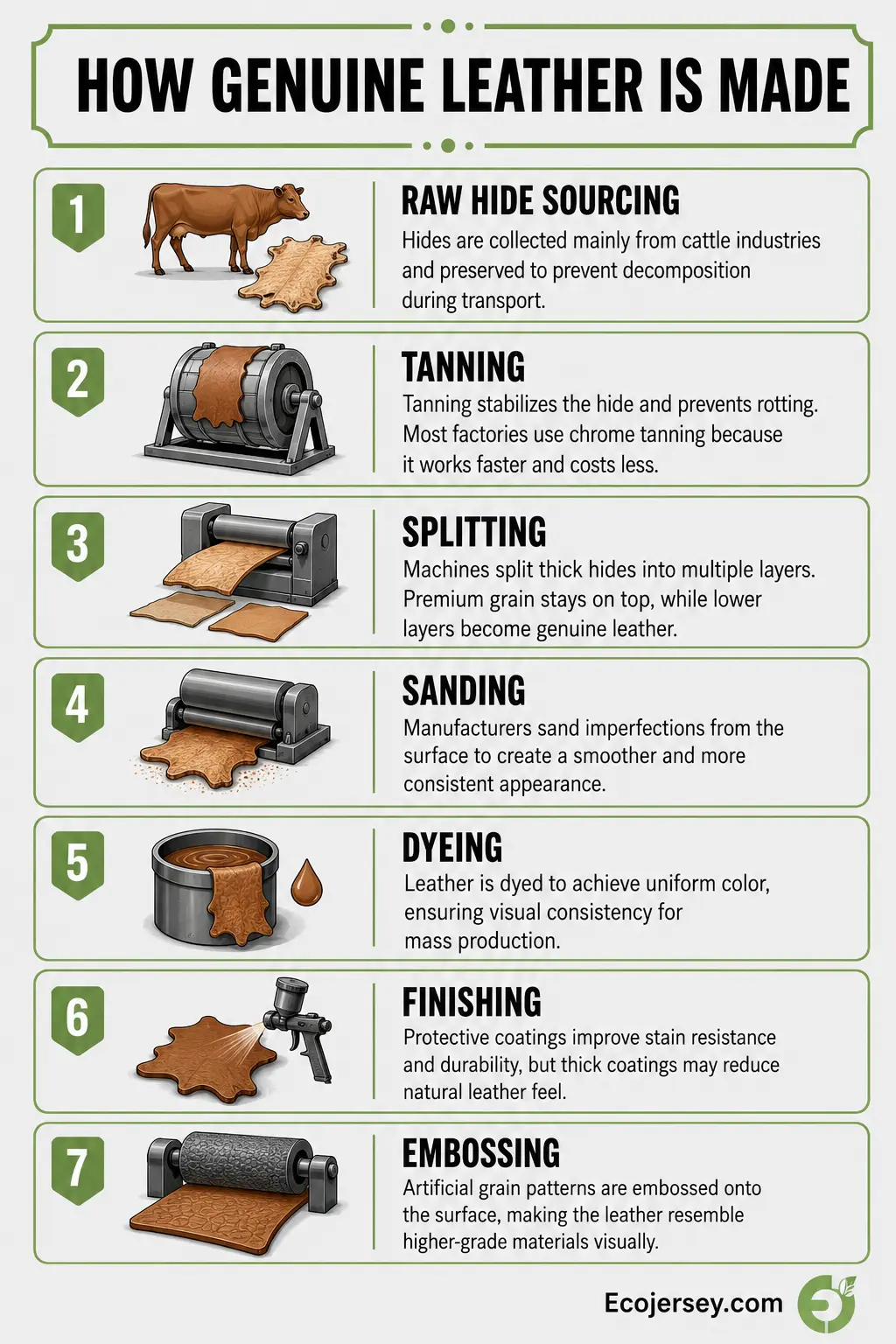
Raw Hides
The livestock and cattle industries are the main suppliers of hides. Leather companies use preservatives to stop the hides from decaying during transport.
Tanning
Tanning is the process of keeping the hides from decaying. The cheaper and faster method is chrome tanning.
Splitting
Leather manufacturers run these thick hides through a machine that splits the hides into multiple layers. The top sheets are kept as premium grain. The lower sheets are used to create the genuine leather.
Sanding
Manufacturers sand away all the imperfections and any residual fibrous materials left. This gives the leather a consistent and smooth appearance.
Dyeing
This process is used to give the leather the desired uniform hue, and improves visual consistency for mass production.
Finishing
The final protective coat on the leather improves stain resistance while strengthening the leather. The finish can be overly thick and changes the leather feel.
Embossing
Manufacturers use embossed grain patterns to give the leather a more consistent appearance. This gives the leather surface an appearance that resembles higher-grade grades.
What Does Genuine Leather Feel Like?
Texture
Genuine leather may be softer than full-grain leather.
The coated surface may appear smoother than full-grain hides.
Smell
Genuine leather preserves the natural leather scent. The smell may be altered by the synthetic coat.
Flexibility
The leather bends, flexes, and retains all of its integrity. Lower-quality products may break or crease within a short time of use.
Grain Pattern
The surface grain patterns may appear uniform.
Artificial embossing seems to be the norm.
Warmth vs Synthetic Leather
- More warmth and breathability when compared to faux leather.
- PU leather feels more plastic-like.
Is Genuine Leather Good Quality?
For the price you pay for genuine leather, quality and durability is fairly average.
Pros of Genuine Leather
- Affordable
- Genuine leather is more affordable than premium leather grades such as full-grain and top-grain leather.
- Real Leather Feel
- Real leather contains natural fibers that provide a more authentic feel.
- Flexible
- Products created by manufacturers, especially shoes and bags, have been noted to be soft, flexible, and overall more comfortable.
- Widely Available
- Fashion and furniture brands, due to genuine leather’s popularity, have offered many styles.
Cons of Genuine Leather
- Less Durable
- More natural leather fibers tend to weaken due to heavy processing, hence the more fragile nature of genuine leather.
- Cracking Risk
- With genuine leather, the risk of cracking is even more likely to occur. As a result, poor finishes could lead to peeling.
- Limited Patina
- Genuine leather develops limited patina over time.
- Lower Prestige
- Most luxury brands would most likely agree that genuine leather lacks the prestige associated with premium leather markets.
How Long Does Genuine Leather Last?
Average Lifespan
With the quality and the nature of this leather, it could last anywhere between 3 and 10 years, though reasonable upkeep and product quality and maintenance can affect its lifespan greatly.
What Affects Durability
- Thickness of the Leather
- Quality of the Coating
- Daily Wear
- Exposure to Moisture
- Maintenance
Why Leather Should Be Maintained
Conditioners stop leather from drying and cracking. Also, leather should be stored properly to keep the structure.
Genuine Leather Lifespan Estimates
| Product | Average Lifespan |
|---|---|
| Wallets | 3–5 years |
| Belts | 4–7 years |
| Shoes | 2–5 years |
| Sofas | 5–10 years |
| Bags | 3–7 years |
Uses of Genuine Leather
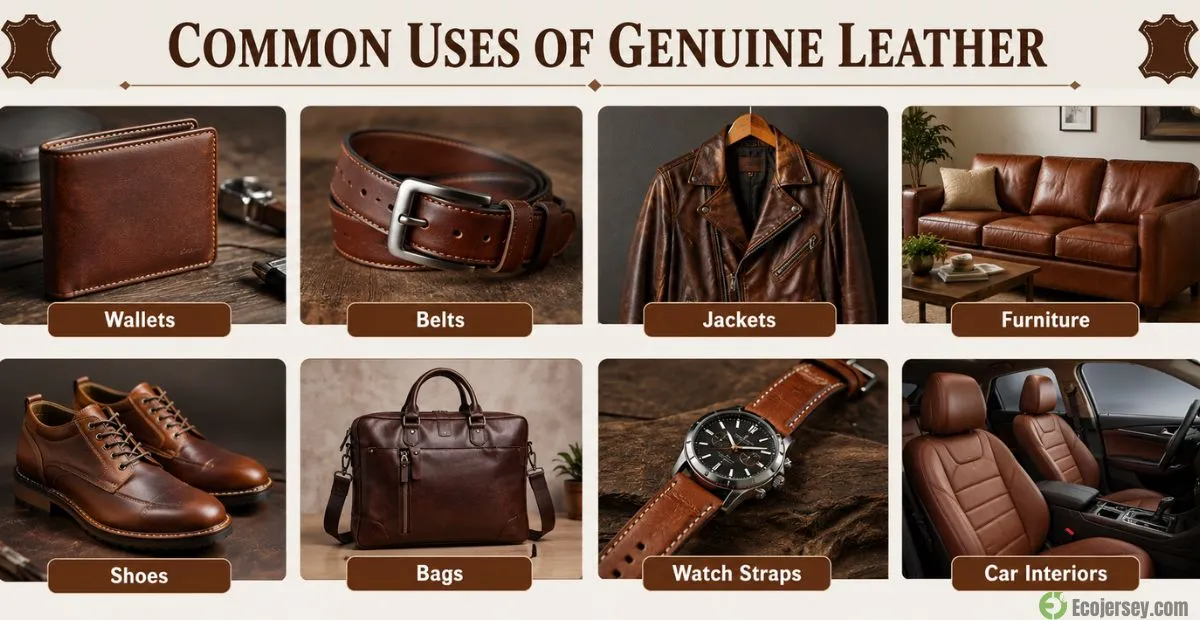
Wallets
- Cheap to make in large quantities.
- Soft and comfortable in the pocket.
Belts
- Strong and flexible.
- Easy to make many different types.
Jackets
- Cheaper than other leather options.
- Used by many different fashion brands.
Furniture
- Protective coatings can improve stain resistance on seating surfaces.
Shoes
- Strong and flexible.
- Often used in casual shoes.
Bags
- Used by many different fashion brands.
- Can be embossed to look even more expensive.
Watch Straps
- Soft and comfortable.
- Easy to order in a variety of textures and colors.
How to Identify Genuine Leather?
Smell Test
- Leather smells like earth.
- Synthetics smell more like chemicals.
Texture Test
- Real leather has an irregular surface texture.
- Man Made leather is more uniform.
Water Absorption Test
Genuine leather slowly absorbs small water drops.
Faux leather often resists water more than genuine leather.
Edge Inspection
Real leather has edges that look fibrous and layered.
Synthetic leather has edges that are smooth and look like plastic.
Pore Patterns
Pores in real leather regularly look irregular.
Pore patterns that repeat can show that leather was embossed.
Flexibility Test
Genuine leather wrinkles when bent.
Synthetic leather tends to have folds that are sharper.
Be careful when using these tests on expensive products because they may be damaged.
Does Genuine Leather Peel or Crack?
Yes, genuine leather can crack over time, while peeling usually occurs when synthetic coatings begin separating from the surface. Especially when manufacturers apply thick synthetic coatings.
Main Causes
Low-quality finishes
These cheap coatings can separate from leather fibers.
Poor Maintenance
Dry leather can lose its flexibility and crack.
Polyurethane finishes can peel and weaken.
Dry Environments
Low humidity can remove the natural moisture from leather fibers.
How to Reduce Cracking
- Condition leather regularly
- Avoid direct sunlight.
- Store leather products in moderate humidity levels.
- Clean gently using soft cloths.
Is Genuine Leather Waterproof?
Genuine Leather is water resistant, but is not completely waterproof.
Why Leather Resists Water Slightly
The natural oils in leather fibers provide limited resistance to moisture.
Why Water Still Damages Leather
When there is excess moisture it can deplete the oils and weaken the structure of the fibers. This can lead to stiffening, staining, or cracking of the leather.
Protection Methods
- Leather conditioners
- Waterproof sprays
- Quick drying after exposure
- Proper storage
Genuine Leather Pros and Cons
| Pros | Cons |
|---|---|
| Real leather material | Lower durability |
| Affordable pricing | May crack sooner |
| Flexible texture | Limited patina |
| Easier maintenance | Less luxurious appearance |
| Widely available | Surface coatings wear |
| Better than many synthetics | Quality varies greatly |
How to Care for Genuine Leather
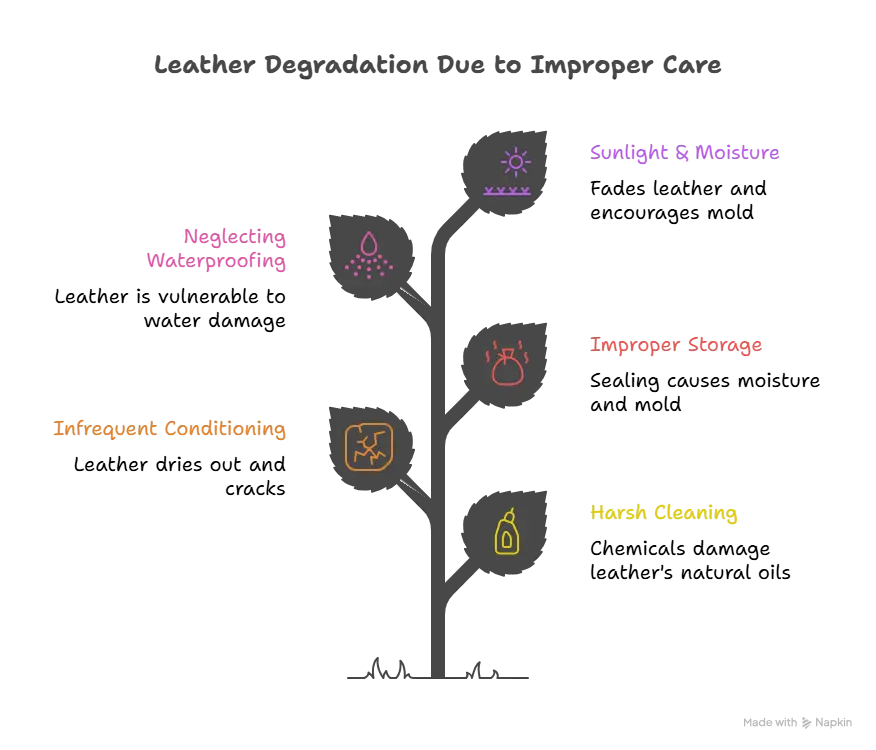
Cleaning
- Use soft microfiber cloths regularly.
- Avoid harsh chemical cleaners.
Conditioning
- Apply leather conditioner every few months.
- Conditioning prevents drying and cracking.
Storage
- Store products in cool, dry areas.
- Avoid using sealed plastic bags.
Waterproof Sprays
- Use leather-safe waterproof protectors.
- Be sure to reapply after heavy use.
Avoid Sunlight & Moisture
- Direct sunlight slowly fades and dries leather.
- Mold growth is encouraged by excessive humidity.
Is Genuine Leather Worth Buying?
For Budget Buyers
Yes, genuine leather offers strong value for moderate budgets. It provides authentic leather feel without luxury pricing.
For Luxury Buyers
Luxury buyers prefer full-grain or top-grain leather for aging and durability.
For Everyday Use
Genuine leather lasts for daily accessories and casual items. Cost to replace is also low.
For Fashion Products
Many fashion brands use both genuine leather and faux leather depending on price, style, and sustainability goals.
Conclusion
What is genuine leather? Genuine leather is the real deal – leather. It comes from real animal hides, usually from the lower layers after the top grain has been separated. The costs are lower than for full-grain and top-grain leather but higher than synthetic leather. Still, it boasts flexibility, texture, and the authentic appearance of leather.
On the hierarchy of leather grades, genuine leather is placed at the mid-tier position. For leather goods like wallets, shoes, belts, bags, and furniture, it is a cost-effective option for consumers. While mid-tier leather provides a nice balance of cost and utility, it falls short of premium leather grades in terms of durability, patina, and prestige.
Since genuine leather gives a decent amount of utility at a lower price point, it is a good option for budget-buyers. However, genuine leather may not be the right choice for consumers who want superior quality and durability; for those consumers, full-grain or top-grain leathers may be a better option.
FAQs
Is genuine leather expensive?
Genuine leather is costlier than synthetic leather but cheaper than the higher quality grades.
Can genuine leather get wet?
Yes, it is safe to be wet, but water may lead to a slow decline in quality over time.
Does genuine leather smell?
Yes, genuine leather has a distinct natural and earthy smell.
Is genuine leather durable?
It offers moderate durability for everyday products.
Is genuine leather vegan?
No, genuine leather does not fall within the domain of veganism as it is sourced from animals.
Why is genuine leather cheaper?
The hides used for the leather originate from lower layers, and the hides themselves are processed heavily.
Is 100% genuine leather good?
Yes, it is good, but the manufacturing standards can vary.
Does genuine leather peel?
Yes, after wearing for years, surface coatings can begin to peel or flake over time.
Is genuine leather breathable?
Yes, it is quite breathable. Most synthetic substitutes for leather cannot compare.
Does genuine leather crack?
Yes, the cracks can be attributed to the substandard quality of the leather coating and neglect of maintenance.
Is genuine leather better than PU leather?
Definitely, genuine leather is superior as it is of higher quality, and naturally, it lasts longer when compared to PU leather.
Is genuine leather fake?
No, genuine leather is true leather material, as it originates from animal hides, as opposed to being artificial.