Introduction-
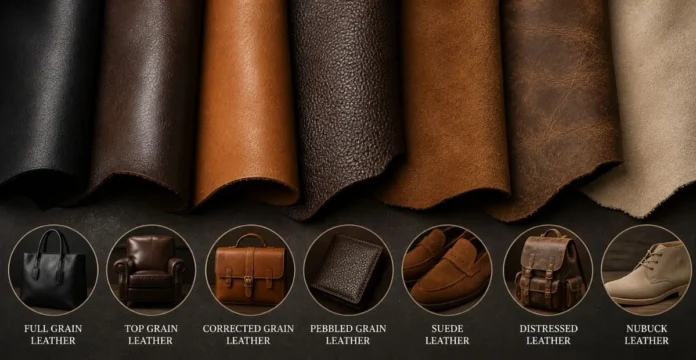
Leather is a flexible, durable material made from processed animal hide like from a cow, pig, or goat. During the fabrication, animal hide is preserved, preventing decay, and each kind of leather is a product of animal source and the lead up to the finish. While different animal hide lead to different leather, the treatments and finishes also affect the final product. Treatments and finishes include dyeing, coating, and buffing. In summation, leather characteristics depend on the animal type, the fabrication process, and the final coating or treatment.
Types of Leather By Grain Quality
| Leather Type | Durability | Price | Texture/Look | Maintenance | Best Uses |
|---|---|---|---|---|---|
| Full-Grain | Very high – strongest | Highest | Natural grain, unique marks | Regular oiling/conditioning | Premium furniture, boots, high-end bags |
| Top-Grain | High | High–mid | Smooth, even grain | Wipe clean; condition occasionally | Jackets, sofas, car seats |
| Genuine | Moderate–low | Affordable | Uniform grain (often embossed) | Low (coated so easy wipe) | Budget bags, belts, interiors |
| Bonded | Low – lowest | Lowest | Artificial, printed grain | Not needed (but fades/cracks easily) | Cheap furniture, book covers |
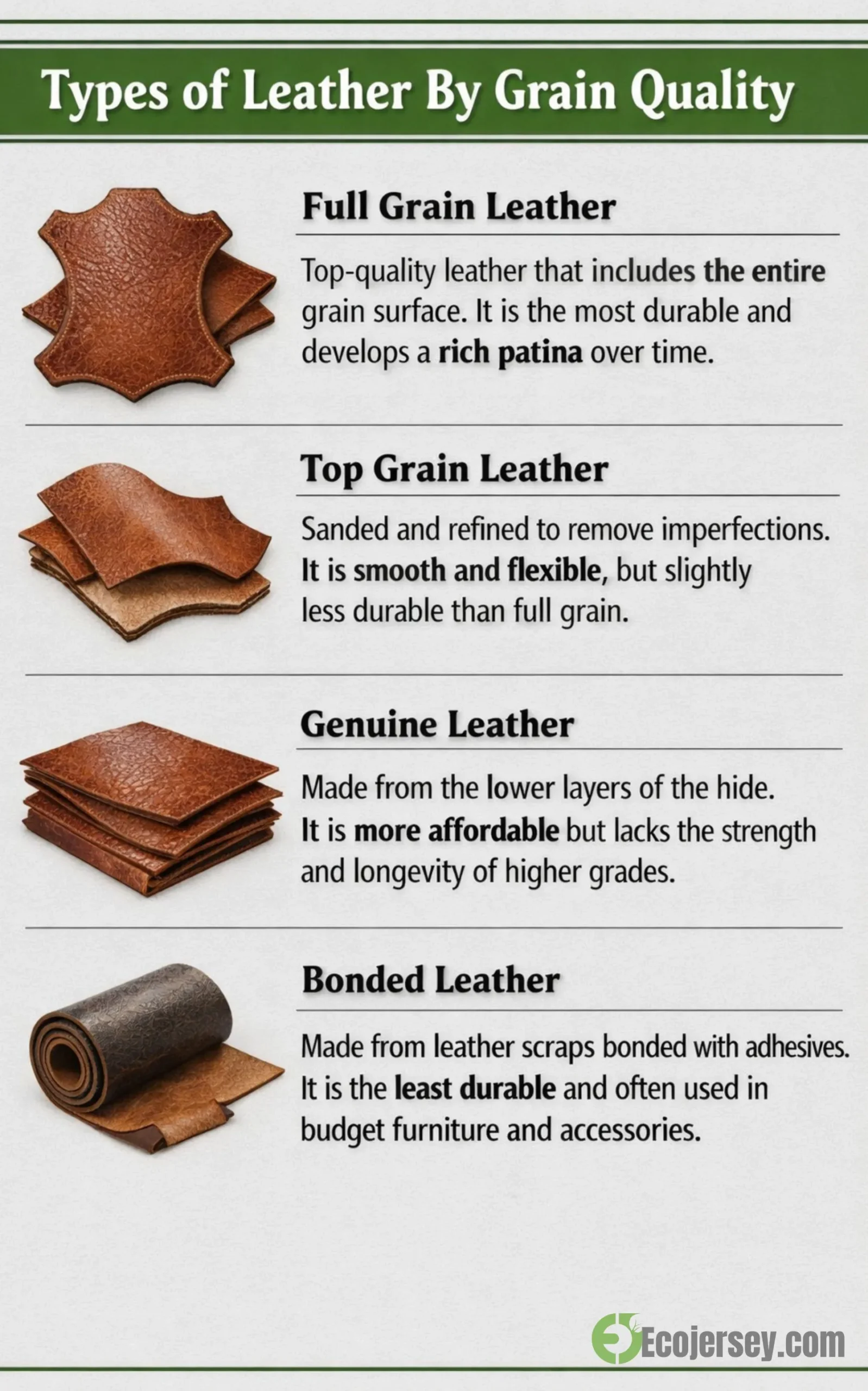
Leather can be categorized by the hide’s surface as either: Full-Grain, Top-Grain, Genuine, or Bonded. Which impacts the affordability, appearance and strength.
Full-Grain Leather
Full-grain leather can be sourced from the outermost portion of the hide. Because the outer grain layer remains intact, full-grain leather is exceptionally strong and resilient. It also has a beautiful and rich patina, and can be long-lasting. Due to the sourcing of Full-Grain leather being from the outermost layers, this leather is also the most expensive. You mostly see this leather in high-quality furniture, boots and bags.
Pros: Incredibly strong and durable; ages well and maintains beautiful patina; appearance is unique.
Cons: Very expensive; visible hide and texture still remains.
Top-Grain Leather
Top-grain leather comes from the outer hide but has had the surface sanded or buffed to minimize imperfections, resulting in an even, smooth surface. It maintains excellent durability but is slightly less durable than full-grain leather. Since some of the grain is removed, this leather is typically thinner. It is more affordable than full-grain leather. Top-grain leather is mainly used in items such as jackets, leather bags, and leather sofas.
Pros: Excellent durability; smooth appearance; more affordable than full-grain leather
Cons: Some of the natural characteristics and imperfection are lost; less oil; may wrinkle, patina, or scratch.
Genuine Leather
By definition, genuine leather is real leather, but from the base layers of the hide. The term itself is not a quality grading, but is often a synonym for cheaper leather. Genuine leather hides are made by cutting off the top grain, then either buffed or embossed on the surface to achieve uniformity. Compared to the higher grades, genuine leather is cheaper but is also far less durable. Genuine leather is often used for cheaper shoes, jackets, or other accessories.
Pros: Affordable; light use; surface is coated and can be wiped.
Cons: Weaker; less tear resistant; not as lasting; no natural patina; susceptible to more cracking and wearing.
Bonded Leather
Bonded leather is a reconstituted material made from leather fibers bonded together with polyurethane or other binders. The combination gives it a leathery look, but it typically has a fraction of what is required for actual leather. It is also the weakest, being presented as the cheapest option when it comes to synthetic leather materials. However, bonded leather is already deteriorating as it is prone to cracking and peeling. It is used in the construction of very low-end bags, furniture, and notebooks.
Pros: Feels cheaper; similar artistic appearance; may have a leather scent.
Cons: Extremely low lifespan; detachment along the layering; has no chance of being salvaged; less of a leathery texture..
Types of Leather By Animal Source
Also, There are different groups of leather categorized according to the types of hides. The texture, thickness and softness may vary depending on the type of leather.
Cowhide
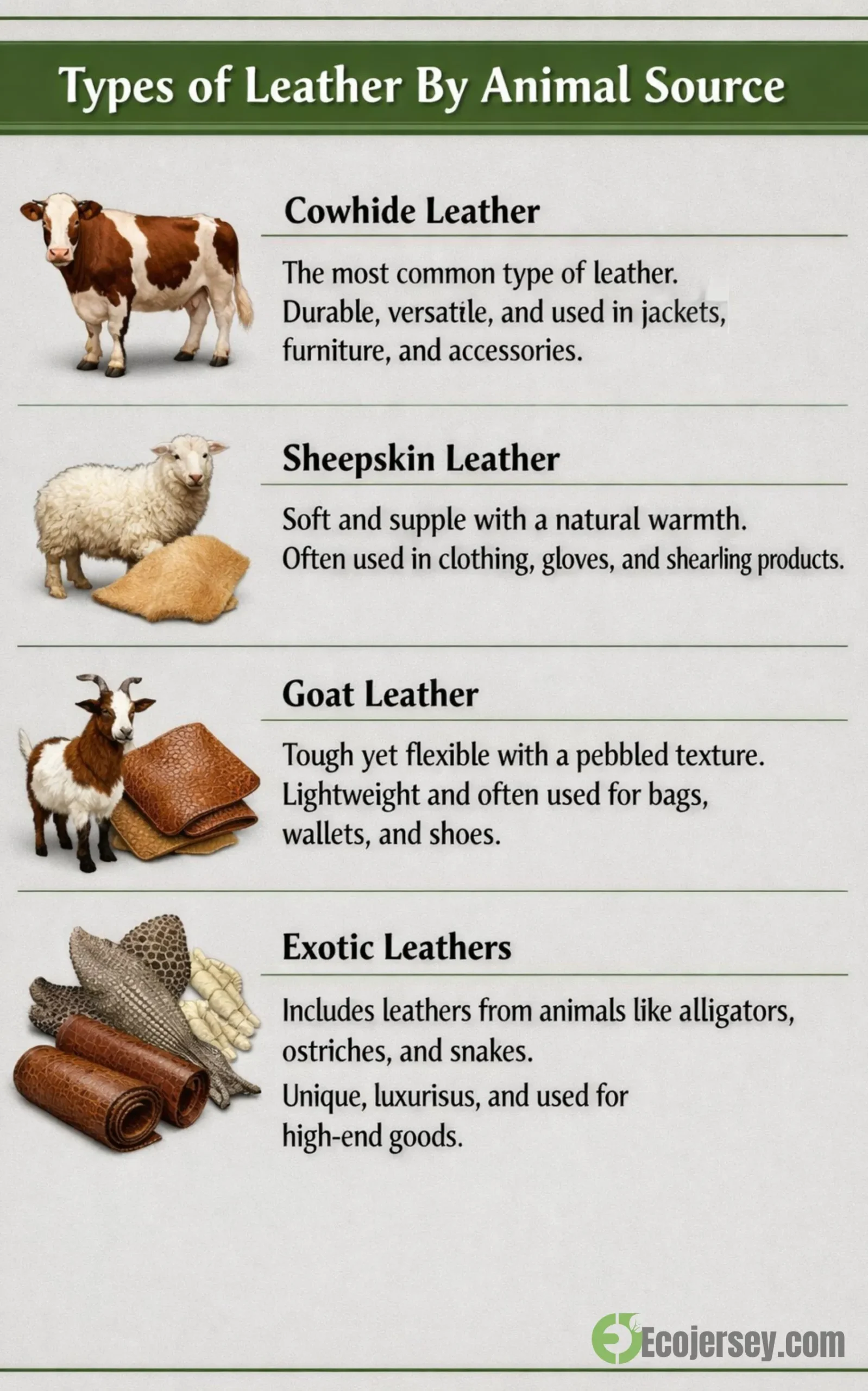
Cowhide is the leather that is used the most often. It is strong, tough and durable which means that it is very appropriate and has many uses in manufacturing industrial items. It is often used by bikers and motorcyclists for making the jackets, belts and boots as cowhide leather tends to resist wind and water. Cowhide leather that is tanned is of medium softness, Untanned hide is called rawhide, which is hard and stiff, whereas cowhide leather becomes flexible after tanning..
Characteristics: very stiff , highly resistant to abrasion , and thick grain.
Sheepskin
Sheepskin leather is from sheep (with the wool still on one side). It is one of the lightest leather types available that is still very soft and supple. It has some natural water resistance due to lanolin, but it is not flame-resistant.. It will keep things warm and breathes well. It is used in jackets, gloves, hats and slippers. Sheepskin is used in situations where a very soft leather is required. Sheepskin leather is generally more soft and more delicate than cowhide.
Characteristics: Velvet-like grain, very soft; insulates heat; flexible and comfortable.
Goatskin
Goatskin leather is famously tough leather. It is thinner and lighter compared to cowhide. The US Air Force have even used goatskin for aviator jackets. The distinctive grain texture of goatskin leather is of small pebble grains. Goatskin leather is also more flexible and easier to break in, compared to cow leather. This is why goatskin leather is more favored for jackets and gloves.
Characteristics: light, supple, fairly abrasion resistant, and has pebble grain
Lambskin
This leather comes from young sheep and is the softest of the common leathers. The diddle highly shiny and soft finish is a greater drape. It is perfect for high quality fashion jackets and coasts lining. It gives a luxury, satin finish. It is buttery the high grain lines. It is however, delicate and does not hold as long as coarse hides.
Characteristics: Very fine and silky, not very thick.
Exotic Leathers (Snake, Crocodile/Alligator, Ostrich)
Exotic leather textures derive from reptiles and birds. As snake leather, python has a unique large scale pattern. It is used for tough accents like snake leather belt and snake skin shoes. crocodile and alligator leather is thick-skinned and large scale patterned. It tough, water-resistant, and durable. Ostrich varietals have a distinctive bumpy pattern. It is an exotic leather, as it is thick, but soft. Ostrich leather is consistently quality robust leather. Ostrich leathern, like crocodile leather, is used for boots and leatherwork. These exotic leathern are much costlier than bovine leather.
Types of Leather By Finishes & Treatments
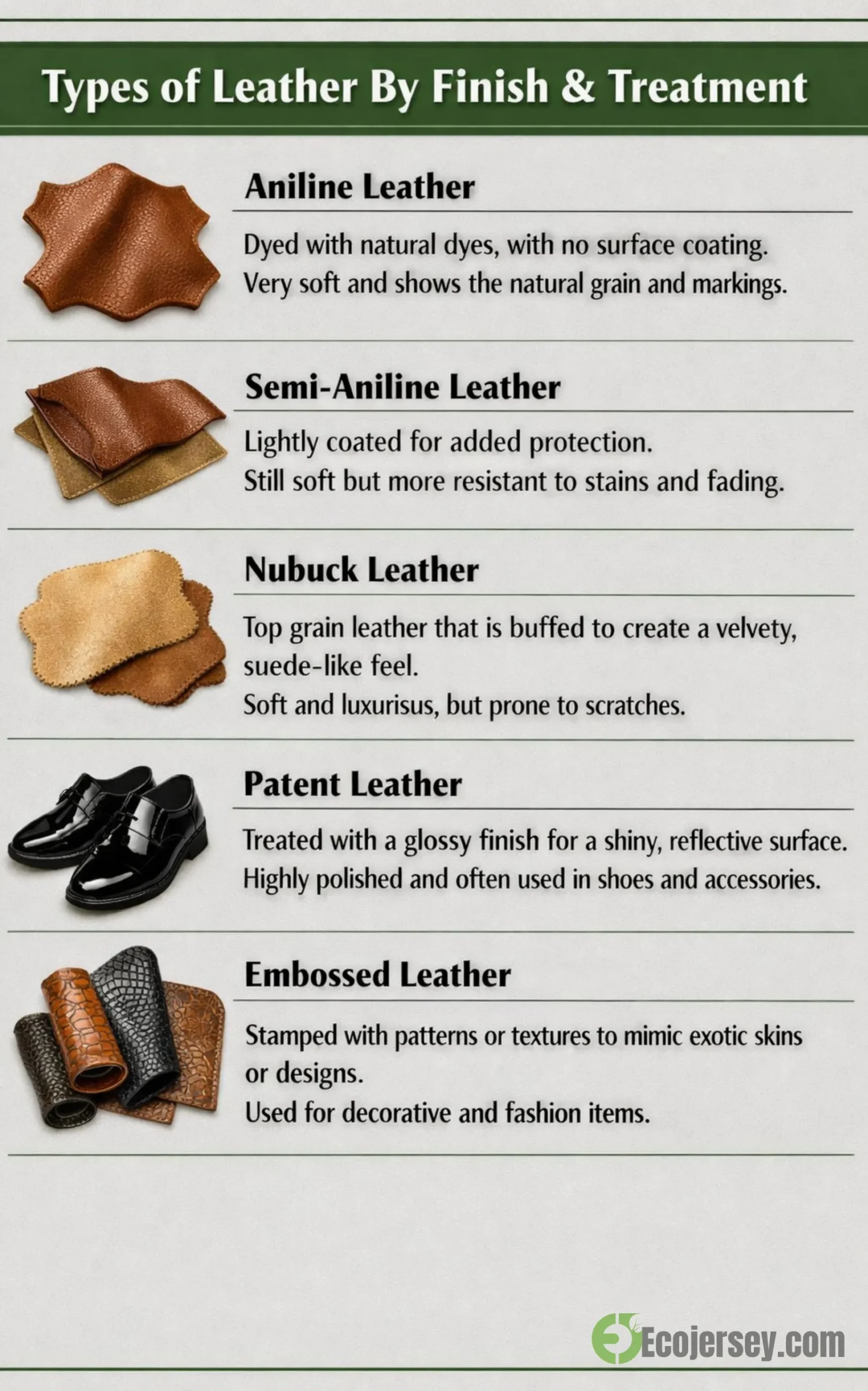
The term “finish” refers to how the surface of leather is coated or dyed. This may lead to different appearances of the leather and as a result, different maintenance requirements.
Aniline leather
Aniline leather receives no protective coating and is dyed with only transparent dyes so there is full visibility of the surface. This leads to the visibility of natural surface characteristics such as skin imperfections and surface grain. Leather that is fully aniline is extremely supple and natural in feel, and as a result, has a strong tendency to develop stains. This leather is usually for products that are luxurious and add character, such as high end leather jackets and luxury leather furniture.
Semi Aniline leather
Semi-aniline leather is aniline leather with a semi-opaque light coating of a protective pigment. This coating makes the pigmentation level somewhat even so that the leather is still soft and supple, but has a greater resistance to stains, smudging, and sun exposure. Semi-aniline leather shows an even greater amount of grain than aniline leather, and is even semi-aniline leather, making it a great compromise for various applications such as automotive leather and certain furniture leathers.
Pigmented leather
Pigmented leather (also known as corrected leather or protected leather) is leather that has been densely coated with opaque pigments. This makes the leather very uniform in color, hides many of the surface imperfections, and makes the leather very durable and stain resistant. Pigmented leather is the easiest of the three to clean due to its protective coating. The protective coating makes the surface easy to clean and more resistant to stains. This leather is the most widely used amongst places like car manufacturers, high-traffic home furnishing manufacturers, and shoemakers. Because pigmented pigmented leather gets its color and surface imperfection uniformity from the coatings, the natural leather grain is less showcased.
Nubuck leather
Nubuck leather is leather that has had the grain surface slightly sanded or slightly buffed. The surface is fleecy and the grain is more exposed than pigmented leather. Nubuck has a very classy satin finish, but is very easily stained, nubuck is very easily damaged during wet or high moisture conditions. Nubuck is generally more durable than suede because it is made from the outer grain layer rather than the inner split. Companies frequently use nubuck for parts that demand good toughness.
Suede Leather
Suede comes from the underbelly of the animal hide and has a silken and fuzzy texture. Flexible and soft, suede is also prone to damage. Water and the environment can easily damage the textile. If rough handling is involved, it can also easily be scratched and worn off. You can usually find suede on items like jackets, shoes, and accessories. Suede is wanted precisely for plush look suede. If the suede does take damage, the look can be protected from the moisture and helped by a cleaning brush that is much for softer than the damage suede.
Patent Leather
The only requirement for patent leather is that it is finished. When leather is finished with a plastic material and a gloss look is desired, patent leather can be created. Designed with a shiny leather like the texture of a mirror, patent leather is usually calf leather. An impermeable layer is actually the function of the outside layer of patent leather because the leather loses it’s ability to breathe. Patent leather is very prone to cracks and breaking because the coating reduces breathability and flexibility compared to untreated leather and bends much like a hard material would. but unlike suede, maintenance is patent leather is incredibly easy.
Which Type of Leather Is Best?
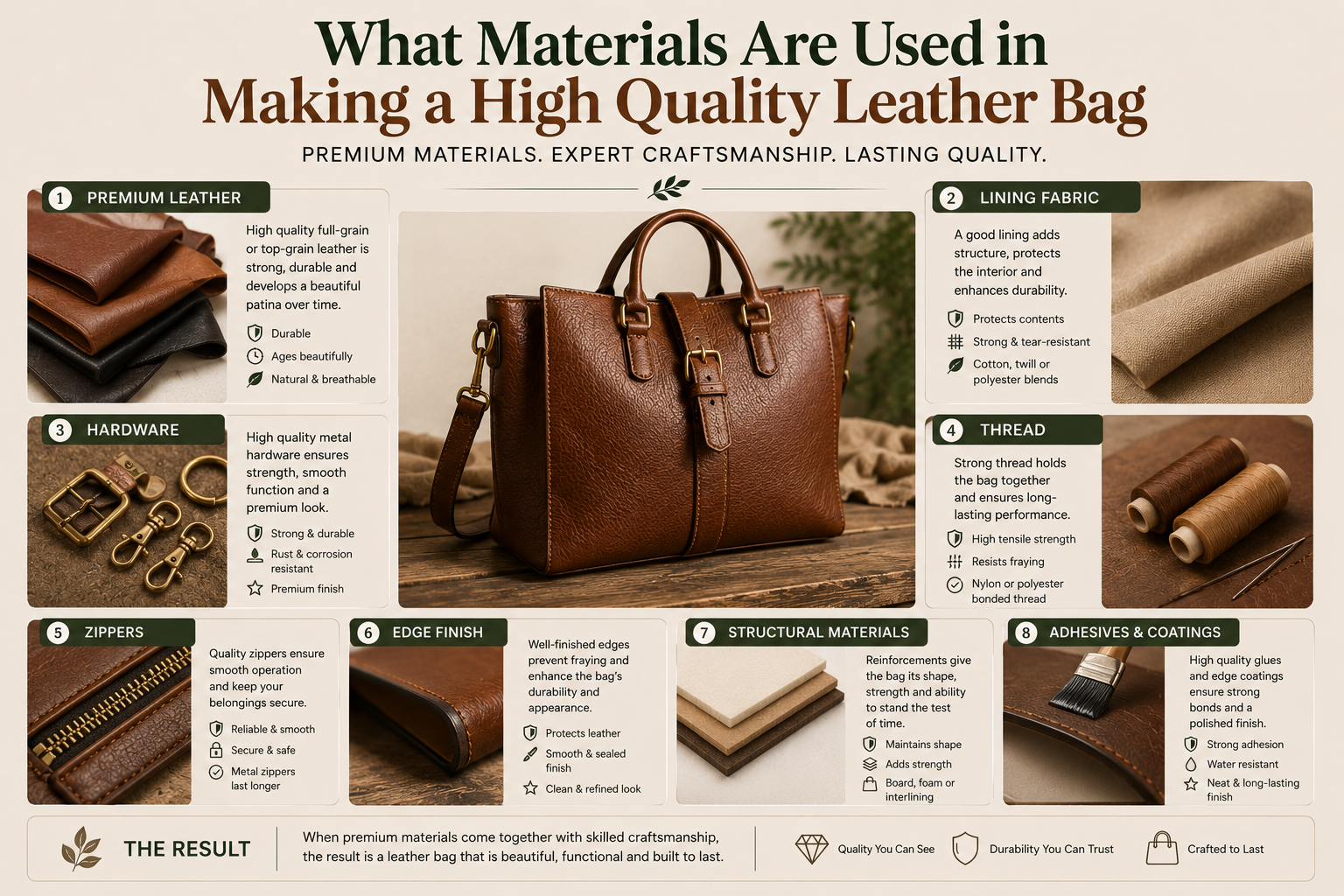
Best for Bags: Full-grain cowhide (or calfskin) is the best option for travel and heavy-use bags because they are almost indestructible and age beautifully. Lambskin is used for high end designer bags for a prestigious touch, but for everyday bags a cotton-canvas bag lining and cowhide bag exterior is the best option.
Best for Jackets: Jackets also vary based on style. Cowhide or goatskin jackets tend to be more durable and abrasion resistant, making them ideal for motorcycle or bomber jackets. However, for a more luxurious experience, lambskin or sheepskin jackets are buttery soft and will fall the way a drapey fabric will, however, horsehide is also a favorite for classic motorcycle jackets.
Best for Sofas: For a favorite sofa, full-grain or a high top-grain, pigmented leather is recommended. These leathers are thick and durable, so they will last a long time. Pigmented (or protected) leathers are often used on furniture because of the balance they strike between being long-lasting and comfortable, as they can weather light and spills well.
Best for Shoes: For calfskin (specifically, box-calf), shoes are usually the traditional choice. For boots and casual shoes, rugged full-grain cowhide or a waxed containing leather (like Horween Chromexcel) is typically used. For more expensive shoes, less common materials are used, like shell cordovan (from horsehide).
Common Misconceptions (Myth-Busting)
- Is ‘genuine leather’ always low quality? Not necessarily—it varies widely in quality but is typically lower than full-grain or top-grain leather. The guarantee that it’s not some faux leather, but some lower-quality inner-split leather. That’s what “genuine leather” means, but it’s not top-grain or full-grain.
- Is suede real leather? Yes, 100%. It comes from the inner side of a hide that has been sanded. It’s the inner layer, and made of genuine leather (remind you it’s a split of cow or perhaps a lamb).
- Is faux leather a type of leather? Of course not. Faux leather includes materials such as PU (polyurethane) and PVC (polyvinyl chloride), which are different types of synthetic leather are plastic. Leather, by definition, is a hide that has been tanned from an animal. Faux leather, on the other hand, is not made of tanned hide. It’s a coating of plastic made on a leather-like fabric.
Real vs. Faux Leather
Key Differences: The real leather is tanned animal hide. This material is durable and develops a patina. Faux leather is a cheaper alternative made from synthetic polymer that can deteriorate over time. Faux leather is also a plastic material, and is made to look like leather. Real leather is more expensive than faux, but can be more durable. Faux leather is cruelty-free, but it is generally less breathable than real leather.
Pros and Cons:
Real Leather:
Pros: With care and proper storage, real leather goods can be passed down and stay functional for decades (or even centuries). Real leather goods will always have a unique aesthetic and improve with age. They are biodegradable and come from the meat industry as a byproduct, so they help to reduce waste.
Cons: Higher cost. There are many concerns with leather goods from the infrastructure of the industry (such as deforestation, land use, and green house gases). Animal dehydration and many of the individual logistics of each tanning process are often unavoidably toxic and will always pollute the surrounding area.
Faux (Synthetic) Leather:
Pros: Faux leather can often be found for a lower cost compared to real leather. Only one of those costs included the use of animals, and it can be purely synthetic. It comes with a similar unanimous feel as real leather and will always have a uniform look. It is also waterproof and cleanable with extreme ease. (PU leather in particular has fewer toxins than PVC.)
Cons: Faux leather will show its wear, and associated lack of dependability, in a few years, if not a few months. Faux leather often contains (PU or PVC), causing it to be entirely from Plastics (or PVC). Additionally, it is not biodegradable. This also makes it poor for clothing as it can lack breathability and be uncomfortable for long wear.
Leather Grades vs. Types
“The words “grades” and “types” are often mistaken due to their similarities. Grade is the quality level of the leather and there is no universal grading system like Grade A or Grade B in the leather industry; quality is assessed based on processing and finish. A leather type is classified by how the hide is processed and finished, such as full-grain, top-grain, or suede. Type is a descriptor for how the leather is finished and how it is processed, while grade is a quality level for the skins. An example of this would be that full-grain leather (type) is given a grade of Grade 1 or Grade 2 (grades) based on the skins blemishes and imperfections.”
How to Identify Leather Types
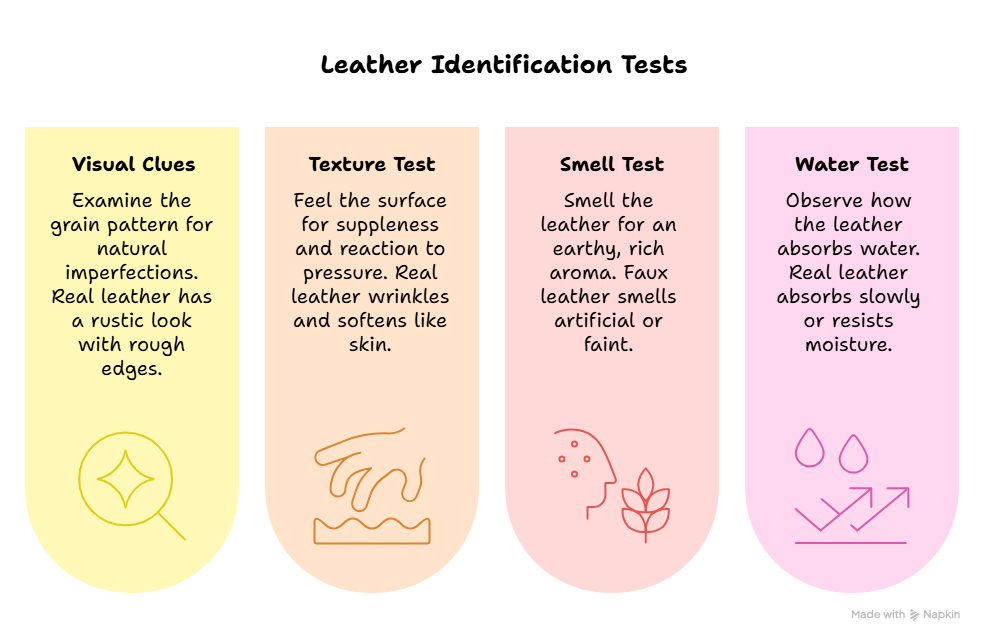
- Visual Clues: Take a close look at the grain pattern in the material. Real leather is dyed, instead of manufactured, and will look uneven with natural imperfections such as pores, scratches, scarring, etc. Uniform, repeating grain patterns signify imitation leather. Leather will have a more rustic look; the edges will appear rough or fibrous in contrast to the thin and smooth edges of a synthetic material.
- Texture Test: Run your hand across the surface. Real leather can be supple and may feel smooth or slightly textured depending on the finish. Real leather will wrinkle and become softer with pressure, much like the reaction of skin. Faux leather is too smooth and too plasticky, and doesn’t have the reaction to pressure that skin or leather has.
- Smell Test: Smell your leather sample. Real leather has a more earthy, rich aroma and sometimes smells like bark. Faux leather will smell artificial with either chemical or only faint and nearly odorless smells.
- Water Test: Conduct the water test in an inconspicuous area of your leather sample. After placing a drop of water on the surface, observe how leather absorbs liquid. Some untreated leathers absorb water slowly, but many finished leathers have protective coatings that resist moisture, whereas faux leather tends to repel liquid with water beading and running off the surface.
Uses of Each Leather Type
Fashion (Clothing & Footwear): Deerskin, goat skin, cowhide, lamb skin, and lamb skin are used in luxury gloves and jackets. Shoes can be calf, cordovan, or oleo-buffalo. Nubuck and suede provide a soft texture in casual shoes and jackets.
Furniture: Sofas and chairs can be upholstered in durable full-grain leather and pigmented top-grain leather. These leathers can sustain heavy use from a family. Aniline finishes can be used on luxury lounges. These types of finishes are also similar to those used on car seats.
Automotive: Most car interiors (that use leather) use pigmented leather. Leather of this kind have a uniform finish and are resistant to sun and stains. Higher end cars use top-grain hides that are aniline or semi-aniline finishes, which differ from pigmented leather in appearance and level of surface coating.
Accessories: Cowhide, calfskin, and exotic skin (like those of crocodiles and ostriches) can be used. These materials lend a belt, wallet, or bag prestige. A sturdy belt can use full-grain cowhide, while fine handbags often use full-grain of lamb or calf skin. Luxurious watch bands can be made of calfskin or alligator. Leather is used on small accessories (like key fobs and pencil cases) because of its feel and longevity.
Care Tips by Leather Type
- Full-Grain/Top-Grain: Clean with a soft cloth and mild soap. Apply a leather conditioner repeatedly. Do not get leather wet. Products that contain chemicals can damage leather. To keep leather from drying and cracking, keep it away from sunlight and heat.
- Aniline/Semi-Aniline: Clean spills with a cloth. Aniline leather is known to be a little more demanding and might need a little more TLC, so try a mild, non-abrasive soap. Apply leather conditioner. Avoid polishing or waxing as these can darken the leather.
- Pigmented/Coated Leather: Remove dirt with a cloth and some soap. Leather cream is suggested, as it keeps this type of leather from drying out. Avoid using cushion wipes or anything thoroughly textured.
- Suede/Nubuck: To clean this type of leather, use a suede brush to gently lift and restore the nap. Then, use a suede protector spray to keep the shoes from further damage. If leather is wet with water, blot it gently with a paper towel to absorb moisture, and let it dry on its own (never use heat).
Sustainability & Ethical Concerns
Tanning Impact:
Chrome tanning, used in about 90% of leather, chrome tanning is fast and ensures evenly colored leather, but is a water contamination hazard. Vegetable tanning is a little better but slows the process and both methods improve durability, but leather still requires proper care and does not last indefinitely. There are new methods designed with the ecosystem in mind, but they are still very limited in the mass leather market.
Environmental Footprint:
Leather is a byproduct of the meat industry and livestock farming, which is an unsustainable practice and a major source of deforestation and CO2. Livestock farming contributes significantly to greenhouse gas emissions, but it is not the largest global source. Unfortunately, the main alternative, synthetic leather, is made with petroleum and emits waste. For this reason, long-lasting leather is sometimes a better alternative than synthetic leather, which is expected to last a much shorter time.
Ethical Sourcing:
Animal welfare, particularly of the livestock and exotic skins use, is a major concern with leather. The Leather Working Group is an advocacy group that ensures higher standards of the industry. The alternative leathers, also concern of the ecosystems and drank made of pineapple and cork, and/or leather made of mushrooms, do not have widespread market support.
Conclusion-
Select the ideal leather types with the appropriate understanding of grain quality, source, or leather origin, sourcing animal acquisition, and leather grades. Pick full-grain or top-grain leather for the highest grades of quality leather. Cowhide and exotic hides contain different leather grades. When it comes to leather finishes, you can choose an aniline finish or a pigmented finish. You’ve also learned how to tell the difference between real leather & fake leather, the true fables surrounding leather, a leather identification guide, and leather care guide.
For every leather purchase, be confident with the choices you make. Regardless of leather type or source, consist of quality leather, which is an investment. When handled appropriately, leather is a timeless investment, and the only thing that can change is the true quality, which we can assure is impeccable.
FAQs
What are the 4 main types of leather?
Four commonly recognized commercial categories are full-grain, top-grain, genuine, and bonded leather.
Q: Which leather lasts the longest?
By definition, full-grain leather is the most long-lasting and resistant to damage as it is made with an entire surface fiber. A full-grain leather bag or boot may last more than a few decades.
Q: Is “genuine leather” real leather?
There is a truth, and a falsehood, to the name “genuine leather”. The connotation of “genuine leather” is that it is leather that is real, however by definition it is leather made from lower quality inner splits. In this case, it is real leather, but of lower quality.
Q: What is the most expensive leather?
The most expensive leathers are exotic hides, like saltwater crocodile (Porosus croc), which luxury brands like Hermès use. Other costly options are alligator, ostrich, and high-grade stingray. Finely tanned horsehide leathers are also pricey, but exotic reptile skins are the most expensive.